

jews in the d
continued from page 18
AJC and co-chair of its government
relations/domestic affairs subcommit-
tee. Involved in the leadership of both
the Isaac Agree Downtown Synagogue
and uptown at B’nai Israel Synagogue
of West Bloomfield, Ruby can be found
assisting with services as a gabbai on
any given Shabbat. Ruby has also served
as co-chair of the Limmud Michigan
programming committee and was
selected last year to be a part of the
prestigious Wexner Program, a two-
year commitment to leadership devel-
opment in the Jewish community.
Q: How did you become an immigra-
tion attorney?
RR: I grew up in Franklin, went to
Groves High School and graduated
from the University of Michigan with
a degree in English and history — the
kind of education you can do every-
thing and nothing with. So, prior to
law school, I spent some time as an
AmeriCorps VISTA (Volunteer in
Service to America) in a social service
agency in Brooklyn, N.Y., doing front-
line work with emigrés from the former
Soviet Union, Holocaust survivors and
others facing challenges in the commu-
nity.
Living in New York was fun, a great
place to be in my 20s. I call it “my New
York interlude.” But I knew I wanted to
go back to school and saw how a law
degree ultimately would open doors for
me and make me a better advocate for
people in need.
It was the heart of the recession — a
good time to be a law student and a
better time to come home. Though I
applied and got into several law schools,
my Midwestern sensibilities kicked
in and brought me back to Detroit to
Wayne State University Law School.
From the start of law school, I knew
I wanted to be involved in advocacy
or public interest in some way. That
first summer, I got a job as a volunteer
working the hotline at an organization
called the Counsel in Advocacy Law
Line — “CALL.” At that time, CALL
was the statewide intake center for
almost all the legal aid organizations
in the state of Michigan. So, say you
were evicted or wanted to file for
divorce, you’d call us. The phones were
answered by attorneys and we’d provide
brief legal advice and assistance over
the phone. It was like a legal services
emergency room — a triage system. For
more serious cases, such as domestic
violence where children were involved,
we referred cases to our local aid offices
around the state for direct representa-
tion.
The CALL experience was eye-open-
ing. Essentially, every call I answered on
the job was a rehearsal for a question
on the bar exam. I learned a lot on the
job and stayed for the duration of law
school, then continued to work there
for a year, answering calls from people
facing foreclosures, evictions, bank-
Amendment Right to counsel, even
if they can’t afford an attorney. But in
a civil proceeding — such as divorce,
bankruptcy, eviction, foreclosure —
those sorts of civil matters — the gov-
ernment is not required to provide an
attorney.
Immigration law is civil law so when
someone is sent to removal proceed-
ings, the government is not required to
provide counsel there either. Your situa-
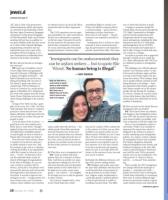
“Immigrants can be undocumented; they
can be asylum seekers … but to quote Elie
Wiesel, ‘No human being is illegal.’”
— RUBY ROBINSON
Ruby and Yifat Clein (a
social worker in mental
health on staff at Kadima)
married in September.
With family now in
Kibbutz Sasa and Tel Aviv,
visits to Israel are des-
tined to be frequent.
ruptcy, utility shut-offs, divorces — the
whole parade of horribles stemming
from the financial woes of the reces-
sion. It’s my opinion that every attorney
should work in legal aid at the start of
his or her career in the law because it
grounds you and then teaches you how
the law works and how it is practiced
every day.
Q: What drew you to immigration law?
RR: I took an asylum and immi-
gration clinic for a semester at Wayne
State. And that was another eye-open-
ing experience helping two sets of cli-
ents from Rwanda seek and ultimately
obtain asylum in the United States. In
the legal service realm, many immi-
grants — non-citizens — are ineligible
for the legal services we take for granted
in other contexts.
Every person charged with a crime
in the United States has a Sixth
tion can be a matter of life or death, but
in the context of civil law, you are often
invisible in our system unless you can
afford counsel. Whether you are 3 years
old or 30 years old, whether you are a
frail senior or even incompetent, the
government is not required to pay for
your attorney. So, if you have counsel,
if you have an advocate and represen-
tation in court, it can make all the dif-
ference in the outcome of your case and
your access to justice.
Q: Explain the difference between a ref-
ugee and a person seeking asylum.
RR: Refugees and asylees must meet
the same basic definition: that they have
a well-founded fear of persecution by
the government on account of their
race, religion, origin, membership in
a particular group or political opinion
or that the government is unable or
unwilling to protect them. The differ-
ence is where that decision is made.
A refugee is someone outside the
United States who has gone through the
U.N. High Commission on Refugees
and has met the requirements and
background checks of many depart-
ments and agencies, including the State
Department and the U.S Citizenship
and Immigration Service (USCIS).
What most people don’t appreciate is
that it takes 19 steps to travel and enter
our country as a refugee.
An asylee is a person who is approved
through a similar process, inside the
U.S., either affirmatively with USCIS or
in a defensive posture in Immigration
Court.
The challenge now with the adminis-
tration’s “zero-tolerance policy” is that
it has sowed confusion, anger and fear
not only in the border region, but also
across the country. We’re seeing a sharp
rise in people without criminal records
being detained in all settings — fami-
lies separated at the borders, people in
their homes, people out on the streets,
people who are driving. It’s creating a
lot of havoc. People are worried, scared
to leave their homes, take their kids to
school, given this substantial rise in the
number of detentions.
Q: How accurate are the claims that our
immigration laws are broken?
RR: There haven’t been any substan-
tial changes in the immigration system
since 1997. But the power that the exec-
utive branch wields is incredible. And
we’re seeing that in full force right now.
Even so, our immigration system is
not broken. While it can certainly be
improved, the system does what it is
designed to do, which is to preserve
certain underlying racist immigration
policies. As a nation, we have a shame-
ful immigration history that excluded
the Chinese altogether, drastically
reduced immigration from Eastern and
Southern Europeans in the early 20th
century, interned Japanese Americans
and, until the early 1950s, prevented
anyone who was not considered a “free
white person” or “aliens of African
nativity … or descent” from naturaliz-
ing.
More recently, the 1997 immigration
law changes altered the landscape to
penalize — criminally and civilly —
people who had (or were) entering the
United States unlawfully or overstaying
their visas. It created additional legal
barriers to permanent residency (green
cards), limited waivers and reduced the
continued on page 22
20
October 25 • 2018
jn