

jews in the d
Jewish Contributions to Humanity
# in a series
These Jews
Were Great
Mind Readers.
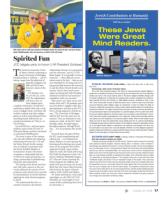
Mel Lester and Ira Jaffe have hosted U-M tailgate parties for nearly 50 years and have hosted
about 100,000 people. They are honorary co-chairs of the JCC event.
Spirited Fun
JCC tailgate party to honor U-M President Schlissel.
T
he Jewish Community Center
of Metro Detroit is planning to
honor University of Michigan
President Mark S. Schlissel — and it’s
taking a page from the playbook of
legendary tailgaters Ira
Jaffe and Mel Lester,
honorary chairs of the
event.
On Tuesday, Oct.
30, at 6:30 p.m. at the
JCC, the organization
Mark Schlissel will host a true-to-
form tailgate party
complete with kosher corned beef
sandwiches, spiked cider and a wide
array of tailgate treats. Activities will
include cornhole and other tailgate
games as well as entertainment from
marching bands, followed by an
awards presentation at 7:30 p.m. in
The Berman.
Ira and Mel’s pre- and post-game
tradition spans nearly 50 years of
Wolverine history and has welcomed
an estimated 100,000 guests.
The event is open to the commu-
nity and will celebrate the enduring
relationship between the U-M and
the Metro Detroit Jewish commu-
nity as Schlissel is presented with
the Boneh Kehillah (Builder of
Community) Award. This honor
recognizes a relationship that has
evolved over many generations, cre-
ating a partnership in philanthropy,
education and community.
The timing of this honor has been
met with some concern as the uni-
versity addresses the actions of two
professors who elected not to provide
recommendations to Jewish students
applying for study abroad programs
in Israel.
“We understand that this is a
sensitive moment in the historic
relationship between our community
and the university,” says JCC CEO
Brian Siegel. “It is especially in these
moments — when difficult conver-
sations need to be had — that we are
most thankful for the long and trust-
ing partnership between the universi-
ty and the Metro Detroit Jewish com-
munity. I know these hard conver-
sations are being had with President
Schlissel and that he has heard and
empathizes with our concerns.”
Mel Lester’s son, Matt, a host com-
mittee chair and U-M graduate, grew
up at his father’s tailgates while also
participating in activities at the JCC.
Now a strong supporter of both, he
says, “The University of Michigan
and the JCC have the same sort of
mission: They are dedicated to edu-
cating our youth. At the JCC, that’s
through camps, through leagues,
through programs, through Book
Fair … It’s one program after anoth-
er.”
Proceeds from the gala will ben-
efit JCC youth programming and
cultural arts — everything from
infant childcare to senior groups for
learning and socializing year-round.
Some of the programs that will be
supported include camp scholar-
ships for youth, the Sarah and Irving
Pitt Child Development Center, the
Kenny Goldman Basketball League,
JCC Maccabi Games Opening the
Doors program for children and
adults with special needs, the Jewish
Book Fair, the Lenore Marwil Jewish
Film Festival, the Janice Charach
Gallery, SAJE, FedED and Melton.
For ticket information, visit jccdet.
org/tailgate or call (248) 432-5418.
Attendees are encouraged to wear
casual clothes celebrating their favor-
ite university. ■
Stanley Milgram
Solomon Asch
STANLEY MILGRAM (1933-1984). b. New York, New York. d. New York,
New York.
Uncovering a dark corner of human nature.
One of the most important people in the history of social psychology, Stanley Milgram’s
experiment on obedience remains to this day among the most well-known and most disturbing
studies ever done in the social sciences. Born in the Bronx, Milgram identified strongly with
his Jewish heritage from an early age, and resolved early to better understand the Holocaust.
After receiving his Ph.D. from Harvard, in 1960 Milgram became a professor at Yale. In July
1961, three months after the start of Adolf Eichmann’s trial, in which he said he and the Nazis
were just following orders, Milgram began an experiment in which he tested the ability of
humans to violate their consciences in order to obey a higher authority figure. He conducted his
experiment as follows: The subject was told that he was part of a study of memory and learning.
He was instructed to teach word associations to a second subject, who he couldn’t see. When
the second subject selected an incorrect answer, the one asking would administer a shock,
which the second subject supposedly (but not in reality) felt. These shocks eventually became
very painful, and even dangerous to the second subject’s health. When the first subject would
object and wish to stop, the experimenter would verbally prod him to continue administering
increasingly stronger shocks. Sixty-five percent of the subjects continued to administer shocks
up to the highest levels. Milgram’s experiment was extremely controversial at the time, and
the conclusions to be drawn from it are still debated. Whether or not the Milgram experiment
explains a large part of Eichmann’s reasoning that the Nazis were just “following orders”, Stanley
Milgram’s work shed light on a darker side of human nature.
SOLOMON ASCH (1907-1996). b. Warsaw, Poland. d. Haverford, Pennsylvania.
How peer pressure shapes our minds.
A leading social psychologist of the 20th century, Solomon Asch showed how strongly
peer pressure impacts people’s decision-making. Born in Warsaw, Asch’s interest in
psychology was sparked at the age of 7, during a Passover seder. He saw his grandfather
pour an extra glass of wine. A young Solomon asked why he did that, and his grandfather
said the cup was for the prophet Elijah, who would soon come to drink it. Expecting that
Elijah would come, Asch thought he saw the level of wine in the cup drop. Nearly 40 years
later, as a psychology professor at Swarthmore College, Asch conducted what he called
“an experiment in perceptual judgment.” The subjects were given a card with three lines
of different length, and shown a line of “standard” length on the board. They were then
asked to say which line on their card was the same length as the one on display. Each time
the experiment was run, one student heard the others assert that a line obviously shorter
than the one on display was in fact the same length. The students choosing the wrong
line were in fact instructed to do so by the experimenter, and the student feeling the peer
pressure was the subject. About one-third of the time, the subject chose the line that his
fellow students chose—the wrong line. Asch’s experiment showed how group pressure
can change one’s perception of obvious reality.
Original Research by Walter L. Field Sponsored by Irwin S. Field Written by Jared Sichel
jn
October 25 • 2018
17