

arts&life
theater
The Toast W
Of Jewish
Broadway
Musicologist Dr. Michael
Ochs brings the joy of Yiddish
operetta to Ann Arbor.
JULIE SMITH YOLLES SPECIAL TO THE JEWISH NEWS
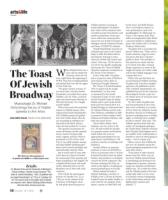
TOP: Stills from 1923 productions of
Di goldene kale. ABOVE: A c. 1920s program cover.
details
Dr. Michael Ochs and the University of Michigan’s
School of Music, Theatre & Dance present “The
Toast of ‘Jewish Broadway,’ 1923: Di goldene kale
by Joseph Rumshinsky” at 7:30 p.m. Tuesday, Oct.
23. The event is free to the public and no tickets
are required. Earl V. Moore Building, Britton Recital
Hall, Ann Arbor. Events.umich.edu.
58
October 18 • 2018
jn
hen Michael Ochs was 2
years old, his family left
Germany, where he was
born, right before the beginning of
WWII. They left everything behind
and started their lives all over again
in New York City.
“We spoke German at home. If
you were from a German Jewish
household, you looked down upon
Yiddish,” says Dr. Ochs, a musicol-
ogist and retired music librarian at
Harvard University. “So, I taught
myself Yiddish.”
With a keen and well-researched
interest in Yiddish theater, Ochs
rediscovered Joseph Rumshinsky’s
1923 Yiddish operetta Di goldene
kale (The Golden Bride) when he
was mounting an exhibition for
Harvard’s Loeb Music Library,
where he had worked for 14 years.
The operetta incorporates ele-
ments of klezmer, Jewish cantorial
music, Eastern European folk
music, ragtime and jazz. When it
premiered in 1923 in New York
City, it was wildly popular among
the large Yiddish-speaking popu-
lation, and it toured nationally and
internationally until the 1940s.
But it wasn’t until 25 years after
Ochs’ discovery that he revisited
the manuscript of the operetta and
began translating it into English. He
compiled all the music and words
which, ultimately, led to an Off-
Broadway run in 2016 with a full
orchestra.
Ochs will be the special guest
lecturer on Tuesday, Oct. 23, at
7:30 p.m. on the campus of the
University of Michigan, where
he will speak about the genre of
Yiddish operetta, focusing on
Joseph Rumshinsky’s Di goldene
kale, which will be enhanced with
recorded excerpts from historic and
modern productions of the oper-
etta as well as live musical perfor-
mances by two Jewish University of
Michigan School of Musical Theatre
and Dance (UMSMTD) students.
“Joseph Rumshinsky was born in
Lithuania and came to the United
States in 1903, but before that he
had fantastic training in music
where he worked with cantors and
choirs,” Ochs says. “By the time he
was 18, he was already conducting
and became the ‘Toast of Yiddish
Operetta Composers’ and known as
the ‘Jewish Victor Herbert.’”
In fact, Ochs adds, “Di golden
kale is as good as some of Herbert’s
more famous works, Babes in
Toyland and Naughty Marietta.”
The “Toast of ‘Jewish Broadway,’
1923: Di golden kale by Joseph
Rumshinsky” is a free event
co-sponsored by the Jewish
Community Center of Ann Arbor
and the Frankel Center for Judaic
Studies and is a part of the Jewish
Book and Arts Festival 2018. It is
funded through an endowment that
Dr. Michael DiPietro and his wife,
Alice Fishman, established in 2009
in memory of their mothers, Sybil
Fishman and Pauline DiPietro, who
both were music lovers.
“Alice’s father, Sidney ‘Steve’
Fishman, was very active at the
JCC. He had worked for decades
as a property master on Broadway
which makes this event an
appro,priate presentation for our
endowment,” said DiPietro, U-M
professor emeritus of radiology and
pediatrics.
Caroline Helton, an associate
professor of voice at UMSTMD as
well as an associate of the U-M Jean
& Samuel Frankel Center for Judaic
Studies, often produces or facilitates
concerts by Jewish composers. She
has been working with Ochs via
email on the logistics of adding live
musical performances to his talk.
Helton enlisted the help of
Michael Yashinsky, a lecturer of
Yiddish at the U-M Jean & Samuel
Frankel Center for Judaic Studies, to
work with the two students. Eitan
Mazie, a junior in UMSTMD, will
be the tenor; and Molly Bruner,
who is receiving her master’s in
voice performance (and is the
granddaughter of a Holocaust sur-
vivor), is the soprano lead. They
will be accompanied by John Etsell,
a doctoral student in collaborative
piano, who studies with U-M Music
Professor Martin Katz.
“Di golden kale is so tuneful and
joyous,” Helton says. “Eitan, who is
Israeli American, sings two tenor
solo pieces that have a klezmer
quality to them. The melodies in
this operetta are catchy and fun,
so it’s much more like a musical
theater experience in terms of the
weight and music. It’s written really
well for the Yiddish language; it has
a natural feel to it.”
While Ochs says that there are
several thousand Yiddish operettas,
Di golden kale is the first complete
operetta to be published in print;
Ochs’ scholarly interpretation was
published last year by the American
Musicological Society as part of a
40-volume series of American musi-
cal compositions.
“In 1923, when Di golden kale
was first performed in New York,
there were 14 theaters in a section
of New York City called the ‘Jewish
Broadway’ that put on Yiddish pro-
ductions, including some on Friday
night, so Orthodox Jews wouldn’t
be able to attend,” Ochs said. “The
Yiddish operettas dealt with [the
subject of] immigrants getting to
the United States. Nobody will deny
that [Di golden kale] happens to be
an excellent work. Unfortunately, it
foretells so much of what’s going on
today — but in a funny way.”
Helton concurs that Yiddish the-
ater was very popular among the
Jewish immigrant population in the
early 20th century.
“If you listen to other musical
theater from the 1920s, you can
hear how Yiddish musical theater
is assimilating and drawing on its
background in operetta, character
songs, jazz elements and klezmer,”
Helton says. “It’s a whole lot of fun,
and the Yiddish people of the time
could really relate to a love story
of a Russian woman immigrating
to the United States and how this
lighthearted, romantic plot
unfolds.” ■