

jews in the d
continued from page XX
COURTESY MARK LOPATIN
COURTESY MARK LOPATIN
continued from page 28
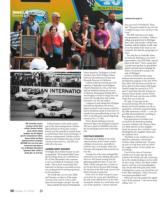
TOP: Samantha Joustra,
Jonathan LoPatin, Mark
LoPatin, Florence LoPatin,
Sarah LoPatin holding
daughter Lily, Eric Magiera
(Sarah’s husband/Lily’s father),
Hanna LoPatin and Steve
Gebhardt (Hanna’s husband).
BOTTOM: Pace cars from other
tracks drive laps before a
race at Michigan International
Speedway. Mark LoPatin is
driving the car at the top.
30
October 11 • 2018
jn
Political leaders in the south-central
part of the state, hearing about LoPatin’s
failed attempts to bring auto racing to
Detroit, saw the potential economic boon
it could bring to their rural community. A
deal was consummated. LoPatin sold his
interest in the Windsor Raceway, formed
American Raceways Inc., and MIS was,
well, off to the races.
LEARNING ABOUT RACEWAYS
Overnight, the LoPatins became an auto
racing family. “My husband didn’t know
the first thing about cars,” said Florence,
90, of West Bloomfield, who continues
to serve as LoPatin & Company’s comp-
troller. “But he knew instinctually that
imperative to having a successful raceway
was creating the best viewing experience
for the spectators.
“He would take our two sons, Mark
and Norman, on trips to all the major
raceways from coast to coast to draw
upon the best design concepts,” she said.
Stops included the famed Indianapolis
Motor Speedway, Darlington in South
Carolina, New York’s Watkins Glenn,
Daytona International in Florida and
Riverside Raceway in California.
LoPatin ended up drawing upon the
expertise of legendary track designer
Charlie Moneypenny, who, at the time,
had just finished creating the raceway
at Daytona. Racing great Stirling Moss
was brought on board to design the road
course for Formula One-style racing.
Estimated cost: $4.6-$6 million.
I suppose it’s only fitting that Michigan
International Speedway, the newest,
fastest racetrack in the country would be
built at breakneck speed. It took only 13½
months from groundbreaking on Sept. 28,
1967, to the first green starter’s flag being
waved on Oct. 13, 1968.
Driver Ronnie Beckman took the
checkered flag in the Michigan Inaugural
250 and a check for $20,088; at the time
the second largest purse next to the Indy
500.
RACETRACK MEMORIES
Witnessing the building of one of the
nation’s premier sports venues created
a lifetime of memories, especially for
LoPatin’s sons. As teenagers, Mark and
Norman sold programs and souvenirs on
race day.
Among one of the more unforgettable
experiences was when Stirling Moss grew
tired of a MIS board meeting, left the
gathering, grabbed a then-15-year old
Mark LoPatin and gave him a chance to
test his pre-driver’s license skills through
the chicanes of the MIS road course in his
father’s Lincoln Continental.
From 16 to 19, Mark was given a pace
car to drive for a year, each identified on
the side as the Official Pace Car for MIS;
turning the vehicles in a week before each
race at the speedway. “I always took the
pace cars out on Woodward,” Mark
said. “Everyone wanted to race me, but
I couldn’t because every cop knew who
I was.”
The MIS experience now spans
four generations of LoPatins. While at
college and grad school at Michigan
State, Mark and Jennifer LoPatin’s son
Jonathan and his buddies would camp
out in the infield of the track on race
weekends. He’s had the racing bug ever
since.
Jon, who lives in Nashville where
he works for Taubman as an owner’s
representative, says MIS holds a special
place in his heart. “I have a great deal
of pride knowing that my grandfather
played a pivotal role in changing the
history of automotive racing in the
state of Michigan.”
Lawrence LoPatin left the racing
business and returned to his real estate
development company in the early 1970s.
Since then, MIS has been owned by two
heavy players in the racing world. Roger
Penske bought the racetrack in 1973
and, 16 years later, the auto racing pow-
erhouse France family, current owners
of NASCAR, took over the reins of MIS,
which they run to this day.
On Aug. 12, just prior to the
Consumers Energy 400, the LoPatin,
Penske and France families were all rec-
ognized at a ceremony commemorating
the 50th anniversary of MIS — a red-car-
pet affair that included the unveiling of
three plaques in their honor.
Four generations of LoPatins were
on hand for the festivities including
Lawrence LoPatin’s wife, Florence; their
son Mark and his son Jon; daughter
Sarah, her spouse, Eric, and their 2-year
old daughter Lily; daughter Hanna and
her husband, Steve.
“My father-in-law would have cher-
ished the celebration,” said Jennifer
LoPatin, Mark LoPatin’s wife. “He grew
up poor on 12th Street and was raised
by a single mother. To him, family was
everything.”
If not for the vision of Lawrence
LoPatin over 50 years ago, the Auto
Capital of the World may still, to this day,
be on the outside looking in on the world
of auto racing. That’s a fact Mark LoPatin
doesn’t want lost on his granddaughter,
Lily, who he told with great pride, while
traveling fast in a pace car around the oval
at the 50th celebration, “This is the track
your great-grandfather built.”
Mark’s not sure Lily grasped the signifi-
cance of the moment — she was too busy
yelling “yay!” ■