
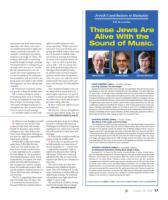

Jewish Contributions to Humanity
#41
#50 in
in a series
agreements and trade enforcement,
especially with China, who steals
our intellectual property rights and
creates counterfeit auto parts, for
example. I would push any admin-
istration to be tough on China. The
problem with tariffs is not having
carefully thought through a strategy.
I’m hopeful there’s a strategy, but, as
of today, we’ve not seen it. I would
like the administration to be suc-
cessful, but what’s happening now
is costs are going up for companies
and consumers; and our farmers are
being used and caught in the middle.
We’re going to see some folk get gob-
smacked.
Q: What kinds of policies would
you pursue to help the middle class?
DS: I work on things to create a
level playing field, such as working
to close tax loopholes to keep more
jobs at home. I’m working closely
with many Michigan businesses to
strengthen our “buy America” provi-
sions as well as on-job training.
I’ve probably talked to about 200
different small businesses and I
always ask them, “What’s your No.1
concern?” Every one of them said
getting the skilled workers they need.
So, I’m focused on skilled trades
and technical training. Everything
in school now is geared toward col-
lege — and we need to tackle that
cost as well — but you can go into
one of the great training centers in
Michigan that’s funded privately
by skilled trades and their business
partners and become an apprentice.
After five years, you walk out with a
professional trade and no debt and
into a job that pays $75,000-$80,000
a year.
Also, students shouldn’t come out
of college with as much debt as if
they bought a big house. I’m part of
a coalition trying to get interest rates
on student loans down and trying to
get some college debt-free.
Q: How would you improve access
to healthcare?
DS: The No. 1 driver of healthcare
costs are prescription drugs. The sys-
Debbie Stabenow continued on page 20
Q: What are your thoughts on trade?
JJ: I believe in free, but fair trade,
reciprocal trade deals with mutual
benefit for all parties, open markets
and open access. I also believe that
when you’re being taken advantage of,
you have the right, the responsibility to
stand up for yourself.
Nobody likes tariffs, and nobody
wants them. I don’t like the term
“trade war” for tariffs because I’ve
been to war; I tend to look at these
as trade negotiations. I’m a supplier
for Ford Motor Co. [He is president
of his family’s business, James Group
International]. I recognize how taxes,
tariffs and trade affect businesses. I
also recognize the currency manipu-
lation, the intellectual property theft
and the predatory business practices of
China, which has taken advantage of
our economy.
The U.S. is negotiating better terms
since the tariffs went into place. The
U.S. economy has increased since
the end of February and the Chinese
economy has gone down. I’m looking
forward to working with anyone in
Washington and abroad to bring these
negotiations to a swift end in a manner
that will benefit the United States and
Michigan.
Q: What kinds of policies would you
pursue to help the middle class?
JJ: We’ve done an epically poor job
of addressing the root cause issue of
income inequality or — a better term
— opportunity inequality. Until we
address that disparity, then nothing
will change. That is why I don’t just
talk about jobs. Jobs are a part of the
equation, but they’re not a solution on
their own.
We need to make sure that we’re
looking at early childhood develop-
ment. That we’re looking at K-12 edu-
cation, including vocational skills and
skilled trades training. We need kids
who graduate from high school to be
college or career ready.
We need look at workforce develop-
ment for the people who are already
These Jews Are
Alive With the
Sound of Music.
Hans Zimmer
Howard Shore
Thomas Newman
HANS ZIMMER (1957-). b. Frankfurt, Germany.
Lion King, Gladiator, The Dark Knight.
Arguably the most dynamic film score composer of our generation, Hans Zimmer has scored
soundtracks for more than 100 films, including The Lion King, Gladiator, The Dark Knight and
12 Years a Slave. He has eight Oscar nominations (and one win), seven Grammy nominations
(and three wins), and 11 Golden Globe nominations (and two wins), and his trademark mixture
of classical orchestras and electronic music are unmistakable to millions of moviegoers. Zimmer
grew up in post-World War II Germany, and his mother (who escaped Germany in 1939, surviving
in England) rarely spoke about her Judaism. Zimmer didn’t publicly reveal that he is a Jew until
a 1999 press conference at the Berlin Film Festival, in which he discussed his score of The Last
Days, a Holocaust documentary. Asked why he chose to work on it, he revealed his family’s
background, which his mother had kept secret because of her anxieties about anti-Semitism in
Germany. Immediately after the press conference, Zimmer, feeling guilty, phoned his mother to
tell her what he had done. After a pause, she said, “I’m very proud of you.”
HOWARD SHORE (1946-). b. Toronto, Canada.
Big, Silence of the Lambs, Lord of the Rings.
The composer of over 80 film scores, including the Lord of the Rings trilogy, Howard Shore
has won three Oscars, three Grammys, and two Golden Globes. By the time Shore was a
teenager, he was playing in bands. He studied music at Berklee College of Music, and at 24
began working with Lorne Michaels, the creator of Saturday Night Live. Newman was SNL’s
musical director from 1975 to 1980, and appeared in many sketches, including Howard Shore
and His All-Nurse Band. Shore’s first film score was the 1976 low-budget I Miss You, Hugs
and Kisses. His biggest break came in 1988, with Big, starring Tom Hanks. Three years later
he scored Silence of the Lambs, and since then his filmography and reputation have grown to
that of one of Hollywood’s premier film score composers.
THOMAS NEWMAN (1955-). b. Los Angeles, California.
The Shawshank Redemption, Finding Nemo, Bridge of Spies.
Nominated for 14 Oscars for film scores including Bridge of Spies, Finding Nemo,
and The Shawshank Redemption, Thomas Newman is the son of famed composer Alfred
Newman, who himself won nine Oscars for Best Film Score, and the brother of Randy
Newman (of Toy Story fame). Thomas’s uncles, Lionel and Emil, are also renowned
composers from Hollywood’s golden age. Newman studied music at USC and Yale, where
he met an early mentor of his, composer Stephen Sondheim. Out of college, Newman
played keyboard in a rock band and was first interested in composing Broadway plays. He
got more involved with film scores in the ‘80s, particularly when John Williams brought him
on board to assist with Return of the Jedi. His 1985 score of Desperately Seeking Susan
helped launch his career, and since then, his electro-orchestral approach has been on full
display in hits like WALL-E, Skyfall and Saving Mr. Banks.
Original Research by Walter L. Field Sponsored by Irwin S. Field Written by Jared Sichel
John James continued on page 20
jn
October 18 • 2018
17