
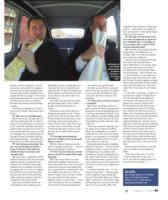

Gad Elmaleh and
Jerry Seinfeld
eating baguettes
in Seinfeld’s
“Comedians in
Cars Getting
Coffee.”
known, and not to brag, but I can fill
out arenas. And maybe I’m stopped in
the street, and my ego is pumped, but,
at some point, I need a challenge. Even
tonight in Paris I’m going to a very small
club unannounced just to try new jokes
in French because there is nothing I
like more than being excited by doing
comedy.
What else am I going to do? I don’t
want to go to dinner with friends. I’d be
bored.
TF: That was very Seinfeld-esque.
GE: Oh ya, oh ya. I actually talk a lot
with Jerry about that. Like, we want to
hang out with comedians; we want to be
on the road with comedians. It’s a little
extreme when you hear it but, in fact, it’s
a way of life and it’s the way you see life.
It’s a language. It’s not only being funny.
Having this mind constantly working,
observing, analyzing — it’s really some-
thing that I love. Even with my family.
TF: Let’s talk more about that. You
grew up introducing your father, a
mime, in Morocco. How did your
childhood shape your humor and
comedic style?
GE: I grew up in a Sephardic-Jewish
family in Morocco. They were not super
religious but they were kind of tradi-
tionalists. We would do Friday night
Shabbat, but we would go to the shul
[synagogue] by car. I went to a religious
school, by the way, not by choice, but
because that was the only school that
really wanted me in there. I had been
expelled from all of the schools.
I grew up in a family [where] the
sense of humor was a language. Not
being silly or funny or making faces or
jokes; just the way we would talk and
communicate was always through some-
thing comedic, maybe because we were
shy. In [Moroccan] culture, there are a
lot of taboos.
My mother was the spirit, the mind,
the quick sharp [one], and my father
[taught me the physical aspect of
humor].
Sometimes I post videos of her on
Instagram and people are like, “Please,
give us more.” Not only because she’s a
Jewish mother but because she is a fun
and funny woman and quick and so
smart. The last video I did with her got
so many views. On the video, she said,
“Everybody talks about Gad as a come-
dian but do you think he’s that funny?
Really?”
TF: You joked about doing the
interview in Hebrew, but you do speak
Hebrew, correct?
GE: Yes. Hebrew, Moroccan Arabic,
and now English, and French — which is
the second language in Morocco.
TF: Have you ever done any comedy
shows in Israel? You speak all the right
languages.
GE: I have many times. I’ve never
performed in English in Israel. I have
only performed in French for the French
community who have made aliyah. But
since I speak Hebrew, I would always put
some Hebrew into the show. They are
always so happy when I do that. I would
love to go back and do the show in
English, maybe in a small venue… I have
a lot of friends now who are comedians
in Israel. One of them is Israel Katorza
— he is funny and a good friend.
My older son had his bar mitzvah in
Tel Aviv and then we went to Jerusalem.
It was a great trip. We didn’t do a big,
crazy party. But what we did, he will
remember.
TF: When did you decide to become
a comedian?
GE: What’s interesting or bizarre is
that I was not the cliche of the goofy kid
doing jokes at school and playing tricks.
I was more dreaming in the back of the
room, thinking, not really talking. But it
was kind of a creative process, all of the
time thinking of what could I do, what
could I be.
There was one point, really, that was
the trigger. Every Friday for Shabbat
dinner we would gather at my grand-
mother’s house. They were very simple
people. I was not raised in a rich family.
I had a sketch that I used to do when I
was maybe 6 or 7 years old.
My grandmother lived in a building
that had seven floors — back in the day,
buildings in Morocco were very noisy
and happening. I was raised in this
atmosphere. I would do impressions of
the women. Only women. I don’t know
why. My grandmother, may she rest in
peace, passed away two years ago at 102.
And by the way, she was not gluten-free
or vegan.
I would do this little show — it was
kind of a mean show — and my grand-
mother laughed so hard [along with
the rest of the family] that every Friday
night I would have to do the show again,
[performing every time there were new
guests]. It was a great bit called “The
Neighbors.” But sometimes I didn’t want
to do it — I was tired, I was pissed off,
but I learned how to make people laugh
even if you don’t want to.
TF: You had your first break in the
U.S. when you appeared as a guest on
Jerry Seinfeld’s show, “Comedians in
Cars Getting Coffee,” correct? What
was that experience like?
GE: Honestly, I don’t think my break
happened yet. “Comedians in Cars
Getting Coffee” was what first exposed
me to American audiences.
And then there was the first TV talk
show that I did with Seth Meyers …
before Seth Meyers, I was no one, noth-
ing, and had never done a talk show
in America. One of my friends, Diane
Von Furstenberg — she’s a fashion icon
— I met her when we were stuck on an
AirFrance plane that would never take
off. We spent the night together, actually.
We became friends and we had a friend-
ship crush. She said to me, “You know
what? You’re very funny. I want to help
you.”
At the time, I was doing a residency at
Joe’s Pub every night. I would perform
with 10, 20 people [in the audience];
sometimes it was sold out. But I was
going to do a show in French at the
Beacon [theater] for the French expat
community, and I said to her, “Bring
your friends to the Beacon because it’s
bigger and we’re going to impress them.”
And she said, “No, you don’t understand,
people like to feel that they’re discov-
ering something new.” And she was so
right. She invited some people, including
Seth Meyers, to Joe’s Pub and organized
a dinner across the street. She was so
generous and nice. Seth Meyers sat in
the room, he saw the show, and she sat
me right in front of him at dinner and
we talked and laughed; and he loved the
show and said to me, “I want you on my
show.”
Because I did Seth Meyers I was able
to go on Colbert, Conan and Jimmy
Fallon.
When I’m in New York, I’m at the
Comedy Cellar almost every day — I
love it, and with the Netflix special out,
now I need new material. ■
details
Gad Elmaleh performs “The Dream
Tour” at the Royal Oak Music
Theatre on Oct. 18. $35 and up.
Royaloakmusictheatre.com.
jn
October 11 • 2018
49