

arts&life
at home
Study
Zones
Set up the ultimate
workstation for your kids.
JACKIE HEADAPOHL MANAGING EDITOR
T
his school year, you can help set
up your kids for success. It’s all
about having the perfect study
zone at home.
Lois Haron, owner of Designs in
Decorator Wood & Laminates in
Farmington Hills, has some advice
for setting up your kids’ study area for
looks — and function.
“Kids love their own space!” she
says. “If you can do a corner desk on
two walls, it is perfect, especially if
you add about 18 inches on one side
for three drawers: a file drawer, utility
drawer for papers and a drawer above
for stapler, notepads and other stuff.
“You should be able to fit a narrow
drawer in the front of the open part of
the desk, where the chair is, for ruler,
pencils, paper clips; that is very useful,”
she adds. “The desk doesn’t have to
be very deep, only about 20 inches,
because it goes back into the corner, so
they can use that space while working
on homework or a project to sort out
their work.”
Lighting is also essential, she says.
“Rather than put a desk lamp on
the desk, I love to do ‘floating’ shelves
that are lighted underneath so that
you have nothing extra on the desk
to get in your way or knock over,” she
explains. “You have lots of light to see
what you are doing any time of the day
or night when working there.”
Haron adds that if you choose to
do a straight desk, try to make the
space fit for two people, so your child
can work or play games there with a
friend.
See the sidebar for five cool ideas for
creating a workspace for kids that will
promote great study habits and inspire
learning. ■
Lois Haron can be reached at
(248) 851-6989.
46
October 11 • 2018
jn
5
Tips For Success
1. Find the right real estate. Every child learns differently. So, depending on the
person doing the studying, the perfect space could be a quiet, bright corner of the
house away from the hustle and bustle, or it could be in the midst of family life and
activity. Experiment with each set up, periodically checking in with your child to
see what’s working and what’s not.
2. Upgrade visual learning. Is your child a visual learner? Upgrade study time in
any sized space with a short throw projector that automatically adapts the projec-
tion brightness to the lighting conditions in the room. One option that allows you to
control the projector wirelessly from a smartphone or tablet is the Casio Ultra Short
Throw LampFree Projector XJ-UT351WN, which features a mercury-free laser
and LED hybrid light source, making it an eco-friendly and safe option for young
students.
3. Embrace the principles of natural wellness. It is said that certain essential
oils can promote focus and improve concentration. These can be diffused, rolled or
simply inhaled to give students a boost when it comes time to cram for an exam.
4. Make time for music. Studies have found that music can help improve mem-
ory. And making music can be an effective stress reliever in the face of school-in-
duced stress. Consider outfitting your child’s study area with an affordable, light-
weight instrument like a Casio CT-X Keyboard, which features an extensive library
of 600 tones and 195 rhythms, supporting diverse musical genres. Whether it’s
a 20-minute study break or a jam session once homework is completed, make it
possible for musical creativity to come to life.
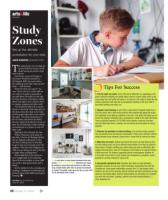
TOP: A cool place to study makes homework time less
painful. ABOVE, TOP TO BOTTOM: Maximize your space
by building a corner desk with drawers on either side.
Long, straight desks allow kids to spread out materials
as needed. If possible, make space for two, so your child
can do homework with a friend.
5. Incorporate educational tech. Education tech tools can help synthesize
classroom concepts. Be sure your child’s workspace incorporates new tech like
ClassPad.net, a web-based mathematics resource for K-12 and beyond, which
students can use to draw geometry figures freehand and input calculations as they
would on real scratch paper. Great for study buddies, the tool allows for simultane-
ous work with calculation, graphing, geometry and data analysis/statistics. ■
From StatePoint.net