

LULLABY AND
GOODNIGHT
From lullabies written to soothe
children imprisoned at Terezin
(Theresienstadt concentration camp
in the Czech Republic) to songs
of loss as faced by adults there,
composing music was a form of
expression that sometimes reached
messages of hope.
Those songs have been
researched by Rachel Joselson,
soprano and music professor at
the University of Iowa, and will be
presented by her Sunday afternoon,
Dec. 9, at the Holocaust Memorial
Center in Farmington Hills. She will
be accompanied by pianist and uni-
versity colleague Réne Lecuona.
Songs of the Holocaust, also avail-
able on recording (Albany Records),
will be part of a one-time program
that goes along with seeing the
months-long exhibit “The Holocaust
Unfolds: Reports from the Detroit
Jewish Chronicle and Jewish News.”
Beginning at 3 p.m., the program
also features a dessert reception.
The cost is $10. To RSVP, call
Brenndan at (248) 553-2400, ext.
145, or visit https://tinyurl.com/
HMCJewishNews.
Mike Smith, DJN Foundation archivist and part
of the exhibit team
best sources they could find.
“Viewers will learn more about the
Holocaust as it happened, and it’s a
unique perspective because it shows
how the Holocaust was brought before
the eyes of the Detroit Jewish commu-
nity through an American English pub-
lication. I hope people get the feeling
of what it was like to be a Detroiter in
1942, 1943 and 1944 as many worried
about family members still living in
Europe.”
The articles became very personal
by honoring local Jewish members of
the armed forces, so many lost in the
fighting of World War II. There also is
a list of survivors trying to find relatives
living in Michigan.
“Roughly 550,000 Jewish men and
women served in the armed forces,
more than the proportion of the popu-
lation of the United States,” says Smith,
also principal archivist for the Bentley
Historical Library at the University of
Michigan.
“We tried to represent coverage and
homage to the members of the Detroit
Jewish community who did so much to
support the war effort against the Nazis
by serving in different ways and provid-
ing funding.”
The first part of the exhibit includes
articles about Hitler’s rise to power, the
threat to Jews, Nuremberg Laws and
Kristallnacht. The second part delves
into reports of atrocities, Russian Jews,
the home front in Detroit, awakening of
the world to the issues and the Warsaw
Ghetto. The third part examines the
details
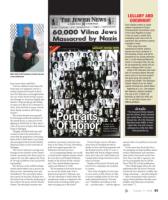
“The Holocaust Unfolds: Reports
from the Detroit Jewish Chronicle
and Jewish News” will be shown
through Dec. 28 at the Holocaust
Memorial Center (HMC) in Farm-
ington Hills. Free with museum
admission fee. (248) 553-2400;
holocaustcenter.org.
resistance movement, American reac-
tions to the Nazis, VE Day, Nuremberg
trials, laws against genocide, the
Eichmann trial and survivors.
An accompanying display case recalls
a United Jewish Appeals mission joined
by Louis Berry and Joseph Holtzman,
leaders of the Detroit Jewish commu-
nity. They visited displaced persons
camps and Palestine in 1948.
“It’s fascinating to look back because
we can see the steady steps with a
historical perspective,” Saltzman says.
“It’s also important to think about the
mainstream media as compared to the
Jewish media in letting people know
what was going on in the world.”
Horwitz hopes viewers will take a
closer look at Kristallnacht with its
attacks on Jews and their properties and
the ill-fated journey of the St. Louis, a
ship filled with Jewish refugees denied
entry into Cuba, the United States and
Canada before being returned to devas-
tation in Europe.
Readers of the Jewish Chronicle and
Jewish News could place the incidents
in context.
“One of the strengths of a free press
in our country is that citizens are able
to receive multiple points of view and
make informed decisions,” Horwitz
says. “Publishers and editors of that
era — just like today — had the right to
espouse their own political or personal
agendas.
“At the same time the Jewish News
was pumping out huge headlines about
massive deportations and extermina-
tions of Jews, the Jewish-owned New
York Times was able to squeeze a few
low-key paragraphs into its ‘All the
News That’s Fit to Print’ publication.
“This exhibit largely shows the role
publications like the Jewish Chronicle
and Jewish News played in credibly edu-
cating, informing — and advocating for
— their communities while construct-
ing fact-based timelines that fake news
peddlers and Holocaust revisionists
can’t refute.” ■
jn
October 11 • 2018
45