

jews in the d
continued from page 12
and me,” Band says. “He rolled up
his sleeves and said, ‘How do you
like your eggs?’”
During his three years at the CDC,
Band was involved in at least 15 out-
break investigations, which set the
record.
“The average epidemic intelligence
service officer probably was involved
in four or five. My wife always
thought, ‘Geez, you’re being asked
to do this?’ It was a number of years
before she learned I had been volun-
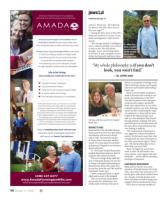
Dr. Jeffrey Band
during a vacation
along the Amazon
BELOW: Meredith
Weston-Band
and Jeffrey Band.
“My whole philosophy is if you don’t
look, you won’t fi nd.”
— DR. JEFFREY BAND
teering, and she wasn’t very happy,”
Band says.
MOVING TO WSU
Band and his wife, Meredith Weston-
Band, packed up their two kids, Joshua
and Marissa, and moved to Royal
Oak in 1981. He joined the faculty
at Wayne State University’s medical
school. Two years later, he was hired
at Beaumont Hospital as an infectious
disease physician.
Dr. Carl Lauter headed Beaumont’s
medical department and was chief of
medicine when Band was hired.
“He was in charge of the adult divi-
sion of infectious disease. He was also
in charge of hospital epidemiology at
Beaumont for almost the entire time
he was here from the mid-’80s until his
retirement,” Lauter says.
Lauter recognized Band as a great
talent and an asset to the hospital.
“He’s an extremely hardworking
person and very industrious, very
intellectually motivated. He’s got an
14
October 11 • 2018
jn
almost encyclopedic knowledge of the
field of infectious disease and hospital
infections and hospital epidemiology,”
Lauter says.
Band received further recognition
while at Beaumont for solving an out-
break of pseudomonas in late 2011.
The affected patients had undergone
cardiovascular surgery, specifically
heart valve replacement, in one of the
hospital’s intensive care units. Nothing
turned up after scrutinizing the surgi-
cal equipment, so Band and his team
looked at the ultrasound gel used
with an echocardiogram that entered
through patients’ esophagi. The team
found the gel to be contaminated with
the same strain of pseudomonas they
were finding in patients.
“We implemented at Beaumont a
very aggressive, intense surveillance
system. We did much more than what
is required by the joint commission or
any other government agency,” Band
says. “My whole philosophy is if you
don’t look, you won’t find.”
Band, 70, began his semi-tretire-
ment in 2016. He still teaches, sees
some patients, writes papers and edits
textbooks — and he still has attending
privileges at Beaumont.
CONTINUOUS INVOLVEMENT
Band and his wife are very active
members of Temple Emanu-El in Oak
Park, where they were married in 1973.
He has given talks about medical issues
for a Sunday morning speaker series
there and looks forward to being more
engaged with his newfound free time.
He is also an associate member of