

in
jews
the d
on the cover
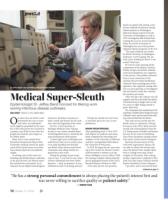
Dr. Jeffrey Band in the microbiology lab at Beaumont Hospital
Medical Super-Sleuth
Epidemiologist Dr. Jeffrey Band honored for lifelong work
solving infectious disease outbreaks.
ROB STREIT SPECIAL TO THE JEWISH NEWS
O
ur short time on Earth is char-
acterized by the way we treat
each other. An individual’s
merit might be quantified by the num-
ber of lives that person has touched in
a positive way. If this is true, then few
people have had the same impact as
Dr. Jeffrey Band.
Band, who is semi-retired from
Beaumont Hospital and Wayne State
University’s medical school, has spent
much of his storied career as an infec-
tious disease physician and epidemi-
ologist.
In solving some of the most con-
founding and deadly disease outbreaks
in the past 40 years, the Detroit native
has touched lives uncounted. As an
educator, he has helped trained legions
of doctors. Band has received acco-
lades, awards and honors for his work
since near the beginning of his career.
On Oct. 4, the University of
Michigan Medical Center Alumni
Society in Ann Arbor awarded Band
its Distinguished Service Award for his
many professional achievements.
“I spent eight years at Michigan and
really haven’t had a lot of contact since.
I was quite humbled and shocked,”
says Band, whose former med school
roommates and college friends sur-
prised him at the event.
Noting the prestige of past recipi-
ents, he says, “I was truly in awe. Some
of these individuals have been Nobel
laureates — these are pioneers. It over-
whelmed me that I was being selected.”
Perhaps he should not have been
so shocked, given his own accom-
plishments.
MAKING BREAKTHROUGHS
After graduating from U-M in 1973
with degrees in medicine and music,
Band completed his internship and
residency at the University of Missouri,
and then a postgraduate fellowship at
the University of Wisconsin.
In 1978, he began his two-year train-
ing at the Centers for Disease Control
and Prevention in Atlanta as an epi-
demic intelligence service officer. With
his training complete, Band joined the
special pathogens branch of the CDC’s
Bacterial Disease Division in 1980.
A few days into his new position,
Band was tasked with solving a mys-
terious outbreak of infection among
dialysis patients in Washington.
Infectious disease experts from the
University of Washington as well as
CDC investigators had already been
working the case for several months
before he arrived. University of
Washington has one of the premier
infectious disease programs in the U.S.
“The main textbook was written
by all the University of Washington
professors. And I’m going ‘Oh, my
God, you’re sending me there?’ I was
scared,” Band says.
He went to work, learning all the
components of the dialysis machine.
Within 10 days, he had the outbreak
solved and identified a new organism
in the process. The problem stemmed
from a cross-connection in the
machine that prevented sterilization
chemicals from reaching parts of the
apparatus. The organism causing infec-
tion was slow growing, so investigators
had not found it when they cultured
the machine previously.
“After five days, the cultures were all
negative and they discarded the plates.
I had them keep it longer and, on day
six, seven or eight, things started to
grow,” Band says.
The companies that manufactured the
machines modified their designs because
of Band’s work, and the head of the dial-
ysis center invited him for dinner.
This early success set the tone for
Band’s career as a physician. During
his tenure at the CDC, Band received
awards and commendations from the
U.S. Department of Health and Human
Services for his work in identifying
Toxic Shock Syndrome among women
who used a certain brand of tampons.
Band also became known for his
work with Legionnaires’ disease. He
was able to culture the bacteria that
cause the disease from samples taken
from a cooling tower atop a hotel
complex in Wisconsin. After solving
another Legionnaires’ outbreak in New
York City, then-mayor Ed Koch invited
Band to breakfast at Gracie Mansion.
“I go there, and it was just Ed Koch
continued on page 14
“He has a strong personal commitment to always placing the patient’s interest fi rst and
was never willing to sacrifi ce quality or patient safety.”
— ROBERT KASS
12
October 11 • 2018
jn