

arts&life
theater
F
My Parsifal Conductor
Heading to NYC this fall? Check out this play written by
a Jew, based on an opera by an anti-Semite
that was conducted by his close friend, a Jew.
ALICE BURDICK SCHWEIGER SPECIAL TO THE JEWISH NEWS
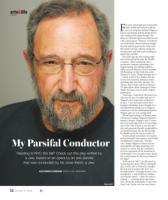
Allan Leicht
52
October 4 • 2018
jn
or years, playwright and screenwriter
Allan Leicht had wanted to tell the
story of composer Richard Wagner, a
known anti-Semite, and his Jewish friend
who conducted his opera Parsifal. The
three-act Christian opera was based on the
13th-century poem “Parzival” by Wolfram
von Eschenbach, about Arthurian knight
Percival and his quest for the Holy Grail.
But Leicht was busy with his acting and
writing career and had to put creating his
dream play on hold.
Five years ago, the time seemed right,
and Leicht penned the play My Parsifal
Conductor. After teaming up with a
production company, presenting a few
staged readings and putting together a
stellar cast and director, it’s now running
Off-Broadway in New York City at the
Marjorie S. Deane Theater through Nov 3.
Leicht, a native New Yorker who has
written for numerous television shows
including Kate and Allie, Mariah, The
Thorns, Ryan’s Hope and the acclaimed
TV film Adam, about kidnapped Adam
Walsh, had been curious about Wagner
growing up.
“Years ago, I read about Hermann Levi,
who was the son of a rabbi and one of
Wagner’s most important conductors,”
he says. “I was fascinated about their
longtime friendship. Some thought Levi
was disloyal becoming one of Wagner’s
conductors, but the relationship between
Wagner and Levi was complicated.”
When King Ludwig ll of Bavaria insist-
ed that Levi conduct Wagner’s final mas-
terpiece, Parsifal, Wagner’s wife, Cosima,
was very much opposed. Levi was a huge
star in the 19th century, a very fine pia-
nist and composer himself, comparable to
Leonard Bernstein, but she felt strongly
he should not be the one to conduct it.
“Cosima didn’t mind that Levi conduct-
ed her husband’s other operas, but Parsifal
was different,” Leicht says. “Cosima
was a deeply religious woman and was
tormented by the idea of having a Jew
conduct an opera that she considered
to be an expression of the mysteries of
Christianity. It was no mere music-drama
but ‘a festival play for the consecration of
the stage.’”
In the end, in 1882, Levi did wind up
conducting the opera. When writing the
play, Leicht, who is Orthodox, thought
the best way to portray the story was
through humor. “I thought because of its
incongruity — anti-Semitism, Judaism
and German opera — that’s the stuff of
comedy — a comedy about anti-Semi-
tism. About the irrationality of anti-Sem-
itism,” says Leicht, who has won Emmy