

views
guest column
Justice Brandeis And A Right
Of Privacy In A Digital Age
T
bookie. What Justice Roberts’ opinion
he U.S. Supreme Court capped
says is that we have a constitutionally
its last term with a landmark
protected privacy interest in these
digital privacy decision in a
case starting out in Detroit: Carpenter kinds of long-term historical records
even though they are made and kept
v. United States.
in the cloud; and the govern-
Chief Justice Roberts’ June
ment must persuade a judge it
22, 2018, majority opin-
has probable cause to believe
ion in Carpenter is about
they are evidence of a crime in
the kind of digital location
order to get them with a search
data automatically created
warrant.
every time our cell phones
Second, the Carpenter opin-
send or receive messages.
ion is important because it lays
In Carpenter, the data was
the groundwork for application
obtained by government
Harold Gurewitz of this right of privacy to the
investigators without a
Special To The
ballooning volume of very per-
search warrant and used by
Jewish News
sonal data generated by all the
prosecutors at Carpenter’s
digital devices we have come
trial to convict him — ironi-
to rely on in our lives without
cally enough — of robbing
cell phone stores by placing him at the blinking an eye — and all those yet to
come.
scenes of the crimes.
For example, we now live sur-
Why should you care? The
rounded by devices that record and
Carpenter opinion is immensely
transmit to some remote place minute
important for at least two related
details from our homes like interior
reasons. First, it puts a real legal limit
temperatures or the absence of food
on government access to the personal
in a refrigerator or even records of
details of our lives remotely stored
our medical or fertility conditions.
by cell carriers in a digital format.
Our personal relationships are culled
Historical cell phone location data is
from social media and stored by some
kept by our cell carriers for up to five
mega-server. And we may be subject
years. They are the makings of virtual
to surreptitious surveillance when we
maps that can lay out every place
leave home by license plate scanners
we travel with our cell phones, 24/7,
or facial recognition devices and iris
365 days a year. When assembled,
scanners at airports.
they indiscriminately reveal both the
Because Carpenter lays the ground
mundane and the confidential parts
work for privacy protection in a digital
of our lives, like trips to work or a
age, law professors opined in the New
grocer or visits to doctors, therapists
York Times shortly after the Carpenter
or perhaps even to a drug dealer or a
opinion was released that the high
court handed down “what may be
the most important privacy case of
the digital era.”
Even though a right of privacy is
not specifically spelled out in our
Constitution, it has grown from
strong roots in our legal tradi-
tion. Justice Roberts’ opinion in
Carpenter builds on the visionary
work of revered legal scholar Louis
Brandeis more than a century ear-
lier.
Brandeis, then a practicing
lawyer, wrote in his seminal 1890
Harvard Law Review article on pri-
vacy, “The Right to Privacy,” that as
a consequence of “the intensity and
complexity of life, attendant upon
advancing civilization,” a right of
privacy should protect individuals
“from invasion either by too enter-
prising press, the photographer, or
the possessor of any other modern
device for recording or reproducing
scenes or sounds.”
Brandeis’ concern then was print
media publishing personal photos
and tabloid papers’ gossip columns
about the personal lives of East Coast
“high society.” About 30 years later,
then as an associate justice on the
U.S. Supreme Court, Brandeis wrote
in Olmstead v. United States, in a dis-
senting Supreme Court opinion cited
in Carpenter by Justice Roberts, about
the need for privacy protection from
the mounting threat of warrantless
telephone eavesdropping.
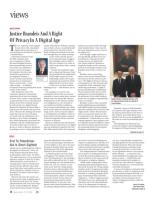
Nathan Wessler and Harold Gurewitz at the
U.S. Supreme Court in front of a portrait of
Louis Brandeis
Brandeis’ vision in 1928 foreshad-
ows present-day legal scholars’ cries
for privacy protections in the face of
the volumes of records about every
detail of our lives never imaginable at
the time he wrote his Olmstead opin-
ion.
The defendant in Olmstead was
convicted of large-scale bootlegging.
In support of the government’s case
continued on page 10
letters
End To Palestinian
Aid Is Short-Sighted
Thank you for publishing Neri Zilber’s
thoughtful commentary, “Why Are
Some Israelis Worried About Cuts
to Palestinian Aid?” (Sept. 13, 2018).
The author presents a very measured,
objective analysis of why the Trump
administration’s current policy is
causing great concern among many
Israeli security officials who under-
stand that when basic public services
( food, education, medical care) are
disrupted, it tends to lead to chaos
and violence.
Between the time the article was
written and its date of publication in
the Detroit Jewish News, the Trump
administration took even more steps
(in the words of Michael J. Koplow
of the Israel Policy Forum) “to blud-
8
September 27 • 2018
jn
geon the Palestinians into submis-
sion” by announcing its intention to
cut $25 million in U.S. aid to the East
Jerusalem Hospital Network and by
shutting down the PLO’s diplomatic
mission in the United States.
As Koplow points out in his Sept.
13 blogpost (“The Spoils of Victory
Over the Palestinians”), the hospitals
that will be affected by the U.S. pull-
ing its funding “are not administered
by the P.A., the U.N., Hamas or any
other actor that the Trump admin-
istration deems objectionable. They
are not even located in Palestinian-
administered territory, but are all
in East Jerusalem, which is formally
annexed to Israel. In fact, they are
licensed and inspected by Israel’s
Health Ministry, so they are com-
pletely under Israeli jurisdiction. They
are doing nothing nefarious and have
never been accused of abetting cor-
ruption or aiding terror. All they do is
provide badly needed and highly spe-
cialized medical treatments to people
who cannot otherwise get them.”
The administration’s unilateral deci-
sion to pull U.S. funding from these
six East Jerusalem hospitals also is a
direct violation of the expressed will
of Congress, as Koplow explains:
“What makes ending aid to these
hospitals particularly duplicitous is
that until recently, the Trump admin-
istration and its Congressional allies
held up the East Jerusalem Hospital
Network as a shining example of the
type of institutions that should be
supported … When Congress passed
the Taylor Force Act, subjecting all
American aid to the West Bank and
Gaza to be eliminated if it directly
benefited the Palestinian Authority in
any way, it specifically exempted the
aid appropriated to the East Jerusalem
Hospital Network. When the Senate
Foreign Relations Committee held
a hearing in July 2017 on the Taylor
Force legislation before it was passed,
Elliott Abrams — as staunch a pro-
Israel Republican foreign policy man-
darin as exists — testified that the
hospitals should not be subject to
any aid cuts and referred to Augusta
Victoria Hospital as a “renowned and
venerable institution.”
I concur in Koplow’s conclusion that
the decision to end U.S. funding to the
East Jerusalem Hospital Network is a
“heartlessly inhumane action” that’s
not about victory and peace but is
rather “nothing more than cruelty for
cruelty’s sake.”
Nancy F. Kaplan
West Bloomfield
continued on page 10