

jews d
on the cover
in
the
StockX
Laces Up
Sneaker “stock market” co-founded by
Dan Gilbert rockets to success.
ADAM FINKEL CONTRIBUTING WRITER
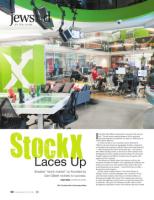
TOP: The StockX office at One Campus Martius.
50
September 20 • 2018
jn
I
n his 20s, Dan Gilbert announced a reason for his success:
fun. “I’ve just always enjoyed going on to the next goal
and achieving the next plateau,” he said in a 1990s story in
Crain’s Detroit Business.
As of this month, a new mountain can be declared in
Gilbert’s extensive business topography. StockX, a startup he
co-founded and incubated with Josh Luber and Greg Schwartz
— which launched just about 30 months ago — has raised a
$44 million funding round, co-led by two of the nation’s most
distinguished venture capital investment firms, GV ( formerly
Google Ventures) and Battery Ventures, the JN reports with
approval of the company.
This infusion of capital values the business well into the
hundreds of millions of dollars. Even adjusting for inflation, the
business has grown its value quicker than many of the most
noted businesses in the nation — from GM to Dow to Nike —
during their early chapters.
StockX, which markets itself as “The Stock Market of
Things,” creates a virtual marketplace for consumers to buy
and sell actual sneakers; often these are limited-edition, in-
demand and sought-after items. The company has a process
to check the legitimacy of each item to ensure the transaction
is authentic, a key part of its business model, which is done
through four operations centers. The business also has created