

sukkot
Traveling Sukkah
The Werner brothers are miniature Chabad
emissaries taking the Sukkot mitzvah to neighbors.
ROCHEL BURSTYN CONTRIBUTING WRITER
F
olks can get creative with
erecting a sukkah, as it can
be out of almost any mate-
rial. What’s sweet is when the
youngest of kids get in on the
action and head outside to share
what they’ve learned about the
holiday with other Jews in the
neighborhood.
One such experience happened
to property manager Dan Rich of
Oak Park. When he first heard an
unexpected knock at the door in
October 2014, he opened it to find
two smiling little boys on his porch.
An older boy accompanying them
hung back slightly. Rich initially
thought they were after a dona-
tion or offering lawn services, but
that assumption was dashed as the
young boy held out his lulav and
etrog and offered Dan the chance
to shake them.
“I was so touched,” Dan said with
emotion. “He explained that it was
Sukkot, that the lulav and etrog
symbolize all the different Jews
and how we hold them together
because we are one nation. He
told me what blessing to say and
helped me shake.”
That boy, Yossi Werner, at the
time, all of 8 years old, now 12,
is the son of Rabbi Shea and
Hadassah Werner of Bais Chabad
of North Oak Park. He has contin-
ued to visit his neighbors every
Sukkot since while his mom
watches from their porch.
The family are Chabad and
follow the guidelines of the
Lubavitcher Rebbe, Rabbi
Menachem Mendel Schneerson,
who instructed his followers to
bring Torah and mitzvot to all
Jews, no matter their affiliation.
Young Yossi said he does so
“because the Rebbe said to” but
admits, “It feels really good. I’m
doing something that helps other
people and I’m very happy to do it.”
Yossi is often joined by his broth-
ers, Avromi, 10, and Zalmy, 8, who
had the important job at age 4 of
knocking on the doors.
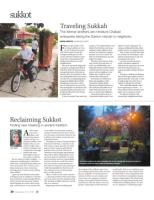
Last year, the three brothers
made a miniature sukkah on
wheels out of extra pieces of wood
and cloth which they put on a
wagon and pulled along with their
bike.
“Eating in a sukkah and shaking
lulav and etrog in sukkos is such a
special mitzvah,” Yossi said. “I want
to help people who don’t have a
sukkah to still get the mitzvah.”
Their makeshift sukkah could
fit two grownups at a time — if
they sucked in their stomachs and
didn’t move around too much.
The Werner brothers rode
around their neighborhood look-
Reclaiming Sukkot
Finding new meaning in ancient tradition.
A
s the moon
waxes into
fullness and
the growing season
reaches its end, we
celebrate Sukkot. This
holiday takes us out
of this modern time,
Carly Sugar
with its comforts and
complexities, through
rituals that seem
downright witchy, if
not counter-cultural.
We are called to build a sukkah — a
temporary dwelling place with three
walls and a ceiling through which you
can see the stars. For a week, we eat,
sleep and pray in these structures,
inviting guests to join us and visiting
other sukkot.
I grew up with limited connection
to Judaism and its traditions. I did the
bare minimum to get through Hebrew
school and my bat mitzvah, without
much thought as to how these teach-
ings could connect to my modern life.
30
September 20 • 2018
jn
As an adult, I’ve had many mentors,
teachers and friends who have shown
me the many connections between our
tradition and modern social and envi-
ronmental issues.
Through my work as Giving Gardens
director at Yad Ezra, I continue to do
this work as I grow food for our food
pantry clients and put agricultural
practices into a Jewish context for
volunteers and program participants.
My work involves exploring the ways
our food system contributes to local
food insecurity and our responsibility
as Jews to heal our world. Our mod-
ern ways involve overproduction to
the extent of extreme waste and harm
while leaving folks like Yad Ezra’s cli-
ents without access to this bounty.
How can this persist?
Often, I return to the same concern
— a disconnectedness from each other,
our food source and the natural world.
The wisdom of Sukkot directly contrib-
utes to a solution.
Beginning with the building and
Carly Sugar’s sukkah at her home in Rosedale Park on the northwest side of Detroit. The home is a
collective of artists and makers called the Glastonbury Collective.
decorating of the sukkah, some of us
are working outside more than we have
all year. Together, we bring represen-
tations of where we are in place and
season into our temporary outdoor
homes. Some gather fallen branches
and flowers, seek out native corn and
gourds, and prepare meals full of sea-
sonal foods. This is our tradition’s way
of ensuring that we stay connected to
the land with a sense of gratitude and
that we do this in community, deepen-
ing our relationships with friends and
neighbors through shared meals and
collaborative building efforts. It’s how
we as a diasporic, wandering people