

eretz
SCAN THIS PAGE
FOR THE TEXT OF
THE CAMP DAVID
ACCORDS
Historic
Peace Pact
PHOTOS BY CIA
Camp David Accords led
to Egyptian-Israeli peace.
DON COHEN CONTRIBUTING WRITER
N
ext March 26 will mark 40 years since Israeli
Prime Minister Menachem Begin and Egyptian
President Anwar al-Sadat signed a peace treaty
on the White House lawn. U.S President Jimmy Carter
hosted the ceremony and signed as a witness.
But the ceremony likely wouldn’t have been possible
had Carter not convened an intense 13-day summit six
months earlier that culminated with the signing of the
Camp David Accords 40 years ago on Sept. 18, 1978.
“Credit Sadat, Begin and Carter,”
says Dr. Kenneth Stein, professor of
Middle East history and political sci-
ence at Emory University in Atlanta,
and president of the Center for Israel
Education. “Credit also has to fall on
Kissinger, Nixon and Ford.”
Stein says Carter’s predecessors’
dealings with Sadat set the stage for
Kenneth Stein
his turn from the Soviet Union to the
United States. “Sadat needed peace.
He understood reality,” Stein says. And he understood
that accommodation with Israel would score big points
with the U.S. and solve several of his problems.
“Credit for [making that decision] goes to Anwar
Sadat,” Stein says. “He made a responsible decision and
Begin gave a responsible reaction.”
Begin, he says, understood that peace with Egypt was
Begin and Sadat and
their delegations at
Camp David
“important for the long-term viability of the State of
Israel.” Egypt was the leader of the Arab world, and its
most populous nation, and the Egyptians had fought
several bloody wars with Israel.
Both men wanted peace, but also needed American
guarantees and financial, diplomatic and military sup-
port to make it happen.
Soon after Carter took office in November 1976, he
focused on convening a Middle East peace confer-
36
September 13 • 2018
jn
ence in Geneva. Neither Sadat nor Begin liked the idea
much, and they began secret contacts to find another
way to move forward. Israeli Foreign Minister Moshe
Dayan was deeply involved in the talks.
Sadat went public on Nov. 8, 1977, telling the
Egyptian People’s Assembly that for the sake of peace
he was “prepared to go to the ends of the Earth — and
Israel will be surprised to hear me tell you: I am ready
to go to their home, to their Knesset itself.”
Six days later, Walter Cronkite, the respected anchor
of CBS Evening News, broadcast interviews with the two
leaders worldwide. Sadat confirmed he was ready to
visit Israel and was “just waiting for the proper invita-
tion.” Begin told him he was prepared to host Sadat
“any time he is prepared to come.”
On Nov. 19, Begin was waiting on the tarmac at Lod
Airport (now Ben-Gurion) with other Israeli leaders
as Sadat disembarked, was warmly greeting and was
whisked through cheering crowds to the Knesset to
speak. He told the Knesset’s 120 members, “Today, I tell
you and declare it to the whole world that we accept to
live with you in permanent peace based on justice.”
Issues and animosities between the two parties rose
over the ensuing months, prompting Carter to dispatch
his Secretary of State Cyrus Vance in early August 1978
to get agreement from both leaders to attend a sum-
mit at Camp David, the rustic presidential retreat in
Maryland.
It was out of the ordinary to
convene such a high-level summit
without a pretty clear idea of the
outcome, but Carter immersed
himself in the details, sent the
press away and the talks con-
vened on Sept. 5.
As the days passed, the media
was rife with speculation about
a breakdown. Indeed, after just
three days, Begin and Sadat would
no longer meet directly with one
another and Carter began shut-
tling between the two. The talks
almost broke off numerous times,
but slow, painstaking progress
was made on what became the “Framework for Peace
in the Middle East.”
Section A of the agreement addressed the West Bank
and Gaza. Sadat and Carter insisted the Palestinian
issue be part of any agreement, and Begin eventually
agreed to negotiations for Palestinian self-government
and “full autonomy.” The agreement also envisioned
peace treaties with Jordan, Lebanon and other Arab
states but accommodation with Israel was adamantly
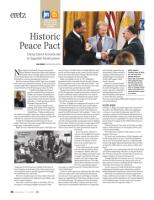
ABOVE: Egyptian
and violently opposed by the
President Anwar al-Sadat,
Arab parties, which refused to
left, and Israeli Prime
negotiate with Israel and sus-
Minister Menachem
pended Egypt’s membership
Begin, right, shake hands
in the Arab League, which
after signing the Camp
lasted a decade.
David Accords 40 years
Section B concerned itself
with Egyptian-Israeli relations. ago at the White House,
with U.S. President Jimmy
In return for Egyptian accep-
Carter as the broker who
tance, economic cooperation
signed the historic accord
and demilitarization of the
as a witness.
Sinai Peninsula, Israel agreed
to return the Sinai and put
the issue of uprooting 2,000 Israelis living there up for a
vote of the Knesset.
ACCORD SIGNED
On Sept. 17, Begin and Sadat signed the Camp David
Accords at the White House, with Carter signing as
a witness. A week later, the Knesset voted 85-19 to
commit to a phased, but full Israeli withdrawal from
the Sinai Peninsula meeting a key Sadat demand and
paving the way for negotiations on a peace treaty. The
peace treaty was signed on the White House lawn six
months later.
“National interest,” Stein says, is the basis on which
leaders “make decisions on sovereignty, borders, the
economy and viability.
“The treaty has worked for both nations over the
decades,” Stein says.
“It’s intact and a cornerstone of both Egyptian and
Israeli foreign policy,” he says. “Israel has predicated
much of its security policy based on a relatively quiet
border with Egypt. Egypt predicated its African Policy
on that they didn’t have to worry about conflict with
Israel.”
Egypt built a new relationship with the United States
and Israel’s relationship with the U.S. deepened. Since
the 1979 peace treaty, the countries have been the two
largest recipients of American foreign aid.
Though referred to for decade as a very “cold” peace,
Section B of the Accords was a great success for all
three nations. Section A dealing with the Palestinians
and other Arab nations was a deadend.
Can the success of Camp David and the ensuing
negotiations leading to peace illuminate a path for
Israeli-Palestinian negotiations? Stein doesn’t think so.
“Both sides at Camp David wanted an agreement.
Today conditions are not ripe,” he says. “Both sides are
fragmented, and the Palestinians are not just fragment-
ed, but dysfunctional. America can’t want an agree-
ment more than the respective sides.” •