

travel
continued from page 92
“The Buddhist Burma was, for the most
part, a welcoming home for Jews for
almost 160 years.”
— SAMMY SAMUELS
both Shabbat and the fourth night
of Chanukah. If I met Sammy in
the Upper West Side of New York, I
would have taken him for a Columbia
University student. A true citizen of
the world, Sammy was educated in
both Israel and the U.S. with degrees
in business and computer program-
ming and worked in New York for
years. He could have chosen to stay in
the U.S. or go to Israel. But a descen-
dent of multiple generations of a
Baghdadi family in Burma, Sammy is
holding the torch to preserve Judaism
in the land of golden pagodas. His
forebear, who came from Baghdad
in the early 19th century, was one of
the founders of the Great Synagogue
of Burma in 1854 and its first facility
manager. That responsibility stayed
in the family.
THE SAMUELS’ STORY
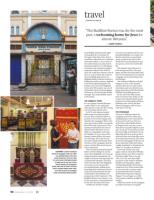
CLOCKWISE: Located on Dalhouse
Street, the synagogue used to be within
easy walking distance from many
Jewish homes prior to the war. Now,
it is in the heart of the Muslim district
of Yangon and is very easy to miss.
Sammy Samuels, the synagogue’s
trustee, talks with the author. Two Sifrei
Torah in exquisite antique silver cases.
In the best of times, the synagogue
could accommodate 500-plus people.
94
September 6 • 2018
jn
For me, Sammy is Jewish Burmese
royalty. While we are waiting for
other guests to arrive for the evening
service, Sammy tells his story.
In 1978, when Sammy’s grand-
father Isaak was dying, he asked
his son, Moses, Sammy’s father, to
promise to never leave Yangon and
abandon the synagogue. When a few
years ago, Sammy’ father was gravely
ill and had only a short time to live,
Sammy promised him the same. It
did not matter that there was no
rabbi, no congregation and only a
few families. As a true scion of the
dynasty, Sammy follows his ances-
tors’ footsteps. Every day, he and
his sisters, Dinah and Kaznah, keep
the doors of the synagogue open for
expats, travelers like us and anyone
who is interested.
When Sammy’s great-great-grand-
father arrived in Rangoon, he, like
many other Baghdadi, was not escap-
ing persecutions and pogroms. He
sought and found wide-open land for
a commercial enterprise. This first
of the Samuels, like other Baghdadi
newcomers, soon was joined by
an extended family, settling down,
launching their businesses and mar-
rying. The Samuels family became
comfortable in their lifestyle and
prosperous in their businesses. “The
Buddhist Burma,” says Sammy, “was,
for the most part, a welcoming home
for the Jews for almost 160 years.”
In 1893, the old 1854 wooden
structure was replaced with the new
beautiful building we see today. The
British and the Jews wanted their
secure worlds to last forever. But
World War II and the Japanese inva-
sion put an end to this comfortable
life.
The Samuels stayed because of
their strong conviction: The syna-
gogue, just like the Jewish faith itself,
must not be abandoned. The beloved
synagogue survived bombings, fires
and lootings.
Out of almost 3,000 Jews who left
Rangoon in 1941, a few hundred
returned after the war only to find
devastation and ruins. But the syna-
gogue stood intact with all its beauti-
ful Sifrei Torah safely preserved.
By the end of the 20th century,
there were fewer than 50 Jews in the
country. The Samuels family stayed
and persevered throughout all those
turbulent years. And so did their
beloved synagogue with its doors
wide open every day.
THE SYNAGOGUE
Located on Dalhouse Street, the
synagogue used to be within easy
walking distance from many Jewish
homes prior to the war. Now, it is
in the heart of the Muslim district
of Yangon and is very easy to miss.
Only when our guide stopped us and
said, “Look up,” we turned away from
the street sights and looked over the
high white wall at an archway deco-
rated with blue-and-white tiles and a
seven-branched menorah. The name
of the Great Synagogue of Burma was
also in deep blue: Musmeah Yeshua,
roughly translated as “bring forth sal-
vation” or “the place of salvation.”
In the best of times, the syna-
gogue could accommodate 500-plus
people, Sammy says. But on that hot
December night, there were only
a few of us. We came from differ-
ent places in the world to celebrate
Shabbat and Chanukah: a globe-
trotting Israeli family with a baby, a
couple from New York, travelers like
us, two men and a woman, expats
and professionals from Colorado
and Florida, living and working in
Yangon. I was as happy as a child
when Sammy asked me to light the
candles.
While the exterior of the synagogue
is modest, the interior is magnifi-