

travel
The Land Of The
Golden
Pagodas
T
he road to Myanmar ( formerly known as Burma)
is definitely less traveled, even for a seasoned
globetrotter. But if you venture along with your
eyes and heart wide open, the country embraces and
woos you with its sparkling beauty and the sincere
friendliness of its people. The country’s temple art is
matchless in its elegance. The deepest spirituality of its
ancient form of Buddhism seamlessly blends with the
pagan spirits of the Burmese universe.
Our “Burmese days” began in Yangon, home to more
than 5 million people and the country’s largest urban
center. It is also home for two most venerated ancient
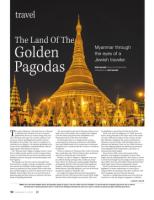
Buddhist treasures: the gold-covered Shwedagon and
Sule Pagodas.
The Pagodas are the true centers of people’s lives.
Each immense complex contains monasteries, medita-
tion schools and multiple smaller pagodas, some of
which are dedicated to Nats, spirits of the world. Both
Sule and Shwedagon are said to be dated to the time of
Buddha. These holiest relics are covered with tons of
glistening gold and their spires are adorned with thou-
sands of sparkling diamonds.
Myanmar through
the eyes of a
Jewish traveler.
IRENE SHALAND SPECIAL TO THE JEWISH NEWS
PHOTOGRAPHY BY ALEX SHALAND
The ancient faith practiced in Myanmar infuses every
daily action of the people. They consider their religion
to be the oldest and purest form of Buddhism, the
Theravada school or the Way of the Elders.
In Theravada, there is no clergy, but the country
is punctuated by numerous monasteries with 50,000
nuns and 40,000 monks. Every young man in Myanmar
should become a monk at least for a week or a month in
his lifetime.
When we shared our “Burmese Days” with our friends,
they would often ask: “Did you find any Jews in Burma?
And why on Earth did they come there?”
Indeed, it is hard to imagine a religiously observant
Jew with his family arriving in this “unlike any other”
land with its rice fields and countless golden Buddhas
and pagodas. But they did, and many built significant
fortunes, while playing an important role in turning
British Burma, especially Rangoon, into one of the most
prosperous regions in Southeast Asia.
Jews began arriving in Burma in growing numbers
between the first (1824-26) and the second (1852) Anglo-
Burmese Wars when Yangon was annexed. They were
the Baghdadi, a special breed of the Jewish tribe.
There were also the indigenous or “tribal” Jews: the
Karen, living primarily in the Karen state, in the south-
ern and southeastern regions of the country, and the
Ben Menashe, residing in the remote northwestern
Myanmar, near the border with the Indian states of
Mizoram and Manipur. Since the late 1940s, the Karen
have been fighting against the Myanmar government,
demanding first their independence and, later, an
autonomous federal region.
Since the late-20th century, thousands of Ben
Menashe were longing to immigrate to Israel. They
began actively studying Judaism in their desire to return
to what they thought was the religion of their ancestors.
Since 2005, when the chief rabbi of Israel declared their
aliyah legal, many of them immigrated to Israel.
However, the Burmese Jewish story belongs to the
Baghdadi. To better understand, we need to go to
Yangon, follow the footsteps of the Jews in Burma, visit
their synagogue and meet Sammy Samuels.
Samuels, a cordial bespectacled man in his 30s, had
invited us to visit the Yangon synagogue to celebrate
continued on page 94
ABOVE: One of the holiest Buddhist shrines, the Shwedagon Pagoda of Yangon is said to be dated to the time of Buddha. It is covered with tons of glistening gold and its spire is adorned
with thousands of sparkling diamonds. Built on a small hill, the Shwedagon dominates the entire city. It seems to overlook everything and explain everything about Burma.
92
September 6 • 2018
jn