

Rosh Hashanah
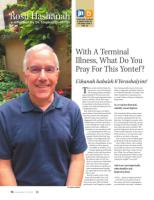
a reflection by Dr. Stephen Goldman
SCAN PAGE TO READ
A SHORT STORY BY
GOLDMAN FROM A
1989 JN.
With A Terminal
Illness, What Do You
Pray For This Yontef?
L’shanah haba’ah b’Yerushalyim!
T
hese words end the final clos-
ing s service every Yom Kippur.
Our fasting (maybe) and pray-
ing are fini
finished. We have just com-
pleted 10 of
o the most important days
on our cale
calendar. We do this, hope-
fully, every year. Each year we pray to
be inscribed
inscribe in the Book of Life for
another yea
year and ask forgiveness for
a multitude of sins.
But, what
wha if you knew you had a
good chanc
chance of not being around for
the next y yontef ? Not metaphori-
cally, but what if you had been
diagnosed
diagnose with an illness that may
indeed take
your life in less than
t
a year? Would the words of your
prayers then have a different
meaning,
meanin or any meaning at all?
I am speaking about this con-
cept because
I am one of those
b
people.
peopl Shortly after last Yom
Kippur,
Kipp I was diagnosed with
a for
form of ALS that does not
give me a long lifespan. It has
robbed
me of my speech,
rob
my ability to swallow, of my
trumpet
playing, of blowing
tru
shofar
shof at shul, and forced me
into ea
early retirement. I see my
body slowly
s
withering away as
the dis
disease takes its toll. Yes,
there is a great new medication
that sl
slows down the progres-
o the disease, and there is
sion of
some amazing research going
on, esp
especially in Israel, that may
offer a cure.
th reality is this: I, like
But the
ot
many other
people, have a ter-
ill
minal illness.
I pray that I will
mor time with my family
have more
and friend
friends. And I began to wonder
Dr. Stephen Goldman
12
September 6 • 2018
jn
how, being acutely aware of my mor-
tality, to approach a holiday centered
on teshuvah, [literally “a turning” and
often translated as repentance] as
we read a litany of prayers asking for
forgiveness.
So, we can hear from God,
salachti, you are forgiven.
The meaning of these prayers, how-
ever, start to shift when you realize
you may be speaking them for the
last time. You begin to wonder what
are you praying for? Not why you are
praying, but do these familiar words
now mean the same as before? We
pray for forgiveness from our sins, to
work toward teshuvah. To become a
better person, to not miss the mark
as often as we have in the past.
And we pray to be inscribed again
in the Book of Life for another year.
Time really is short. I am coming
to the end of mine. Do these words
even hold any value to me? Not from
bitterness, but from a sense of won-
der: What if we all knew that our
time is growing short? What would
our focus be in prayer? More time?
Asking for insight? Less pain?
And, to me, most importantly,
what should we ask
forgiveness from.
Al Chet … grant us forgiveness from
… The list in every prayer book is
the same, and some congregations
even add their own take, a modern