
looking back
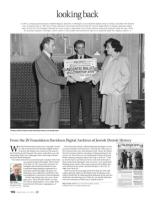
In 1950, a newly passed provision enabled religious observers in Michigan to cast absentee ballots when a holiday coincided with Election
Day. As Election Day in 1950 fell on Rosh Hashanah, the Greater Detroit B’nai B’rith Council aided efforts to register absentee ballots.
Here, B’nai B’rith Vice President Maxwell M. Lowe accepts a registration from Shirley Ostrow as Bernard Friedman holds the sign. While
this provision passed in Michigan, Jewish voters in some states were denied the right to an absentee ballot for religious reasons. •
Courtesy Leonard N. Simons Jewish Community Archives, Lowe Family Papers.
From the JN Foundation Davidson Digital Archives of Jewish Detroit History
W
ith Rosh Hashanah just days away, I thought I would
do a bit of research into the Davidson Digital Archives
to see how the holiday was covered over the years by
the JN and the Jewish Chronicle. The answer is that there was a lot
of reporting. There were 5,920 pages with a wide range of stories
that cited “Rosh Hashanah.”
The earliest entry that was more than just a mention of the term
was a poem by Morris Rosenfeld, “Pity, O Israel,”
in the Sept. 14, 1917, issue of the Chronicle. An
immigrant from Poland, Rosenfeld was also
a tradesman before gaining a reputation as a
noted poet and literary figure. His poem was
dedicated to Jews suffering in World War I and
was published in connection to Rosh Hashanah.
Another interesting early entry was a front-
page story, “The Call of the Shofar,” on Sept.
19, 1919, by Rabbi Judah L. Levin, rabbi of the
Mike Smith
Detroit Jewish News
United Jewish Orthodox Congregations of
Foundation Archivist
Detroit.
106
September 6 • 2018
jn
There have been plenty of Rosh Hashanah greetings over the
years from families and businesses. The Sept. 26, 1924, issue of
the Chronicle had a nice advertisement from “Henry the Hatter,
Detroit’s Exclusive Hatter,” extending “cordial greetings for the
season.” Or “Don’t Be Late,” the Ambassador Curtain, Rug and
Shade Cleaning Company urged in the Aug. 8, 1945, JN — that
is, don’t be late to send all your front-room cloth materials to
them before Rosh Hashanah. And, of course, I very much liked
thinking about results of the soup recipes for the holiday that
were featured in the article “Jewish Penicillin,” in the Oct. 12,
2006, issue of the JN.
There was also the front page of the JN for Sept. 22, 1944, with
a photo of Jewish soldiers in the British Army in Palestine in the
midst of World War II, celebrating Rosh Hashanah. By the time the
shofar blew the following year in 1945, the war and the Holocaust
were over. It had been a better year. L’ shanah tovah! •
Want to learn more? Go to the DJN Foundation archives,
available for free at www.djnfoundation.org.
Scanned image of the page. Keyboard directions: use + to zoom in, - to zoom out, arrow keys to pan inside the viewer.
September 06, 2018 - Image 106
- Resource type:
- Text
- Publication:
- The Detroit Jewish News, 2018-09-06
Disclaimer: Computer generated plain text may have errors. Read more about this.