

Jewish Contributions to Humanity
# in a series
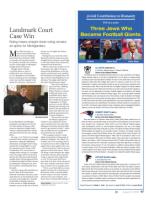
Landmark Court
Case Win
Three Jews Who
Became Football Giants.
Ruling means straight-ticket voting remains
an option for Michiganders.
M
ary Ellen Gurewitz, a
lawyer at the Detroit law
firm of Sachs Waldman
and Detroit Jews for Justice (DJJ)
co-founder and steering commit-
tee member, recently won a historic
case for voting rights in Michigan’s
straight-ticket voting issue.
Straight-ticket voting is
a tool that allows a voter to
swiftly select every Democrat
or every Republican on the ballot
by just checking one box. Michigan
voters have had the straight-ticket
option for 126 years. A law passed
focuses on civil rights for African
Americans.
During the case, Gurewitz estab-
lished that African Americans used
straight-ticket voting at a much high-
er rate than white voters: 80 percent
compared with 50 percent.
“African Americans mostly vote for
Democrats,” she added. “Evidence
showed that Republicans in the leg-
islature and the party were pushing
the elimination of straight-ticket vot-
ing in order to help Republicans win
elections. The judge ruled that the
law had a discriminatory intent.”
Three and a half years
ago, Gurewitz, a lifelong
Detroiter who lives in
Palmer Woods, co-found-
ed DJJ with Andy Levin
and Rabbi Alana Alpert.
She has served as presi-
dent of DJJ’s fiscal sponsor
Congregation T’chiyah
and serves on the DJJ fun-
draising and steering com-
mittees. She specializes in
union-side labor law and
political and election law
at Sachs Waldman.
Mary Ellen Gurewitz
“The Secretary of State
has filed an appeal, but
I think it’s very unlikely it will suc-
by the Republican-led Michigan
ceed,” said Gurewitz, who adds that
Legislature and signed into law by
Michigan’s November election ballot
Gov. Rick Snyder in January 2016
needs to get printed by Sept. 7, allow-
aimed to eliminate straight-ticket
ing very little time for an appeal to
voting. A judicial injunction shortly
proceed before the deadline.
after prevented the law from taking
“This is going to protect voting
effect.
On Aug. 1, U.S. District Court Judge rights for hundreds of thousands of
people in Michigan,” she added. “It’s
Gershwin Drain issued a permanent
a terrific win. It’s so exciting, and it’s
injunction, ruling that Michigan’s
so important to be able to fight back
elimination of straight-ticket voting
against forces that suppress the vote.”
violated the Voting Rights Act and
Gurewitz says her work on the case
the equal-protection clause of the
appeals to her Jewish values. “What
Constitution. The case preserves
I’m doing is advocating for the rights
straight-ticket voting as a civil rights
of minority citizens, protecting and
issue. The judge said in his decision
trying to advance their opportunity
that the law that previously banned
to vote. To the extent that I have
straight-ticket voting suppressed the
constitutional rights of black citizens been able to do that, I have advanced
the cause of justice, and that’s what I
by making the voting process more
have wanted to do in my legal career.
time intensive, deterring folks from
“This is a case that affects so many
the polls.
Gurewitz, along with Mark Brewer, people who have for so long been at
the bottom of the economic ladder
former chair of the Democratic
National Committee, has been a prin- in this country,” she said. “I think it
cipal attorney on the landmark court advances the cause of justice, and
that’s what we should all be doing.” •
case that was brought for a number
of plaintiffs, including Common
Valeriya Epshteyn of Detroit Jews For Justice
Cause and the A. Philip Randolph
Institute, an arm of the AFL-CIO that contributed to this story.
Al Davis
Robert Kraft
Arthur Blank
AL DAVIS (1929-2011).
b. Brockton, Massachusetts. d. Oakland, California.
Owner of the Oakland Raiders.
The longtime owner of the Raiders franchise was born on July 4 and died on Yom Kippur,
fittingly dramatic dates for a man with a remarkable life. From his days as a college student
at Syracuse, Davis was fascinated by football. He wasn’t on the varsity team, but snuck into
practices to take notes. After college, Davis went on to become a coach for a U.S. Army
football team in Virginia, and eventually worked his way up to becoming an assistant coach
and recruiter at USC. After a brief stint with the Los Angeles Chargers, the startup Oakland
Raiders (he pronounced it Raid-uhs) hired Davis as a head coach and general manager for
two years. He was appointed the American Football League’s commissioner, and helped
shepherd its merger with the National Football League. Then, he bought partial ownership
with the Raiders, soon becoming the face of the franchise. Under his direction the Raiders
became one of the most successful pro sports teams, winning three Super Bowls from 1967
to 1985. Davis’s silver-and-black, pirate-logo Raiders in many ways resembled him—resistant
to authority and prone to a rebel attitude. That outlook on life also made him a civil rights icon
for the NFL. He refused to allow Oakland to play a preseason game in segregationist Mobile,
Alabama, and he was the NFL’s first owner to hire a black head coach, Art Shell.
ROBERT KRAFT (1941-).
b. Brookline, Massachusetts.
Owner of the New England Patriots.
Born and raised in an Orthodox Jewish family, Robert Kraft’s father wanted his son to
become a rabbi. A young Kraft, though, as he has told it, loved football too much and couldn’t
focus enough to be a clergyman. Today, Kraft is one of the National Football League’s
most accomplished owners, an uber-successful businessman, and one of the largest
philanthropists towards Israel. Kraft grew up a New York Giants fan (before the New England
Patriots existed), and began his very successful career in business, not football—acquiring
the packaging company Rand-Whitney Group and creating Internal Forest Products. His
pursuit of the New England Patriots began in 1985, when he purchased an option on the
land surrounding the field where the Patriots played. Three years later he purchased the
stadium, and, finally, in 1994, he bought the team for $172 million. During Kraft’s reign, the
Patriots have been the NFL’s best team, reaching the Super Bowl eight times, winning five,
and having a winning record in 21 out of 23 seasons. In addition to giving millions of dollars
to Jewish causes in the U.S. like Jewish Federations, Hillels and Yeshiva University, Kraft is
a major supporter of the state of Israel. He has brought many New England Patriots players
to Israel built the Kraft Family Stadium in Jerusalem, and created the Israeli Football League.
ARTHUR BLANK (1942-).
b. Sunnyside, New York.
Owner of the Atlanta Falcons.
Owner of the NFL’s Atlanta Falcons and Atlanta United soccer team, co-founder of The
Home Depot, philanthropist—what hasn’t Arthur Blank done? Born and raised in Queens,
Blank got his start in the business world as an accountant, ran a drug store, and met Bernie
Marcus while working for a home improvement center. Both were fired, but then co-founded
Home Depot—a decision that made them both billionaires, and gave Blank the wherewithal
to purchase the Falcons in 2002. Blank’s Arthur M. Blank Family Foundation has donated
millions of dollars to charitable causes, including local, national and Israeli organizations as
well as institutions providing medical care for children.
Original Research by Walter L. Field Sponsored by Irwin S. Field Written by Jared Sichel
jn
August 30 • 2018
17