

arts&life
film
BlacKkKlansman
Spike Lee’s new
fi lm is required
viewing about anti-
Semitism today.
EMILY BURACK JTA
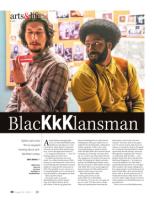
ABOVE: Adam
Driver and
John David
Washington in
BlacKkKlansman.
48
August 23 • 2018
jn
A
bout halfway through Spike
Lee’s new film BlacKkKlansman,
I pulled out my phone to write
a line down. Adam Driver’s character,
a Jewish cop named Flip Zimmerman,
says “I never thought much about it”
— “it” being his Jewishness — “now I’m
thinking about it all the time.”
I couldn’t get that line out of my
mind. As a white Jewish person, Flip’s
journey to self-awareness in the face of
overwhelming anti-Semitism resonates
deeply for many Jewish Americans in
2018. The parallels to our current era
is something Spike Lee is conscious of,
and referential to, throughout the film.
Minor spoilers ahead.
Let’s back up for a second:
BlacKkKlansman, which opened
Aug. 10 in Metro Detroit, is the
tale of Ron, a black cop (played by
Denzel Washington’s son, John David
Washington) who goes undercover to
infiltrate the Ku Klux Klan, calling their
hotline using his “white voice,” and
eventually getting to speak to David
Duke himself. When he’s invited to Klan
meetings, he obviously can’t just show
up. So, a white cop, Flip (Adam Driver),
who happens to be Jewish, becomes his
body. The pairing of a black cop and a
Jewish cop infiltrating the Klan seems
like the set up for a dark buddy comedy.
And while there were many laugh-out-
loud moments, the film addressed its
subjects with nuance and care.
After Flip attends a Klan
meeting and returns to the
police office for a debriefing,
he tells Ron, “For you it’s a crusade, for
me, it’s a job.” Yet, Ron tries to shake
Flip into realizing that thwarting the
Klan’s plan is also in his own best
interest. “You have skin in the game,
too!” he shouts at him. Flip, however,
refuses to accept his “skin in the game.”
For so long, he had identified as white,
ignored his Jewish identity, and went
through life completely fine. Until he
is confronted with the Klan — who
deeply, deeply hate Jews and deny the
Holocaust happened — he refuses to
accept his Judaism. Yet, after Flip is
repeatedly threatened by an overeager
Klan member who keeps calling him a
Jew (suspecting he is Jewish because he
kind of looks like a Jew) and threatens
him to take a “Jew lie detector test,” it
finally hits home for Flip that he will
never be white. Flip’s journey to Jewish
self-acceptance in BlacKkKlansman is a
powerful one.
This is not to say BlacKkKlansman