

views
Ask Attorney
Ken Gross
for openers
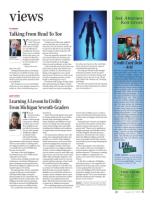
Talking From Head To Toe
Y
Sy Manello
Editorial Assistant
ou are a piece of
work.” Have you
ever heard this
observation? Usually
it is not offered as a
compliment. However,
if you were to consider
all the body parts, you
would note that they
do figure prominently
in our everyday con-
versation.
Top to toe we are
pieces of work.
Feeling frustrated about something?
No doubt you would like to brain some-
one. Maybe you have even declared that
you are tempted to beat their brains out.
Well, let your hair down and tell us how
you really feel!
Not seeing eye to eye on something?
Well, you can vent and give someone an
earful; or, if he’s not forthcoming, toss
him out on his ear.
A project you really enjoy might be
one you feel that you can sink your
teeth into. Do not, however, mouth off
to anyone on the job or you may find
that a tongue-in-cheek response will
get you out the door.
If you are especially optimistic, then
you may find that you can keep your
chin up in most adverse circumstanc-
es. It may be harder to do, though,
when you end up taking it on the chin.
A rule of thumb may be that when you
lend a hand or keep your hand in on a
project, it will be as a shot in the arm.
Being overly aggressive is not a good
idea, however. Extremes are to be avoid-
ed such as keeping someone at arm’s
length or elbowing your way in.
It is better to lift a finger to help rather
than just keeping your fingers crossed
that all will go well. You need not feel the
need to break your back at something,
but when your back is to the wall, think
twice. You do not want to be a part of
something that goes belly up.
You may get cold feet at the thought
of having to perform, but if you know
someone who is involved in theater and
is about to go on, be sure to say, “Break
a leg” (that is the “theater way” of saying
good luck).
See there. You spend each day carrying
with you a body of expressions to enliven
your conversation. •
guest column
Learning A Lesson In Civility
From Michigan Seventh-Graders
T
o be an
American today
is to live in a
world in which people
who practice unfamil-
iar faiths are our next-
door neighbors and
our fellow classmates.
Gail Katz
Yet, too often, people
of different religions
are afraid of each
other and that fear
can lead to prejudice,
discrimination and sometimes violence.
When we know little or nothing about
the religious beliefs of our neighbors and
we classify them as the OTHER, they
become our enemies.
Our hope is that with Religious
Diversity Journeys, the OTHER will be
replaced by our friend.
In these times of public incivility and
intolerance, a Southeast Michigan pro-
gram is helping seventh-graders learn
about their neighbors’ religions by visit-
ing their places of worship.
By learning about what is unfamiliar,
our goal is that our seventh-graders
will help build bridges among the
diverse people of our community and
make Metro Detroit a better place. The
Religious Diversity Journeys program
also helps to prevent the bullying that
sometimes occurs in middle schools.
It’s a model that many adults could
learn from.
About 700 seventh-graders from pub-
lic and parochial schools across Metro
Detroit study Christianity, Judaism,
Islam, Hinduism and Sikhism at local
houses of worship. The visits provide
a base of knowledge about each faith,
including their holidays and traditions,
to dispel myths and stereotypes about
them.
On each journey, students meet with
clergy and congregational leaders who
provide an overview of that religion’s
beliefs and practices, and answer their
questions ranging from marriage cus-
toms to religious symbols. They have
an opportunity to see religious artifacts
and try on some traditional garments —
such as turbans worn by some Sikhs and
head scarves worn by some women who
follow Sikh and Muslim traditions. The
young people usually work on a service
project together and enjoy a lunch with
the traditional food of that religion.
For many students, it is the first visit
to a house of worship outside their own
faith. Recently, one parent urged her
daughter not to attend the session at a
mosque, but her daughter chose to par-
ticipate and later reassured her mother
that there was nothing to fear from
Islam. What they learn provides a basis
to stand up to religious stereotypes.
The concluding session each academic
year is a visit to the Detroit Institute of
Arts to look at religion in art, as well as
a trip to the Holocaust Memorial Center
to learn what can happen when hate and
fear rule.
During the past 15 years, the program
has received very positive reviews from
students, parents and teachers. One
parent said, “Thank you for guiding our
daughter through a remarkable activity
with the Religious Diversity Journeys
experience. She had been very curious
about the different religions and tradi-
tions. I’m grateful she had this exposure
and will do my best to keep this going for
our family.”
When participants were asked how
they could use their new knowledge to
promote greater tolerance at school, one
student answered, “If someone is making
fun of a religion or making bad com-
ments, I can correct them and use what
I know.”
As the first coordinator of Religious
Diversity Journeys, I was surprised and
pleased several years ago when a young
woman approached me and said, “I
was in your Religious Diversity Journeys
program a number of years ago, and it
changed my life!” She is now involved in
diversity initiatives and is making a dif-
ference in our world. •
Credit Card Debt
- Ark!
Here we go again. Credit card debt is
higher now than it was in 2008 - when
the Recession virtually stopped the
world. When that happened, the banks
shut down available credit lines on credit
cards and equity lines by sending letters
to their users after they had already shut
down the use of the credit! Millions of
people were left with no cash in savings
and no available credit on their cards
and equity lines. There are two stories
here. First, and most important - if you
are carrying $30,000 or more of credit
card debt, paying 15% - 30% interest
- you are wasting valuable retirement
money because you're in the credit card
trap. You keep paying the minimums
or a bit more, but the balances never
go down - they usually go up - because
you have no cash left to buy things after
making your payments - so you "Charge
LW7KLVLVWKHELJJHVWÀQDQFLDOPLVWDNH
you can make. Multiply your credit card
balances, by 2.5%, then by 12 (months),
and then by 10 (years) and that is the
amount of money you will have wasted.
(i.e. 50,000 x 2.5% x 12 x 10 = $150,000)
- and that is without earing any return on
your money. The second story is more
telling - what do you think will happen
when economy cools down? Call us
today - we will help you get out of the
Credit Card Trap and preserve your
ÀQDQFLDOIXWXUH
THAV GROSS has been solving
its clients’ business, tax and fi nancial
problems since 1982. Be sure to tune
in to the Law and Reality – Sunday
mornings at 11 AM on TV20.
thavgross.com lawandreality.com
Gail Katz is a member of the education committee
of the Interfaith Leadership Council of Metropolitan
Detroit.
30150 Telegraph, Suite 444
Bingham Farms, MI 48025
jn
August 16 • 2018
5