

arts&life
exhibit
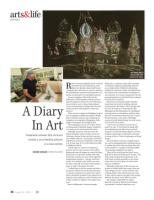
THIS IMAGE: Abby in
Moscow, 2005. LEFT:
Aronson in the studio.
R
A Diary
In Art
Federation adviser Bob Aronson
reveals a soul-feeding passion
in a new exhibit.
SUZANNE CHESSLER CONTRIBUTING WRITER
36
August 16 • 2018
jn
obert Aronson regularly travels to Israel
and other faraway destinations with
distinctive Jewish cultural and histori-
cal significance. But when it comes to pictures
for remembrance and personal expression, he
prefers an alternative to smartphone photos.
Aronson, longtime CEO of the Jewish
Federation of Metropolitan Detroit and now
chief development adviser for the Federation,
draws what he sees in those distant places
as the starting points of images that become
artistic projects reflecting his creative per-
spective.
When Aronson returns to Michigan, he goes
into an equipment-filled art studio at Wayne
State University and uses the renderings as
templates for serigraphs, lithographs, colla-
graphs, monotypes and intaglio prints.
The techniques are not new to him. There
are thousands of finished images completed
over many years and stored in his home.
Although Aronson’s work has been dis-
played alongside works of other artists spe-
cializing in prints, he has not had a one-per-
son exhibit until now. “Landscape as Portrait”
will present a 50-year retrospective of his proj-
ects. It runs Aug. 25-31 at the Galerie Camille
in Midtown Detroit.
“It feels like I’ve come to an important
point in my life,” says Aronson, who will be
displaying some 60 images as curated by Mary
Rousseaux, a local artist, college instructor,
his mentor and the one who encouraged the
independent initiative. “I always wanted to
do the art I wanted to do, which is an artis-
tic diary of my life. It’s based on the people I
know as well as the places I’ve been.
“I asked Mary to be the curator and select
the pieces without my involvement because
I wanted an outside eye to determine which
pieces should be included. I also asked her to
organize and catalog my work. It’s taken close
to four months to organize it by subject and
year.”
Born in Milwaukee, Aronson thought
about art as a primary career after winning
a Scholastic magazine scholarship when he
was in high school. While the scholarship
resulted in a bachelor of fine arts degree from
the School of the Art Institute of Chicago, he
soon learned, as so many young artists do, the
earning limitations in the field, but he refused
to let go of his creativity.
His artistry continued outside of profes-
sional hours devoted to building a Jewish
community for the future. After starting with
an entry-level job as a clerk-typist for the
Milwaukee Jewish Federation, he established
a strong career as a fundraiser and has taken
that role in innovative directions for 42 years.
He also teaches a University of Michigan
course in Jewish philanthropy, the only course
of its kind in the country.
“I never lost my desire or need to be an
artist,” he says. “It went hand-in-hand with
my fundraising work. Most of my artwork,
except for occasional human figures, involves
imaginary landscapes with human elements
in many of them. I look at landscapes as living
things.”
Aronson believes that his completed proj-
ects can be distinguished by markings that go
in similar directions. Most etchings take four
or five months to complete with many differ-
ent techniques applied to the plates.
“Much of the work from the time I was a
little kid is about the Holocaust,” he says. “The
other major images that repeat have to do
with Israel as based primarily on the many,
many times I’ve been there as well as time
spent on a kibbutz.”
Although a large part of the Aronson col-
lection is in black and white tones, there are
color images as well. A series of three color
etchings reflects sites experienced on a trip
to Kiev, where respect was paid to the people
killed by the Nazis at the Babi Yar ravine.
One image is of the Babi Yar statue
based on a poem by Russian poet Yevgeny
Yevtushenko. Another brings into view