

looking back
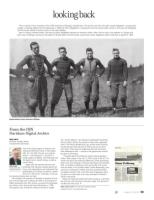
This is a photo of four members of the 1909 University of Michigan football team. The second man from the right, Joseph Magidsohn, is particularly
notable. A starting halfback for the Wolverines in 1909 and 1910, Magidsohn is recognized as the first Jewish letter winner at U-M and, per Wikipedia,
the first-known athlete to refuse to play on the High Holidays.
Born in Tukums, Russian Empire, now part of Lativia, Magidsohn became an American citizen. After U-M, he was a civil engineer in Chicago and
then lived in Michigan, serving on the boards of Temple Beth El and the Jewish Community Center. Magidsohn died in Oak Park at age 80 in 1969.
Bentley Historical Library, University of Michigan
From the DJN
Davidson Digital Archive
MIKE SMITH
DETROIT JEWISH NEWS
FOUNDATION ARCHIVIST
One of the cultural gems in Detroit is the
Holocaust Memorial Center in Farmington
Hills. Yes, the HMC focuses on a singular
theme — the Holocaust — and this is a
tough subject to address. The Holocaust was
the darkest era in Jewish history, as well as
world history.
I agree with the premise that we must
Mike Smith
remember
and educate ourselves about evil
Detroit Jewish News
times,
and
organizations and individuals that
Foundation Archivist
perpetrated such evilness to prevent a repeti-
tion of it in the future. A tall task, to be sure,
but ignoring history does not help.
For archivists, the question of whether to preserve the his-
tory of evil things such as slavery, the KKK or the removal of
Native Americans from their homes, as well as the Holocaust,
has historic roots. During the French Revolution in 1789,
the question was: Should the historical records of royalty,
the “Ancien Regime,” be retained or destroyed? Should the
French citizens archive the records of those who oppressed
them? The French decided that, yes, archive those historical
records because they are part of history and we can learn
from them. They took one additional step that Americans
have followed as well — records of the government should
be open to all citizens.
I thought about the Holocaust and the above question
when I read a piece in the July 17, 2001, issue of the JN. The
article was about the Holocaust Memorial Center purchasing
land for its new building on Orchard Lake Road in Farmington
Hills; it included a rendering of the new facility. This center
was the dream of its founder, Rabbi Charles Rosenzveig, who
was born in Ostrowiec, Poland, and who survived the Nazi
occupation himself. And, it was the result of generous fund-
ing and much hard work from many members of Detroit’s
Jewish community.
Today, the Holocaust Memorial Center stands as a reminder.
No one who visits and learns will soon forget. The archivist in
me likes this very much. •
Want to learn more? Go to the DJN Foundation archives,
available for free at www.djnfoundation.org.
jn
August 9 • 2018
58