

jews d
in
the
dear debra
A Lonely
Mom
S
end your questions to
deardebra@renmedia.us.
DEAR DEBRA,
Debra Darvick
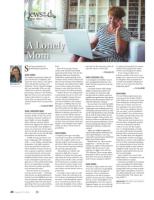
My daughter graduated college last
year and moved to California. She
enjoys her work, shares a cute apart-
ment with friends and has a new
boyfriend. I know I should be happy,
but I am miserable. When we talk,
I battle not to make her feel guilty
for leaving. I keep our conversations
light, but I am so very sad and frus-
trated at how hard it is to stay in
touch. How can I get past this and
celebrate what I know are good mile-
stones?
— Lonesome Mom
DEAR LONESOME MOM,
Good for you for quelling the guilt
monster. Guilt is a sure way to cre-
ate distance. Instead, continue to
keep it light. Let your daughter
share what she chooses and be
interested. Support her choices and
voice your pride. Your daughter is
aware, on some level, of your pain.
Give her the gift of knowing you are
OK so that she can live her life fully
and without second doubts.
A child moving out and on can
leave a huge gap. Fill it with good
stuff — a new hobby, volunteering,
meditation. You didn’t mention
if you are married or if there are
other children at home, but if you
have a spouse or partner, cultivate
a new joint interest. Create some
new special experiences with the
child(ren) still at home. If you need
to see a therapist to process your
grief, do so. Our local Jewish Family
Service is a good place to begin.
Your sorrow is normal. Just don’t
let it become the norm.
Now let’s move to on your let-
ter’s last seven words — “celebrate
what I know are good milestones.”
Exactly. You have fulfilled your mis-
sion and raised a fully functioning
young adult. That’s the rub about
parenting. We do our job and then,
darn it, they go off and live their
26
August 9 • 2018
jn
lives!
Some 20 years ago I heard
author and scholar Daniel Matt
speak about his book, God and the
Big Bang. Matt was sharing the
Kabbalistic understanding of the
creation of the world in which God
(the Ain Sof, without end) withdrew
God’s great and endless Divine light
so as to leave a place for human
beings to exist and thus have the
space to grow into their potential.
I believe there is an analogy here
to parenting. You are in every cell
of your daughter’s being. For her
to grow into her full potential,
you must withdraw a bit and give
her space, confident that in your
absence, you are still present. You
have left within her the light of your
love, your lessons and example, a
lifetime of shared experiences. Do
what you need to fill the absence
with positive emotions and actions
while maintaining a respectful con-
nection. You never know what may
happen. Your daughter just might
return one day. LA real estate is
prohibitive.
DEAR DEBRA,
A couple of years ago I was diag-
nosed with a rare form of abdominal
cancer. We caught it early; I went
through surgery and treatment and
all is well. Other than a yearly check-
up, I have put the experience behind
me and am enjoying my life.
The problem is a relative who
remains in high-drive concern.
Whenever we speak, she asks point-
edly about the cancer and how I am
doing. I have told her I have stricken
the word from my vocabulary, and I
have moved on and no longer want
to discuss it. I don’t know how to be
any clearer, and she doesn’t seem to
get the hint.
I no longer want to take her calls
because I know she will bring it up.
It’s not that I am putting my head in
the sand. I lived through the experi-
ence, received the necessary treat-
ment and, thankfully, it has worked.
I now choose to focus on the living
part and not the experience. How do
I get this relative to back off ?
— Choosing Life
DEAR CHOOSING LIFE,
I can imagine no healthier way to
have managed the hand you were
dealt. You have moved on; your rela-
tive has not.
I see three choices with varying
degrees of personal comfort. You
can continue to screen her calls;
but given she is a relative and not a
peripheral acquaintance, that option
falls into the throwing-the-baby-out-
with-the-bathwater category.
You can state even more forcefully
in person or via a note, i.e., “Relative,
I appreciate your ongoing concern. I
am healthy and have moved on with
my life with gratitude I came through
this as well as I have. Please do not
bring it up again. When you do, you
focus on a time in my life that is not
part of my present experience. If you
cannot manage this, please under-
stand that I will have to limit our
contact.”
Again, you might be approach-
ing the baby and the bathwater, but
you’ve given Relative a very clear
expectation and outcome should she
ignore your stated wishes.
Behind door No. 3 lies one last
suggestion — humor her and
change the subject. When Relative
begins with the concern, inter-
rupt her in a light voice and say,
“Oh, Relative! There you go again.
Remember? We’ve moved on from
that! Now, who do you think this
year’s Oscars nominees will be?”
DEAR DEBRA,
I became a single mother by choice.
It was not a decision I made lightly,
and is one that has brought me
untold joy. There is frustration
and pain as well when strangers
assume, because my hair is graying,
that my 3-year-old daughter is my
granddaughter. Last week, when it
happened again, my eyes welled up
with tears and I was too choked up
to respond. Fortunately, the woman
realized she’d stepped into tender
territory and changed the subject.
It was a long road for me to
become a mother, and I am so very
happy to be a mom and to be raising
my daughter. Why do people have
to make such hurtful assumptions?
What can I do to prevent this from
happening again?
— I'm the MOM
DEAR MOM,
I do not think people (most, any-
way) mean to be hurtful. While I
don’t think you can prevent anyone
from making the assumption that
hurts you so much, you can use
the exchange to do some educat-
ing. “This is my daughter, Joyous,”
you can reply, “I am so grateful to
be her mother.” You can even turn
the tables and ask if they have any
great parenting tips to share.
What you do want to prevent is
the hurt these misguided assump-
tions are causing you and that
work is on you, not the inquisi-
tors. A caring therapist can help
you mine and release the painful
feelings these comments provoke.
Also, consider that your daughter
is a bystander in these exchanges.
What do you want to role model for
her? Use these misunderstandings
as a demonstration of your love for
her and the depth of your mother/
daughter bond. Scoop her up and
hug her exuberantly when you set
the record straight.
Now, readers. Let’s use I’m the
MOM’s letter as a reminder to us all
to think before we speak.
Gray hair and baby do not always
mean a grandparent relationship.
Next time you see a woman and a
young child, and you want to gush,
don’t make assumptions. Focus on
the child and guide your comments
in that direction. “Oh, what a dar-
ling child!” •
Debra Darvick is the author, most recently, of
We Are Jewish Faces.