

views
essay
essay
continued from page 5
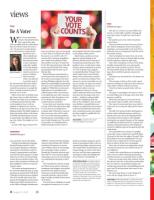
Be A Voter
W
hen I was in elementary
school, I cherished Election
Day. I spent those days
with my bubbie and she would always
take me with her when she went to
vote. The precincts in drab elemen-
tary school gyms or musty church
basements were
often underlit and
overcrowded, but
they hummed with
a sense of purpose
and pride. I pulled
on the silly-looking
curtains that drew
closed to protect our
Alicia Chandler
privacy. I relished
those moments
when I was allowed
to crowd in next to
her and watch her fill out her ballot.
On occasion, kind election workers
would let me practice on sample bal-
lots as I waited anxiously to turn 18
and cast my own vote.
Fifteen years after my bubbie’s pass-
ing, I have come to realize that these
Election Day rituals were as important
as sitting around her kitchen table
as she taught me how to roll out
rugelach or sitting on her couch in
Oak Park as she gave me my first set of
knitting needles. My bubbie taught me
about our Jewish culture in the forms
of Yiddish and baked goods, but, just
as importantly, she taught me about
our civic culture. She taught me to be
a Voter.
As next week’s Aug. 7 primary elec-
tions are only days away, are you going
to vote? There is an 80 percent chance
the answer is no. In 2014, only 17.4
percent of the voting age population
cast a ballot in the primary. While
that number went up to 41.6 percent
for the 2014 general election, that still
means more than half of the voting
age population did not show up on
Election Day.
Brian Dickerson commented in a
recent Detroit Free Press editorial, “If
the world is run by people who show
up, then Michigan residents have del-
egated the responsibility for governing
our state to the small fraction of their
neighbors.” While there are electoral
implications, I am troubled by the
cultural impact of low voter turnout.
A most glorious part of the American
experiment is that, through our vote,
we are all given ownership of our
country’s present and future.
So now that most American citizens
over age 18 have been given their right
to vote, what are we doing? We’re
tossing it aside. What does it mean to
throw away our vote as if it is value-
less? Are we like absentee landlords,
abandoning our responsibility to take
care of what belongs to us? Do we feel
so powerless, or so disillusioned by
dysfunctional government, that we
have forgotten that this system grants
us, the people, all the power?
Adam Grant, a professor of man-
agement and psychology at the
Wharton School of the University of
Pennsylvania, posits that part of the
problem is how we talk about voting.
Voting is almost exclusively an action,
“Go vote.” Instead, Grant suggests
we should talk about “being a Voter,”
which makes it part of our identity.
Being a Voter means that we partici-
pate in our democracy. Being a Voter
means we exercise ownership over our
city, our county, our state, our country.
Being a Voter is a patriotic act we are
blessed to be able to exercise.
Regardless of who you vote for,
make a statement about your identity
and values by choosing to take own-
ership — simply by casting a ballot.
Instead of complaining about the
lines or the candidates, show up with
your children or grandchildren and
embrace an opportunity our ancestors
could not have fathomed. Next week,
start a ritual that may be more impor-
tant than rugelach or gefilte fish. On
Aug. 7, be a voter. •
(ORR) be reunited with their families,
and how long will that take? Will the
travel ban be temporary or perma-
nent? Will the attack on the immigra-
tion and refugee system continue
through the November elections and
then end? Or is the American public
witnessing a new era of zero-tolerance
in recognizing the humanity in all of
us?
The United States must be remind-
ed of those times when it welcomed
immigrants and refugees who needed
protection from violence. Jewish
Americans, and all historically dehu-
manized minorities, must use their
legacy to fight on behalf of the human-
ity of others.
Everyone has an obligation to speak
out against the attacks on U.S. immi-
gration and asylum programs, and to
stand up and support others who are
experiencing danger and persecution.
The United States should embrace all
human beings, no matter where they
are from, with the same compassion
and respect, rather than falling back
into its history of xenophobia. •
Alicia Chandler is president of the Jewish
Community Relations Council/AJC.
commentary
continued from page 6
ture, paved the way for this policy.
During his presidential campaign,
Donald Trump promised “a total
and complete shutdown of Muslims
entering the United States until our
country’s representatives can figure
out what the hell is going on,” in spite
of the two-to-three year-long vetting
system that was already in place. The
power of the president to reframe reli-
gious affiliation as threat to national
security reigns.
The unease and apprehension of
the American public persists as many
questions go unanswered. Will all the
2,300-plus Central American children
who were forcibly taken from their
parents by Immigration and Customs
Enforcement (ICE) and turned over
to the Office of Refugee Resettlement
8
August 2 • 2018
jn
Kathie Friedman-Kasaba is associate professor
of international studies and Jewish studies in
the Henry M. Jackson School of International
Studies at the University of Washington. She
grew up in Oak Park. This article originally
appeared on the website of the Stroum Center
for Jewish Studies, part of the Henry M.
Jackson School of International Studies at the
University of Washington. Learn more and read
more articles by faculty and students at https://
jewishstudies.washington.edu.
After all, it is a treat to see your child as the
star of a woodsy idyll, complete with gaga pit
and ropes course. It makes me want to go to
camp.
But another part of me wishes the photos
weren’t there.
I don’t need them to know if my son is home-
sick. He’d be smiling for at least some photos
regardless, so it’s impossible to tell. And if he is
homesick, he’s not coming back until the end of
the session anyway.
I don’t need photos to know if my son is sick.
Last year he got a fever on the last night of camp,
and the infirmary called me right away.
And I don’t need photos to know if he’s doing
all right emotionally. If he were abnormally
upset, the camp would let me know. They’ve
seen thousands of kids just like him, most hang-
ing in there until their parents swoop in for
pickup.
The photos are not about him. The photos are
about us.
They reassure us that we have made a good
choice in sending our child away, that camp pro-
vides all the comforts of home and more.
They let us share our good choice with our
friends.
They give us something to do when we miss
our kids, filling a bit of the gap where their daily
presence would be.
What they don’t give us is the part I loved
most about camp: a healthy sense of mystery.
How many of our parents knew one-tenth of
what went on at camp, the silly and the memo-
rable?
The silly: The summer before ninth grade, at
a three-week residential summer school, my
friends and I were sick of the dining hall food
and ordered Chinese delivery. After illegally
meeting the car outside the gates of the campus,
we spilled beef with broccoli over a square foot
of grass, picked up the pieces with chopsticks,
moved to a different part of the quad and ate the
whole thing.
The memorable: One summer at campfire
camp, after many crooked arms and belly flops,
I learned to dive from the edge of the pool. Were
there photos of my accomplishment? No, and
the fact that I could choose to tell my parents
about it made it all the more meaningful.
Those days of mystery are largely gone, along
with the bowl haircuts and corduroy shorts of
my childhood.
I realize that camp photos are not going away.
They echo our culture of feel-good parenting,
and they reassure us constantly about our kids.
When my son gets home this weekend, I’ll ask
him about what I saw in the photos, particularly
the one where he was petting an alpaca and
another that showed him cannonballing into the
pool. And I’ll ask him about what wasn’t in the
pictures, too.
But I sure hope there are some things he’ll
never tell me, things I’ll never know. •
Sarah Cooper teaches eighth grade U.S. history and is the
author of Making History Mine: Meaningful Connections for
Grades 5-9. She lives with her husband and two sons just
outside Los Angeles. This essay is reprinted from kveller.com.