

“It is a martial art,
but it’s a non-
contact martial
art. There’s enough
violence in the
world. We don’t
teach kids how
to fight; we teach
kids how to play.”
Jewish Contributions to Humanity
#3 in a series
These Three
Jews Brought
Justice For All.
— BAZ MICHAELI
LOUIS BRANDEIS (1856-1941).
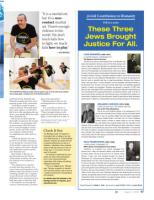
TOP TO BOTTOM: Baz Michaeli started learning capoeira at age 14 in his native Israel; students
train by doing ginga, a mainstay move of the Brazilian martial art.
and Detroit Prep. Michaeli and
Richards’ program has been incor-
porated as part of the curriculum.
“I told Baz I wanted to open a
studio in Detroit. These kids don’t
have many options, so when they
fall in love with something, they go
all in. I very quickly fell in love with
them,” Richards says.
She focuses on more than the
physicality of capoeira. She teaches
the students core principles such
as perseverance. Kids also learn
five to seven Portuguese words a
month. At the end of the school
year, students celebrate their
accomplishments with a belt cer-
emony.
“I think the parents were sur-
prised to see the kids running up
to me during the ceremony. Some
of the mothers came up to me say-
ing it’s really cool to have a female
role model who teaches martial
arts,” Richards says.
Katy Strader is director of
special projects at the Detroit
Achievement Academy. She says
the students were receptive to
capoeira.
“Our students love capoeira
so much that they practice it at
recess, home and sometimes in the
hallways when they think no one is
watching,” Strader says. “Capoeira
is more than just a bunch of hard
skills that can be measured by how
high they jump or hard they kick
— the students are learning self-
control, communication, personal
space and cooperation.”
Michaeli stresses they are not
teaching kids how to harm other
people.
“It is a martial art, but it’s a
non-contact martial art,” he says.
“There’s enough violence in the
world. We don’t teach kids how to
fight; we teach kids how to play.” •
To see capoeira in action, check out the
video at thejewishnews.com.
Check It Out
The Michigan Center for Capoeira in
Farmington Hills is hosting a four-day
event beginning Aug. 9. To acknowledge
students’ progress, the school will host
a capoeira performance as well as a
batizado, a celebration where students
receive a belt and move up in rank, on
Friday, Aug. 10. The event is free and
open to the public.
The batizado is bookended by work-
shops and rodas, where participants
form a circle around performing
capoeiristas while singing and playing
traditional instruments.
“This is our biggest event,” Michaeli
says. “We give recognition to students
who have been training, and we also do
a capoeira performance choreographed
with students.”
For details about the batizado or the
Michigan Center for Capoeira, go to
www.tmc4c.com.
b. Louisville, Kentucky. d. Washington, D.C.
The Supreme Court’s first Jew.
The first Jew to serve on the Supreme Court, Louis Brandeis was
raised and educated in Kentucky, lived with his family during a brief
move to Germany, and then attended and graduated Harvard Law
School at 20 as valedictorian. Brandeis opened a law firm in Boston
with one of his classmates, and received his bar without even taking
the exam. During his years in private practice, Brandeis fought against
the press’s invasion of privacy, monopolies, political corruption, and for labor issues like the
minimum wage. He even created the “Brandeis Brief”, a term now given to legal arguments
that rely more on scientific data than on legal documentation. Brandeis and Woodrow
Wilson held each other in mutual admiration, and the president nominated Brandeis to
the Supreme Court. He was in the court’s minority liberal wing, and repeatedly supported
freedom of speech and expression. Brandeis was generally a supporter of FDR’s New
Deal, but also ruled against FDR’s overreaches, declaring the National Industrial Recovery
Act unconstitutional and opposing Roosevelt’s court-packing scheme. Later in his life, he
was an active Zionist, bucking with most American Jews in his belief that the creation of a
Jewish state in Palestine was of vital importance. Nearly 80 years after his death, Brandeis’s
opinions (even in dissent) on individual liberty have had a profound impact on American law.
BENJAMIN CARDOZO (1870-1938).
b. New York, New York. d. Port Chester, New York.
One of the Three Musketeers.
One of the most influential justices in the development of U.S.
common law in the 20th century, Cardozo was born to a storied Jewish
family; in fact, his ancestors helped found the oldest congregation
in America, Shearith Israel. In the New York U.S. Court of Appeals,
Cardozo issued a number of original rulings on tort and contract
law, and enjoyed near universal support upon his nomination to the
Supreme Court by Herbert Hoover. Along with Brandeis and Harlan Fiske Stone, Cardozo
was part of the court’s liberal wing, also known as the Three Musketeers. In his personal
time, most of Cardozo’s volunteer activities were dedicated to the Jewish community. He
was a member of the Judean Club, an association of Jews when they were excluded from
most country clubs and other groups, and served on the American Jewish Committee and
the Zionist Organization of America.
FELIX FRANKFURTER (1882-1965).
b. Vienna, Austria. d. Washington, D.C.
FDR’s adviser turned Supreme Court justice.
Frankfurter, an immigrant from Austria, graduated from
Harvard Law in 1906, but received a dearth of job offers due to
his being Jewish. He took a job with the U.S. attorney, Henry
Stimson, in New York, who eventually brought him along to
Washington D.C. while serving as Secretary of War. Frankfurter
remained there until 1914, when he joined Harvard Law’s faculty.
For the next 25 years, Frankfurter built his reputation as a professor and commentator on
major issues of the day, including his opposition to the execution of Sacco and Vanzetti,
and to the Supreme Court’s striking down much of the New Deal. Frankfurter helped found
the ACLU, and was a close adviser to FDR, who nominated him to the Supreme Court in
1939. In his 23 years on the court, Frankfurter offered far more dissenting than concurring
opinions, and generally sided with the court’s progressive wing, although he had a strong
independent streak. He was hesitant to go against popular opinion, or rule against state
governments, lower courts and private economic parties.
Original Research by Walter L. Field Sponsored by Irwin S. Field Written by Jared Sichel
jn
August 2 • 2018
17