

jews d
on the cover
in
the
Quest For Kindness
Rabbi’s lifework is teaching us how to love and respect each other.
DAVID SACHS CONTRIBUTING WRITER
T
wenty years ago, Rabbi Tzvi Muller,
then a yeshivah student in Israel,
had a chance encounter on a
Jerusalem street that shook up his Jewish
conceptions — and forever altered the
course of his life.
This one brief conver-
sation with a random
stranger sent Muller on
a decades-long quest
to enhance the way
Judaism’s Golden Rule
— to “love your neigh-
bor as yourself ” — is
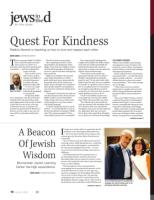
Rabbi Tzvi Muller
understood and applied
in everyday life.
On that day, Muller
met a backpacker who did not look par-
ticularly Jewish. He learned the young
man’s aging mother had recently revealed
to him that she was, in fact, a Jew and
a Holocaust survivor. In response, the
shocked son journeyed from Montana to
Israel to see if he could, in any way, con-
nect with his newly discovered Jewish
roots.
Thus far, he had come up empty.
After explaining his desire to learn
about Judaism, the backpacker asked
Muller, a New York-born rabbinic student
and himself the grandson of Holocaust
survivors, what he had been studying that
day in yeshivah.
Muller was crestfallen. His class had
spent all day learning how to distin-
guish which spots on an etrog made the
lemon-like fruit unfit for ritual use on
Sukkot. But, he thought, how could these
ultra-specific details be meaningful to a
man who knew absolutely nothing about
Judaism?
“Fortunately, I had an elective study ses-
sion that afternoon with a friend of mine,”
Muller recalled, “and we had studied
Chofetz Chaim, the book on lashon hara,
which details how not to harm others
with hurtful language.”
“I told the backpacker about it, and he
melted — he was literally blown away by
the Jewish emphasis on kindness,” Muller
said. “The young man gushed, ‘That’s
what Judaism teaches? It is so beautiful!’”
The young man left, feeling greatly
enlightened by Muller. But Muller walked
away from the incident profoundly dis-
turbed that he had nearly missed an
opportunity to inspire someone about the
richness of his Jewish heritage.
“I knew there are thousands and
thousands of details on how to observe
Shabbos, and hundreds involving the
etrog,” he said. “On the other hand, while
Judaism puts the ideal ‘love your neighbor
as yourself ’ on a pedestal, when it came to
how to actually practice it, it seemed just
an amorphous, generalized concept. It
occurred to me, why aren’t there so many
details guiding us on how to do it?
“I went to my rabbinic mentor who
encouraged me to do research,” Muller
said. “What I discovered blew my mind.
“The Talmud and its sister bodies of
work are saturated with teachings of kind-
ness. However, they were interspersed
throughout many areas and not organized
in a single place. But, once you know
they’re there and you put them all togeth-
er, you find a very rich body of knowledge.”
THE RABBI’S PASSION
While in Israel, Muller raised funding
and organized a team of scholars who
produced a seven-volume encyclopedic
work in Hebrew on the Jewish teachings
of interpersonal relations.
But he realized he had a much harder
task ahead of him — to make this knowl-
edge accessible to all Jews — not only to
scholars but also to those who cannot
even read Hebrew. “This is their heritage,
too,” he thought.
“What I discovered was a historic
opportunity to compile and convey the
Jewish concept of kindness that hadn’t
presented itself for many hundreds of
years.”
Thus, arose Muller’s mission. And he’s
continued this quest by teaching about
kindness for the past 11 years in Metro
Detroit, continually fine-tuning the com-
munication of this body of knowledge.
Muller created the non-denominational
Jewish Values Institute (JVI) to instruct
in the ways of kindness, ethics and mind-
fulness. One goal of his is to get funding
A Beacon I
Of Jewish
Wisdom
Blumenstein Jewish Learning
Center has high expectations.
DAVID SACHS CONTRIBUTING WRITER
t began as a modest effort to expand the Jewish
footprint in the Birmingham-Bloomfield area
— but it has the potential of becoming an edu-
cational gem for the entire Metro Detroit Jewish
community.
The new Hyman and Sonia Blumenstein Jewish
Learning Center, 36300 Woodward Ave., a half-mile
north of downtown Birmingham, is intended for
the educational enlightenment of all — no mat-
ter one’s level of Jewish knowledge, observance or
affiliation.
The Blumenstein Jewish Learning Center is
the brainchild of Eileen and Jerry Borsand of
Bloomfield Hills and was named in memory of her
parents who inspired Jewish values and community
service in their children.
The Borsands have been instrumental in
encouraging the increasing Jewish presence in the
north Woodward area. Some 33 years ago, they
started a synagogue, the Birmingham-Bloomfield
Chai Center, in their living room. The growing
congregation later moved to rented space in the
Birmingham Masonic Lodge, about a mile north of
the learning center, and holds weekly Shabbat and
continued on page 13
10
July 26 • 2018
jn
DENA BORSAND
continued on page 12
Jerry and Eileen Borsand have founded both a
synagogue and Jewish learning center in the
Birmingham-Bloomfield community.