

looking back
From the DJN
Davidson
Digital Archive
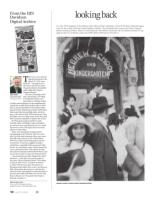
In a rare 1919 snapshot of the Wilkins Street Talmud Torah, standing in front of the door is Bernard Isaacs,
who ran the school (and later United Hebrew Schools). The Lithuanian-born Isaacs was living in Indiana
before moving to Detroit. When he interviewed for the Wilkins Street job, the committee checked his lug-
gage to see if it contained a tallis and tefil lin before offering him the job! •
T
here was a very interest-
ing advertisement in the
March 27, 1942, issue
of the JN — the paper’s very
first issue. The ad was about
the great selection of portable
radios offered by “Boyer’s
Haunted Shacks.”
Mike Smith
First, the technology of the
Detroit Jewish News
day is interesting. According
Foundation Archivist
to Zenith Electronics com-
pany history, a historic maker
of radios and televisions, its accomplishments
include the world’s first portable radio in 1924;
that is, the first portable on the market. Radio
pioneer Edwin Armstrong, inventor of FM radio,
had created the first portable radio, which he
gave to his wife on their 1923 honeymoon. Early
portables were very large, heavy items that used
horns instead of speakers to project the sound.
By 1942, great progress had been made.
Portable radios used lighter tubes and batter-
ies and were now only about the size of a small
microwave oven! A bit larger than your smart
phone or radio today.
There were also plenty of radio stations
broadcasting in the 1940s. By 1922, two years
after the first radio broadcast, there were more
than 600 radio stations in the United States.
However, another interesting point in the ad
was the line “Uncle Sam suggests” families
should have a portable, battery-powered radio
for the “air-raid shelter room” in their homes for
“news and instructions.” This reflects the fact
that America had just entered World War II, and
no one knew what to expect on the home front.
I am puzzled by one other thing in the adver-
tisement — what the heck was the origin of
the name “Boyer’s Haunted Shack”? According
to the ad, there were 17 locations in Detroit
in 1942, with the main store Downtown on
Broadway and Gratiot. But, so far, I can find very
little information about Boyer’s, only that the
chain of stores sold appliances and advertised in
the JN in the 1940s and 1950s. I’m not sure why
Boyer’s Shacks were “haunted,” but I hope to
find out someday. •
Want to learn more?
Go to the DJN Foundation archives,
available for free at www.djnfoundation.org.
50
July 19 • 2018
jn
Courtesy Leonard N. Simons Jewish Community Archives