

spirit
WIKIMEDIA COMMONS
What
would
you do
without
leg pain?
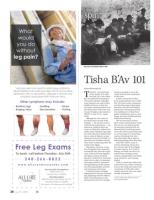
Men pray at the Western Wall in 1929.
Tisha B’Av 101
Varicose veins can result in painful leg symptoms.
Allure Medical can heal your legs with a non-invasive
treatment with no downtime. Leg pain is not the only
symptom associated with varicose veins.
Other symptoms may include:
- Restless Legs
- Bulging Veins
- Swelling
- Discoloration
- Ulcers
- Itching
Free Leg Exams
To book, call before Thursday, July 26th
24 8-266-8 822
w w w.a l lu revei ncente r.com
Beverly Hills/ Birmingham
32804 Pierce St.
Beverly Hills, MI 48025
:HVW%ORRPÀHOG
6900 Orchard Lake Road, Ste 215
:HVW%ORRPÀHOG0,
(Located in the Beaumont building)
28
July 19 • 2018
jn
myjewishlearning.com
T
isha b’Av , the ninth day
of the month of Av (this
year July 22), is the major
day of communal mourning in
the Jewish calendar. Although
many disasters are said to have
befallen the Jews on this day,
the major commemoration is of
the destruction of the First and
Second Temples in Jerusalem in
586 B.C.E. and 70 C.E., respec-
tively.
Although the exact date of
the destruction of each of the
Temples — the ancient centers
of Jewish life and practice — are
unknown, tradition dates the
events to Tisha b’Av. Indeed, the
rabbis of the Talmudic age made
the claim that God ordained this
day as a day of disaster as pun-
ishment for the lack of faith evi-
denced by the Israelites during
their desert wanderings after the
exodus from Egypt.
During the centuries, a num-
ber of tragedies have clustered
around this day, from the expul-
sions of the Jews from England
and Spain to more localized
disasters. Tisha b’Av is, therefore,
observed as a day of communal
mourning, which is expressed
through fasting and the absten-
tion from pleasurable activities
and extraneous diversions.
A whole literature of dirges
appropriate to this day of mourn-
ing, beginning with the biblical
Book of Lamentations on the
destruction of the First Temple,
has been created to serve the
needs of the Jewish community
at this time.
A three-week period of low-
level mourning leads up to Tisha
b’Av; the three weeks commemo-
rate the final siege of Jerusalem
that led to the Second Temple’s
destruction. During this period,
it is traditional to refrain from
public celebrations, such as wed-
dings, and many traditional men
refrain from shaving.
The last nine days of these
three weeks culminating in Tisha
b’Av are an even deeper period
of mourning, during which tra-
ditional Jews avoid eating meat;
some who did not previously take
on certain aspects of mourning,
such as refraining from shav-
ing, will assume these signs of
mourning during these nine days.
Tisha b’Av itself is a day of
intense mourning, whose prac-
tice mirrors that of Yom Kippur
in many respects. It is a day of
fasting, on which one also is to
refrain from washing, sexual
activity, using perfume and other
such ointments, and wearing
leather.
Visits to cemeteries reflect the
mood of the day, which continues
even at the break fast meal at the
conclusion of Tisha b’Av, when
neither meat nor wines are tradi-
tionally consumed. •
To see a video about Tisha b’Av, go to
youtu.be/Zxtz4LtJAf0.