

jews d
in
the
continued from page 12
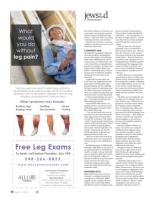
What
would
you do
without
leg pain?
like Turkey, Morocco or Tunisia, one
community may have had a greater
representation and influence than
others — right now there is a strong
Azerbaijani Jewish representation
— but this has not been a cause for
conflict in carrying out services and
traditions, Natan says.
A PERMANENT HOME
Varicose veins can result in painful leg symptoms.
Allure Medical can heal your legs with a non-invasive
treatment with no downtime. Leg pain is not the only
symptom associated with varicose veins.
Other symptoms may include:
- Restless Legs
- Bulging Veins
- Swelling
- Discoloration
- Ulcers
- Itching
Free Leg Exams
To book, call before Thursday, July 19th
24 8-266-8 822
w w w.a l lu revei ncente r.com
Beverly Hills/ Birmingham
32804 Pierce St.
Beverly Hills, MI 48025
:HVW%ORRPÀHOG
6900 Orchard Lake Road, Ste 215
:HVW%ORRPÀHOG0,
(Located in the Beaumont building)
14
July 12 • 2018
jn
All Sephardic synagogues follow the
Orthodox tradition, though Behar
says not all members are Orthodox.
Rather than affiliating with a level
of observance, as Ashkenazi Jews do
in the United States, Sephardic Jews
gravitate to joining to maintain their
unique ethnic culture, Behar says.
There is a mechitzah and a women’s
balcony and, in Sephardic tradition,
the bimah is in the center of the
sanctuary.
Logistically, because there has
never been one neighborhood with
large pockets of Sephardim, pick-
ing a permanent site for a building
has been a point of contention since
the 1930s, Behar says. For decades,
there was a debate whether that site
should be either in West Bloomfield
— where younger families were mov-
ing — or remain in Oak Park with
the founding generation.
Not until the 1990s did the con-
gregation form a consensus on mov-
ing building plans forward in West
Bloomfield, Behar says.
“I was on the board and I was in
my early 30s at the time with many
other aging board members when
we had this meeting in 1996,” Behar
recalls. “I stood up and I asked (those
in favor of the Oak Park site), ‘Which
of your children or grandchildren
will remain with the Sephardic com-
munity’ and pointed out that the
Jewish population in general was
shifting northwest of the city.
“And, for the first time in 60 years
of debating, there was a unanimous
decision to agree on a building loca-
tion.”
Fundraising began in 2000 shortly
thereafter, with Behar as the chair. At
an opening fundraiser, $450,000 was
raised in a single evening. The build-
ing was opened in 2002 and remains
the core of Sephardic culture in
Detroit. In addition to services, Keter
Torah welcomes the wider com-
munity for programs about differ-
ent Jewish communities within the
Sephardic world.
MAINTAINING ROOTS
Behar admits that when you are a
minority in a religious minority, it
is tough not to assimilate. Behar’s
mother was the youngest of seven
children and was the only sibling
that did not marry an Ashkenazi Jew.
However, almost 70 descendants
of his mother’s family attended the
celebration — one coming from as
far away as Taipei, Taiwan — and all
have stayed close to their Sephardic
roots through their customs and
cuisine.
“The fact that they still cling to
Sephardic roots is a testament to
their ancestry,” Behar says. “They all
have the memories of our commu-
nity and growing up in the Sephardic
social circles — from the long sum-
mer picnics and card games to cel-
ebrating lifecycle simchahs together
and hearing all the languages from
Arabic to Ladino to Turkish. And
now we have a building to house all
of that tradition, and that is how it
will stay.”
For Kim Benezra, a second-gener-
ation American born to a Moroccan
mother and an American father, it is
those Sephardic melodies of Shabbat
and the High Holiday services as well
as the eclectic cuisine that keeps
her connected and involved to Keter
Torah as sisterhood president. Her
family has been members since the
1960s.
“My father was not Sephardic, but
he wanted us to maintain that cul-
ture,” Benezra says. “Within the con-
gregation, we found a home within
the company of other Sephardic
Jews. To maintain that culture and
be in a community where you can
get exposed to all the languages from
where we are from — from Arabic to
French to Spanish and sometimes
many languages in one sentence —
has been an invaluable experience
for my children.”
Benezra’s children, Shlomo, 19,
Becky, 18, and Yoni, 16, studied at
Chabad for their religious educa-
tion, and she remembers attend-
ing Hebrew school at Adat Shalom
Synagogue and Congregation
Shaarey Zedek. Still, she and her
family maintain close ties to the
Sephardic circle within the wider
Ashkenazi Jewish circle.
Though her kids are older, they
have found a tight social circle at
Keter Torah and enjoy going to
Shabbat services, where children and
teens are encouraged to participate
and lead.
“Ultimately, what keeps us con-
nected to Keter Torah is the unique
and eclectic mix of all those nation-
alities,” Benezra says. “We have a cus-
tom of singing to congregants each
week on the week of their birthday.
Where else in Detroit can my chil-
dren come to services and be asked,
‘Do you want to sing in Farsi, Ladino,
Arabic or Hebrew?’ We are a small
congregation, but when you are
Sephardic, this place is home.” •