

jews d
in
the
BRIAN MASSERMAN
on the cover
Preserving
Culture
Keter Torah marks 100 years of the
Sephardic community in Detroit.
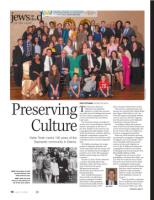
ABOVE: Descendants of Judith
and Jacob Chicorel at the
100th anniversary gala.
RIGHT: Judith and Jacob
Chicorel in 1925 with the first
four of their seven children.
STACY GITTLEMAN CONTRIBUTING WRITER
T
he distinction between
Ashkenazi and Sephardic
Judaism is evident the moment
one walks into the building that houses
the Keter Torah congregation at the
corner of Orchard Lake and Walnut
Lake roads.
The mezuzah is hung vertically, just
as they were on the doorposts of Jewish
homes in Jerusalem at the time of
the First Temple. In the entryway, the
congregation proudly displays ornate
Torah encasements, centuries old from
Sephardic communities around the
world that in their time held the scrolls
vertically as they are read in Sephardic
style.
On Shabbat mornings, the unique
sounds of Sephardic melodies and
Torah trope meld with the aromas and
tastes of a Kiddush lunch lovingly pre-
pared by some of the 100 congregant
families representing more than 20
countries.
On June 21, Keter Torah celebrated
a century of proudly preserving
Sephardic culture for future genera-
tions in Detroit with nearly
200 guests and speeches
delivered by descendants of its
founding families.
They included third-gener-
ation member and third-gen-
eration synagogue President
Ricky Behar, whose grandpar-
ents Jacob and Judith Chirorel
founded Keter Torah in 1917,
Rick Behar
after arriving in Detroit from Turkey.
Chicorel was a spiritual leader and
hazzan who trained with Turkish Rabbi
Izak Algazi (1899-1950). In 1917, the
Chicorels began hosting High Holiday
services and soon after the organiza-
tion became known as the Sephardic
Community of Greater Detroit.
According to Behar, three genera-
tions of the Chicorel/Behar family have
served on the board contiguously, and
60 out of those 100 years a Behar has
served as congregation president.
Behar has vivid memories growing
up among the synagogue’s congregants
in religious and social settings. There
were Chanukah and Purim parties,
summer picnics and religious ser-
vices in the 18 different locations the
congregation would rent out before
breaking ground and opening its West
Bloomfield building in 2002.
Though he has no memory of his
grandfather, who died when Ricky was
2 in 1963, he recalls the story of how
Chicorel was promised “on his death-
bed” by congregants and hazzanut
Yeshua Katan and David Hazan
that they would continue the
traditions of preserving the
distinct sounds and melodies
of the Sephardic customs at
services.
“These lay leaders could have
let our traditions and melodies
slip away, but they kept it up
for 35 years,” Behar says. That
continued on page 12
10
July 12 • 2018
jn