

arts&life
exhibits
Americans
and the
Holocaust
A new exhibit dispels the myth that most Americans
were unaware of the atrocities happening in Europe.
COURTESY OF FRANKLIN D. ROOSEVELT PRESIDENTIAL LIBRARY & MUSEUM
BARBARA LEWIS CONTRIBUTING WRITER
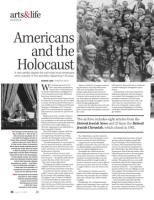
TOP: Passengers aboard the MS St. Louis,
May 13, 1939-June 17, 1939. On May 13,
1939, the German transatlantic liner St.
Louis sailed from Hamburg, Germany, for
Havana, Cuba, carrying 937 passengers, the
majority of whom were Jewish. When the
St. Louis arrived in Havana, the passengers
learned that the landing certificates they had
purchased were invalid. After Cuba refused
to allow the passengers to land and the
United States (and other Western Hemisphere
nations) did not offer to take the passengers,
the ship returned to Europe. The American
Jewish Joint Distribution Committee worked
with the State Department, ultimately
persuading four countries — Great Britain,
France, the Netherlands and Belgium —
to admit some of the passengers. The
remaining 254 were forced to return to
Europe and were killed by the Nazis.
ABOVE: FDR broadcasts his first fireside
chat, March 12, 1933. President
Franklin D. Roosevelt prioritized
economic recovery from the
Great Depression and victory
i n World War II above
humanitarian crises overseas.
36
June 7 • 2018
jn
W
as it simply ignorance that
Jews were being murdered en
masse? Was it anti-Semitism?
Or did the United States’ unwillingness to
rescue Europe’s Jews from the Holocaust
have more nuanced causes?
That’s the question Daniel Greene set out
to answer five years ago when he was asked
to curate “Americans and the Holocaust,” a
new exhibit at the U.S. Holocaust Memorial
Museum in Washington, D.C. It opened
April 23 to commemorate the museum’s
25th anniversary and will run until the fall
of 2021.
Displays show how a number of factors,
including the Great Depression, isolation-
ism, xenophobia, racism and anti-Semitism
influenced decisions made by the American
government, news media, Hollywood,
advocacy organizations and individuals as
they responded to Nazism.
The exhibit dispels a popular myth that
most Americans were unaware of what
was happening in Europe by providing
extensive documentation of news media
accounts from the 1930s and 1940s.
“The difficult question we want people to
ask is: If Americans had this information,
why didn’t the rescue of Jews become a pri-
ority?” said Greene, who teaches history at
Northwestern University.
“Americans had lots of access to the
information — more than previously had
been assumed — though they didn’t always
connect the dots at first,” Greene said.
“They can’t say they didn’t know.”
Throughout the exhibit, newspaper and
magazine articles document the rise of
Hitler and German persecution of the Jews.
A touchscreen near the entrance to the
exhibit connects visitors with regional and
local coverage of the unfolding tragedy.
The display is part of “History Unfolded,”
a crowd-sourced effort in which anyone
can search out articles from the era that
dealt with the rise of Hitler, the persecution
of Jews and efforts to save them, and post
them on the museum’s website.
“History Unfolded” (newspapers.ushmm.
org) has links to more than 300 articles,
with more being added. The archive
includes eight articles from the Detroit
Jewish News and 25 from the Detroit Jewish
Chronicle, which closed in 1951. Greene
says he’s hoping for additional submissions,
especially from college newspapers and the
ethnic/foreign language press.
Greene says the collection shows that the
information reached the American heart-
land, not just major metropolitan areas and
the coasts.
told reporters afterwards that he would not
consider relaxing the immigration quota
system.
Anti-Semitism in the State Department
limited the admission of Jewish refugees
even further. The Immigration Act of 1924
permitted a maximum of 25,967 visas
annually from Germany, but in 1933, only
1,241 visas were issued and there was a
three-year waiting list. Congress failed
to pass proposed legislation in 1939 that
would have admitted 20,000 German refu-
gee children.
The archive includes eight articles from the
Detroit Jewish News and 25 from the Detroit
Jewish Chronicle, which closed in 1951.
The exhibit finds a number of answers
to the question of why rescuing Jews never
became a priority for the United States.
A major reason was that President
Franklin D. Roosevelt’s clear aim in the war
was defeating Hitler, a goal disassociated
from the tragedy befalling the Jews.
Throughout the 1930s and into the
1940s, isolationist sentiment in the U.S. was
strong. Many Americans viewed Hitler’s
conquests as Europe’s problem, not ours.
While Roosevelt felt he might be able to
convince Americans to go to war to defend
democracy, he knew they weren’t as likely
to support efforts to save the victims of fas-
cism.
Anti-Semitism in America was at its
height in the 1930s, said Greene; longtime
Detroiters will remember the anti-Semitic
radio rants of Royal Oak’s Father Charles
Coughlin.
Kristallnacht, the coordinated attacks
against Jewish businesses, homes and syna-
gogues in November 1938, was widely cov-
ered by the American press, yet Roosevelt
The exhibit shows how these national
decisions affected ordinary people like
Flora Hochsinger, a Ph.D. math teacher
in Vienna, who desperately tried to find
someone to sponsor her immigration to
the United States. The White House, State
Department, B’nai B’rith and various celeb-
rities all turned her down. She was deport-
ed from Vienna and murdered in 1942.
Greene says he understands Roosevelt’s
position. Throughout the war years, polls
consistently showed that a huge majority
of Americans disapproved of the Nazis’
treatment of the Jews — but nearly three-
quarters of them were not willing to accept
more refugees. The president knew he had
to lead Americans toward intervention
while at the same time bowing to wide-
spread public anti-immigration sentiment.
Even toward the end, when the War
Refugee Board urged military action to
bomb the tracks leading to the concentra-
tion camps, Assistant Secretary of War John
McCloy responded that the government’s