
views
commentary
Bay View Shouldn’t Be For Christians Only
T
he community of Bay View, Mich., some in Bay View object to this practice
— and sued to stop it.
sits along the shores of Lake
The ADL filed a brief supporting
Michigan, a picturesque summer
resort destination for families across the them, arguing that Bay View’s policy
cannot stand under fair hous-
country. Full of historic build-
ing principles enshrined in
ings and Victorian cottages, Bay
federal and state law. Moreover,
View boasts that it is one of the
under state law, Bay View has
“prettiest painted places” in the
significant authority akin to
United States.
a governmental body — like
Yet behind its pristine facade,
appointing a marshal to arrest
Bay View hides a shameful past
and imprison those who vio-
of discrimination that continues
late its bylaws — and so must
today. Around 1942, Bay View
Rebecca
honor the Constitution as cities
started to limit renters and
Guterman
and towns do. It cannot put the
owners to those “of the white
government stamp of approval
race” and Christian faith, later
on practicing Christians over all
restricting Roman Catholic
others.
membership to 10 percent or
Bay View’s policy does not exist in
less. The race restriction faded out by
a void. Rather it operates alongside
1959, but the religious one persists.
decades of religious and racial discrimi-
Today, Bay View homebuyers must not
nation in housing, both in Michigan and
only be Christian, they must also have a
across the nation, where Catholics, Jews
minister’s letter to prove it.
and other minorities were kept out to
In other words: Buddhists, Hindus,
Jews, Muslims, Sikhs, atheists and many maintain a neighborhood’s image.
In Grosse Pointe, for instance, real
others — including Christians who don’t
estate agents in the late 1940s and
attend or belong to a church — need
’50s used a rigged points system to
not apply.
exclude those who were not considered
Fifty years after the passage of the
“American” enough because of their
federal Fair Housing Act, Bay View’s
country of origin, occupation, friends,
policies seem stuck in the past, harken-
appearance, accent, education, religion
ing back to an era where blatant and
or a number of other factors. While
discriminatory restrictions on home-
most buyers needed only 50 points to
ownership were commonplace. Luckily,
make the cut, those of Polish descent
needed 55, southern Europeans needed
75 and Jews needed 85 (later raised to
90). Blacks, Asians, and Mexicans were
flat-out denied.
When Congress passed the Fair
Housing Act in 1968, followed promptly
by the Michigan Legislature’s fair hous-
ing law, lawmakers formally recognized
what was already common sense — that
these discriminatory practices should
have no place in our society.
Fifty years later, the United States
is more religiously diverse than ever
before. According to the Pew Research
Center’s Religious Landscape Study, a
growing portion of the population (22.8
percent) identifies as unaffiliated or as
a member of a non-Christian faith (5.9
percent). Michigan’s population, in par-
ticular, has set milestones in religious
diversity. Congressman Sander Levin,
who represents suburban Detroit, is
the longest-serving Jewish member of
Congress, and Hamtramck became the
first known city in the United States to
have a majority-Muslim city council.
But with this diversity has come
increased targeting of people based on
their religion, national origin or other
protected characteristics . Hate crimes
against Muslims and Jews increased in
2016, according to FBI data, as did hate
crimes overall. There is evidence sug-
Bayview, Michigan
gesting that such bias has spilled over
into the housing realm, with Muslims
significantly more likely to experience
housing discrimination than their non-
Muslim counterparts.
In light of this data, it is ever more
important to eradicate discriminatory
practices like Bay View’s and ensure
that the Fair Housing Act and the
Constitution remain bulwarks against
them. As the Michigan Legislature
said upon celebrating the Fair Housing
Act anniversary, “[d]iversity creates
stronger communities and provides
Michigan[ders] the best opportunity to
achieve the American dream[.]”
We hope Bay View will soon live up
to these ideals and realize that religious
diversity will strengthen, not harm, the
beauty of their community. •
Rebecca Guterman is a paralegal for the ADL’s
Program on Freedom of Religion and Belief. This
essay was first published on the ADL blog.
Editor’s Note: The Department of Housing
and Urban Development ruled this month
that the Bay View Association has failed
to prove it is exempt from the federal Fair
Housing Amendments Act of 1988, allowing
15 complaints to move forward. These com-
plaints are separate from a federal lawsuit,
which will go before a judge in July.
commentary
W
e are Jewish and pro-Israel
students who are active within
our Jewish communities on
college campuses across North America.
Many of us have helped organize against
the Boycott, Divestment and Sanctions-
affiliated movements throughout our
time on campus.
Over the course of our time fighting
BDS campaigns, Canary Mission was
brought to our attention repeatedly.
Canary Mission is an anonymous site
that blacklists individuals and professors
across the country for their support of the
BDS movement, presumed anti-Semitic
remarks, and hateful rhetoric against
Israel and the United States.
As a group of conscientious students
on the front lines fighting BDS on our
campuses, we are compelled to speak
out against this website because it uses
intimidation tactics, is antithetical to our
democratic and Jewish values, is counter-
productive to our efforts and is morally
reprehensible.
This blacklist aggregates public infor-
mation about students across the country
under the guise of combatting anti-Semi-
tism. It highlights their LinkedIn profiles,
Facebook pictures, old tweets, quotes in
newspapers and YouTube videos. The site
chronicles each student’s involvement
with pro-Palestinian causes and names
other students and organizations with
whom the given student may be affiliated.
We view much of the rhetoric employed
to villainize these individuals as hateful
and, in some cases, Islamophobic and
racist. In addition, Canary Mission’s wide
scope wrongfully equates supporting a
BDS resolution with some of the most
virulent expressions of anti-Semitism and
anti-Israel rhetoric and activity.
Throughout our time on campus, many
among us have been active in the fight
against BDS. Some of us have campaigned
against BDS, others have vigorously spo-
ken out against BDS, and some have even
cast votes on our central student govern-
ments against BDS. We have opposed,
and continue to oppose, BDS because we
believe that BDS delegitimizes the State of
Israel, aims to isolate it as a pariah, paints
the Israeli-Palestinian conflict as a zero-
sum and oversimplified issue, continually
reinforces double standards and polarizes
our campuses in the process.
Given our experiences on our campus-
es, we believe that the best way to combat
such ideas is through open discourse and
critical analysis of the issues surrounding
the conflict.
That said, we condemn all forms of hate
in the strongest possible terms, which
includes any and all anti-Semitic rhetoric
used by some pro-Palestinian activists.
However, we believe that promoting a
negative perception of Muslims, particu-
larly Muslim students on our campuses,
as Canary Mission does, is similarly hate-
ful. As students on the front lines, we hope
that Jewish and pro-Israel communal
organizations will trust us and work more
collaboratively with us to handle this fight
in a credible, respectful and moral man-
ner among our student communities.
We believe that Canary Mission is anti-
thetical and destructive to our shared
cause of supporting Israel and eliminating
anti-Semitism on campus. Instead, we
expect credible Jewish and pro-Israel com-
munal organizations to help us combat
anti-Semitism on college campuses, and
around the world, in a diplomatic man-
SAMII STOLOFF PHOTOGRAPHY
Canary Mission Hurts Israel Supporters On Campus
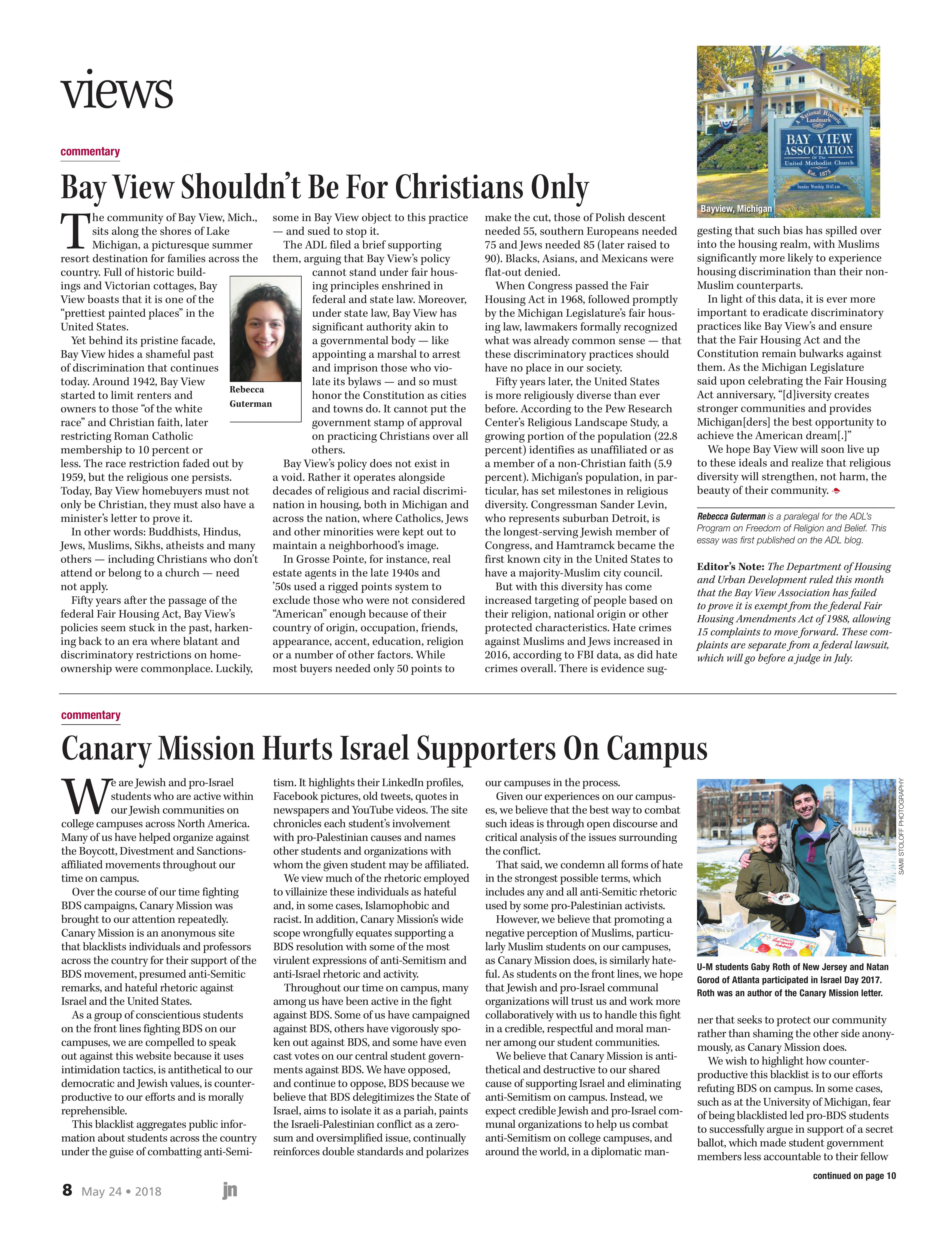
U-M students Gaby Roth of New Jersey and Natan
Gorod of Atlanta participated in Israel Day 2017.
Roth was an author of the Canary Mission letter.
ner that seeks to protect our community
rather than shaming the other side anony-
mously, as Canary Mission does.
We wish to highlight how counter-
productive this blacklist is to our efforts
refuting BDS on campus. In some cases,
such as at the University of Michigan, fear
of being blacklisted led pro-BDS students
to successfully argue in support of a secret
ballot, which made student government
members less accountable to their fellow
continued on page 10
8
May 24 • 2018
jn