
jews d
in
the
BENTLEY HISTORICAL LIBRARY, UNIVERSITY OF MICHIGAN
looking back
Lasting Legacy
U-M’s William Haber turned his
focus to post-WWII refugees.
CINDA NOFZIGER SPECIAL TO THE JEWISH NEWS
T
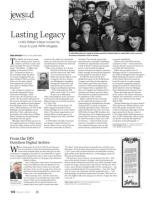
In 1948, William Haber, left, traveled to Germany and Austria as Special Advisor on Jewish Affairs to Gen. Lucius Clay,
the American Commander-in-Chief in Germany.
a person who, while not a household
he slightly out-of-focus image
name, was well-known for his hard work
shows a group of men, some in
and dedication to betterment of Jewish
uniform, and boys in suits, smil-
people around the world.
ing uncertainly. The note on the back
Haber was a professor at U-M and
states, “Wm Haber, … J Officer and
the Dean of Literature, Science
children in (Germany?), W.W.
and Arts there from 1963-1968.
II(?).” The question marks on
As an economist, however,
the inscription make the photo
Haber also put his skills to work
even more intriguing: Who are
to improve the lives of labor-
these children? Where are they?
ers, Michiganders struggling
When was the photo taken?
through the Depression, and
What happened to the kids?
both Jewish and non-Jewish
And, what was William Haber
refugees and displaced persons.
doing there?
Born in Romania in 1899,
I am a reference archivist at
William Haber
Haber came to the U.S. in 1910.
the Bentley Historical Library,
He grew up in Milwaukee.
University of Michigan, which
After earning degrees at the University
means I get a lot of questions and
of Wisconsin and attending Harvard,
search a lot of archival collections for
the answers. Along the way, I’ve become Haber became an economics professor
at U-M in 1936.
familiar with significant Jewish figures
In 1939, while on leave from U-M,
from Michigan, such as Albert Kahn
Haber organized and directed the
and A. Alfred Taubman, men who made
National Refugee Service in the United
buildings and had buildings named
States. This private organization coor-
after them. Their collections are at
dinated efforts of other agencies to
the Bentley. But, I didn’t know William
resettle refugees from Nazi-controlled
Haber. Intrigued by the photograph, I
Europe.
dug deeper into his papers.
In 1948, Haber traveled to Germany
Although I didn’t find the answers to
my original questions, in Haber’s papers and Austria as Special Advisor on
Jewish Affairs to Gen. Lucius Clay, the
and in the online archives of the Detroit
American Commander-in-Chief in
Jewish News, I discovered the history of
Germany. They toured camps of dis-
placed persons, eventually establishing
resettlement opportunities around the
world. In letters to friends and acquain-
tances as he traveled throughout
Europe, and upon his return to America,
Haber strongly advocated that displaced
Jewish people be relocated to Israel.
In 1949, the Detroit Jewish News
detailed his report to the World Jewish
Congress, and other Jewish organiza-
tions. Haber stated that, after Israel’s
creation in 1948, Jewish displaced per-
sons “dropped their complaints that
they were ‘trapped’ and ‘imprisoned’ in
Germany and Austria and went about
their business of preparing themselves
for migration to that country.”
Haber credited his time in Europe
as the catalyst for his interest in the
Organization for Rehabilitation through
Training (ORT), a Jewish vocational
training organization that is still active
today. Shortly after his return to U-M in
1949, Haber became ORT president. In a
1955 interview with S. Regensburg of the
Jewish Daily Forward, he described how
he “observed youth in Israel, once D.P.’s
in Germany — whom he had encoun-
tered as a counsellor to General Clay.
Once shattered humans, they are now
proud citizens, participants in Israel’s
economic upbuilding.”
Haber’s work with ORT took him
around the world — North and South
America, Europe, Israel and various cit-
ies within the United States.
Haber also served the state of
Michigan and the U.S. government in
the 1930s as Michigan’s State Emergency
Relief Administrator and as a member
of the Federal Advisory Council on
Social Security. In an early example
of community-engaged learning, he
designed a project for which his stu-
dents helped to write the Michigan
State Unemployment Insurance Law.
Haber also made time for his fam-
ily; he and his wife, Fannie, had three
children. He continued to work for U-M
until he was well into his 80s. Haber
died in 1989.
During celebrations of modern Israel’s
70th anniversary, William Haber’s work
for Jewish people around the world is
worth remembering. Although no build-
ing is named in his honor, a chair in
U-M’s Judaic Studies holds his name as
does an ORT scholarship. I like to imag-
ine that his work directly helped the
young boys in the photograph. •
Cinda Nofziger, Ph.D., is a reference archivist at
U-M’s Bentley Historical Library.
From the DJN
Davidson Digital Archive
W
hile writing about the JN from 1942-43 over the past
year, several times I referred to fascinating advertise-
ments from Schmidt’s Beer, the beer that (per its ads)
contributed so mightily to the effort to win World War II. I guess
I miss writing about Schmidt’s beer ads, so this week, I decided to
see just what I could find about beer in the pages of the Davidson
Online Archives.
Now, I will admit, I don’t know a lot about beer.
I know the difference between Budweiser and
a craft beer, but when it comes to on-the-spot
decisions, I have to rely on sage advice from my
good friend and outstanding beer adviser, Don
Cohen, also a JN contributing writer.
When entering “beer” into the search box
for the archives, you will find more than 9,000
entries. That’s a lot of reading about beer.
Mike Smith
Detroit Jewish News
Unfortunately for the historic Detroit com-
Foundation Archivist
munity, there were only 13 entries that cited
126
May 24 • 2018
jn
“Free Beer.” I also found entries for Israeli beers, Gold Star and
Maccabee. The first article about these beers appeared in the Dec.
2, 1977, issue of the JN about Gold Star and Maccabee winning
gold medals at the Monde Selection, a world judging of beers in
Brussels and Luxembourg.
The best beer news, however, can be found in the Apr 7, 1916,
issue of the Jewish Chronicle. On page 9, the advertisement for
Detroit-made Goebels Beer had some very useful “scientific” infor-
mation for readers. Did you know that doctors will tell you “there
is not a more efficient strength-builder for the convalescent — nor
a more nourishing food for the young mother — than Pure Beer?”
And, of course, any “physician who has studied the beers … will
unhesitatingly recommend Goebel Pure Food Beer.” Who knew? I
feel a bit slighted. My mom only gave me Vernor’s Ginger Ale when
I was sick. •
Want to learn more? Go to the DJN Foundation archives,
available for free at www.djnfoundation.org.
Scanned image of the page. Keyboard directions: use + to zoom in, - to zoom out, arrow keys to pan inside the viewer.
May 24, 2018 - Image 126
- Resource type:
- Text
- Publication:
- The Detroit Jewish News, 2018-05-24
Disclaimer: Computer generated plain text may have errors. Read more about this.