

JOINT LIST
views
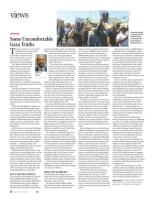
Thousands marched
in solidarity with the
residents of Gaza
in the Israeli-Arab
city of Sakhnin on
Saturday, March 31.
commentary
Some Uncomfortable
Gaza Truths
T
hat the sequence of events that
unfolded on the Gaza border
March 30 was entirely
predictable, and that the reac-
tion to those events was even
more so, does not make the
aftermath any more palatable.
The “March of Return” that
began March 30 and is sched-
uled to resume each Friday,
ultimately culminating in a
Michael J.
May 15 Nakba Day effort to
Koplow
storm the border fence, has
been in the works for months.
Israel had plenty of time to
prepare for it as it watched tent encamp-
ments and paved pavilions get built on the
Gaza side.
The march’s organizers, which did not
include Hamas at the start but certainly
did by the end, also had time to prepare
as they absorbed the warnings issued by
Defense Minister Avigdor Lieberman and
IDF officials and watched Israeli sharp-
shooters settle in on the Israeli side of the
border.
What unfolded followed a familiar pat-
tern; Hamas embedded amongst larger
number of civilians and did its best to pro-
voke an Israeli response to its own violent
tactics. Israel was unable to restrain itself
and ended up killing and injuring a larger
number of Palestinians than is feasible to
explain or justify, and the battle to spin
the result is now hotter than the actual
battle itself.
Clashes between Israel and Palestinians
in Gaza are, for me, one of the most diffi-
cult aspects of the Israeli-Palestinian con-
flict. Positions that are already hardened
become even more so in the red-hot Gaza
forge as you have Israel facing off against
an actual terrorist group while casualty
numbers — including civilian ones —
mount terrifyingly fast and in a one-sided
fashion on the Palestinian side.
While black and white tend not to be
useful colors when thinking about conflict
in the Holy Land, they dominate nearly
every corner of the Israel-Palestine space
whenever fighting erupts in Gaza. Rather
than try to repaint the overall picture with
some gray, it may be useful for each side
to get some of the other side’s black and
white in the hopes of avoiding the same
predictable fault lines next Friday.
ing tires and bullets across a border fence.
If the 5 percent of violent actors abuse the
95 percent of peaceful ones to wreak
havoc, you cannot just pretend
that the 5 percent do not exist and
repeatedly state that the protest was
a non-violent one.
There were many peaceful pro-
testers, and then a non-trivial group
of ones who were there for nefarious
purposes and nothing more. If the
ones who truly want to engage in a
mass act of protest and send a mes-
sage to Israel and the wider world
are unwilling to rein in the trouble-
makers in their midst, then they lose
the moral high ground that they want to
occupy but are unwilling to insist upon.
There is a border fence between Israel
and Gaza. Unlike the security barrier in
the West Bank, the route of which does
not stick to the 1949 Armistice Green
Line, the Gaza barrier is built precisely
upon the line agreed upon by both sides
in the Oslo II agreement in 1995.
Israel has withdrawn all its soldiers and
citizens from Gaza and does not claim the
territory for itself. Attempts to tear down
the fence or cross it to get into Israel ille-
gally are not legitimate forms of protest,
but criminal acts. Every country in the
world has the right to police its own bor-
ders, and the vast majority of them do just
that. Israel’s rules of engagement dictated
firing at anyone who tried to cross the
barrier or damage it, and in the context
of borders around the world, that is both
understandable and legitimate.
The majority of those killed March 30
were not good guys, freedom fighters or
human rights activists. They were known
terrorists, identified by Israel and proudly
claimed by Hamas itself. No deaths should
ever be celebrated and that includes these
ones, but let’s be clear about who these
people were and what their aim was.
Young men carrying AK-47s and grenades,
shooting as they rush the fence, are not
sympathetic figures and they deserve
nobody’s sympathy. Israel makes plenty of
mistakes and does plenty of things wrong
— and if you haven’t ripped this page in
anger yet, I’m about to detail that, too —
but killing terrorists in the midst of violent
acts is not one of them.
ISRAEL NOT BLAMELESS
NOT A PEACEFUL PROTEST
To my friends and colleagues on the left:
What happened that Friday was not a
peaceful protest. The August 1963 March
on Washington did not have galabaya-
clad men throwing Molotov cocktails.
Gandhi’s salt march did not feature burn-
8
April 19 • 2018
jn
To my friends and colleagues on the
right: Israel is not an innocent blameless
actor, thrust into the furor surrounding it
through no fault of its own.
Set aside the Hamas fighters killed
March 30; Israel still wounded hundreds
more. Just consider the odds of every
single one of those people being a terror-
ist or someone affiliated with a terrorist
group in the context of a gathering of
20,000-30,000 people, and you’ll realize
immediately that there is zero chance that
Israel did not shoot and harm completely
unarmed and innocent people.
The fact that this is a lark compared to
what goes on, say, in Syria does not make
it beyond reproach. It also doesn’t matter
that Hamas put Israel in the untenable
situation in which it found itself, since
this does not absolve the IDF from acting
with the utmost care not to kill or even
harm civilians who are in the way. Israel
had a barrier and trenches between it and
anyone trying to breach the fence, and an
array of snipers waiting for anyone who
managed the feat. News reports indicate
that most of those injured were not at the
fence or in the no-go zone leading up to
the fence. Hundreds of injuries not only
looks terrible, it is terrible.
The IDF is not the most moral army in
the world because there is no most moral
army in the world. I know this because the
words “moral” and “army” are generally
at odds, and there is no reason to think
that the IDF is an exception to this rule
that has lasted through centuries of time
and space. Soldiers’ jobs are to kill other
people, and when you are shooting at
someone who is trying to kill you, human
nature dictates that morality and ethics
are not going to be at the forefront of your
mind.
Crimes happen in war, and that Israeli
soldiers do things they aren’t supposed to
does not make them worse than anyone
else. It makes them exactly like everyone
else. Repeating a completely indefensible
and evidence-free platitude like a broken
record not only harms your general cred-
ibility, it makes Israel’s foes work extra
hard to demonstrate that your position is
nonsensical and rub it in your face. It also
creates an impossibly high standard that
can never actually be met, setting Israeli
soldiers up for certain failure. The “most
moral army in the world” talking point is
both substantively and tactically foolish;
it convinces nobody, and every time it is
repeated it does more than anything else
to shift the conversation on to Israel’s sins
rather than its opponents’ ones.
The fact that there are no Israelis in
Gaza does not mean that Israel has no
responsibility for what goes on there.
Israel controls Gaza’s airspace, enforces a
blockade of it from the sea and controls
the border on two of the three remaining
sides. It controls what goes into Gaza and
what comes out of Gaza, both people and
goods.
Only someone who is willfully blind or
purposely obtuse would deign to argue
that Gaza is an independent territory free
of Israeli control. Israel has contributed to
a staggeringly awful humanitarian crisis
in Gaza, and Israel’s political leadership
has used Hamas’ presence there to pun-
ish nearly 2 million people while avoid-
ing having to make any hard decisions.
You can talk all you want about rockets,
but Hamas has not fired a rocket in 14
months, and yet Israel has conceded
nothing while every day the chances of an
explosion increase.
There is a reason that a majority of the
cabinet in the most right-wing govern-
ment in Israel’s history, along with near
unanimity among the IDF leadership, sup-
port building Gaza a seaport and airport
and ending its isolation from the rest of
the world, yet Prime Minister Netanyahu
sits on his hands.
If you were a Palestinian stuck in Gaza,
with barely any potable water, sewage
in the streets, electricity for four hours
a day at best and literally nowhere to go
because Israel — and yes, Egypt, too —
won’t let you out, you’d be pretty despon-
dent, too. You may even do anything you
could to get out, including trying to get
past the border fence.
If tens of thousands of Palestinians
indeed rush the fence and try to obliterate
it on May 15, it really will represent Israel’s
biggest crisis since the Yom Kippur War.
All of this could have been avoided with
some policy changes toward Gaza that
may now be too late, and it’s not like the
Israeli government didn’t have plenty of
voices in its ear warning about just this
scenario for months, if not years.
I don’t expect anyone to read this and
fundamentally change his mind about the
balance of what happened March 30. I
don’t claim any superior wisdom or moral
authority on any of this. The only thing
I am begging to get across is that none
of this is as straightforward as it appears
to those who are passionate about these
issues, and if we at least take a small step
in acknowledging that, perhaps it can lead
to solutions rather than loud and drawn-
out arguments.
If there is one thing I know, it is that
solutions to the Gaza problem are desper-
ately needed, because neither Israel nor
the Palestinians benefit in any way from
iterated and increasingly ramped-up ver-
sions of what took place March 30. •
Michael Koplow is the policy director of the Israel
Policy Forum and an analyst of Middle Eastern
politics and U.S. foreign policy in the region.