

jews d
in
the
Detroit Welcomes OneTable
A new way for
millennials to
make Shabbat
dinner a part of
their lives.
BECKY HURVITZ
SPECIAL TO THE JEWISH NEWS
M
ore than the Jewish
people have kept
Shabbat, Shabbat has
kept the Jewish people.”
This sentiment, penned by
writer and early secular Zionist
Ahad Ha’am, in many ways
expressed his view that the
Jewish people, more than a polit-
ical state, needed a spiritual state
and a way to stay connected to
their heritage and to each other.
Fast-forward 100 years from
Ha’am’s time and you’ll find a
generation of young adults still
working to create and maintain
that connection through the
power of a Shabbat experience.
But it’s not easy. There’s a lot of
competition for what to do on a
Friday night, and even if 20- or
30-somethings want to create a
Shabbat experience for them-
selves and their friends, it can
be a daunting task to bring the
tradition into the 21st-century
in a way that is both meaningful
and doable.
ENTER ONETABLE
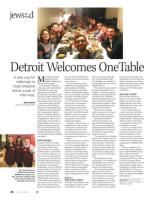
TOP: Jacob Allen hosted a
OneTable Friday night dinner.
BOTTOM: Emily Zussman of One-
Table, Jaime Bean of NEXTGen Detroit
and Sara Fatell of OneTable at the
Nosh :pitality event in Detroit.
26
April 19 • 2018
Founded in 2014, OneTable
Community Dinners is a plat-
form that provides millen-
nials with the tools to make
Shabbat dinner a part of their
lives, whether as guests or as
hosts. Active in more than 90
cities across the United States,
OneTable officially launched
as a hub in Detroit on Feb. 20,
hosting one of its signature
Nosh:pitality events at WeWork
in partnership with the Jewish
Federation of Metropolitan
Detroit and its young adult
division, NEXTGen Detroit.
While Detroiters had access
to OneTable’s online platform
and select resources prior, now
there will be a greater local
presence offering ground sup-
jn
port, localized “nourishment”
options, events, large scale din-
ners and more.
“By lowering barriers that
might keep young adults from
participating in a Shabbat
dinner experience, OneTable
works to make Shabbat achiev-
able and accessible,” said Emily
Zussman, OneTable manager
of people and special proj-
ects. “We do this in a number
of ways, from ‘nourishment,’
which is how we describe
the funding that we provide
Shabbat hosts, to one-on-one
time with a OneTable-trained
Shabbat coach to access to a
slew of resources including
ritual guides, conversation
models and recipes.”
Zussman, a Detroit native, is
confident that Metro Detroit
is the perfect community for
OneTable to do what it does
best and that a local partner-
ship with NEXTGen Detroit will
be instrumental in their suc-
cess here.
“Metro Detroit has a vibrant
and diverse Jewish commu-
nity with a growing millennial
population. Shabbat dinners
already are happening here,
and now we can help provide
more support,” Zussman said.
“We chose to host our launch
event with NEXTGen Detroit
because they’re synonymous
with young Jewish life in
Detroit. They know the unique
needs of Jewish young adults
in the community and they
understand the value of enrich-
ing lives through Jewish ritual.”
WHAT’S A
NOSH:PITALITY EVENT?
OneTable’s Nosh:pitality events
bring together people in their
20s and 30s to learn tradi-
tions and culinary skills, like
how to bake challah, while
also building a community of
young adults who want to host
Shabbat dinners.
“We wanted to make our first
Detroit Nosh:pitality event ‘a
big dill’ so we hosted a pickle-
making workshop and dinner,”
said Jaime Bean, NEXTGen
Detroit Israel Experience asso-
ciate, who will be working
closely with OneTable to facili-
tate local programming and
support here in Detroit.
“We had over 25 young
adults come out for the event
and, weeks later, we’re still
hearing wonderful feedback.”
Sara Fatell, OneTable’s
national community man-
ager, led the pickling portion
of the evening and began by
explaining that fermentation
techniques have been used in
Jewish food preparation for
hundreds of years.
“Two symbols of the Shabbat
dinner table, challah and wine,
are both made using methods
of fermentation,” Fatell said.
“In the Talmud, it states that
all meals should include salt
(something fermented or pre-
served) and something like a
pickle or relish to aid in diges-
tion.”
About 70 percent of the
young adults who attended the
Nosh:pitality event said that
they already had been to or
hosted a OneTable dinner.
“I’ve been hosting Shabbat
dinners with the help of
OneTable for a few months
now. It makes it so much easier
to have friends over and do
something Jewish on a Friday
night,” Sala Wanetick said. “I
am so excited that the organi-
zation will now have a greater
local presence and offer more
workshops and events like this
where I can learn more about
Shabbat and meet more people
who are also interested in
being a part of a Friday night
experience.”
HOW DOES IT WORK?
The OneTable experience
begins on its website. There,
people can sign up to host a
Shabbat dinner or see what
Shabbat dinners in their area
are looking for guests.
“Once someone signs up
to host, we reach out to them
to get a better idea of what
their ideal Friday night dinner
would look like,” Zussman said.
“Based on that conversation,
we pair the host with one of
our Shabbat coaches.”
Coaches are usually former
or current hosts who are sea-
soned pros in Jewish custom,
general hospitality or both.
Coaches serve as a personal
resource to hosts and are there
to help with everything from
cooking tips to Shabbat ritual
ideas.
“We’re so excited for this
partnership and the opportu-
nity to help OneTable expand
their reach here in Metro
Detroit,” Bean said. “Our ulti-
mate goal at NEXTGen Detroit
is to build a strong, vibrant
Jewish community for our local
young adults, and the idea of
having this incredible resource
that will allow for dozens of
Shabbat dinners to be happen-
ing on any given Friday night is
exhilarating.” •
Becky Hurvitz is the online content
strategist for the Jewish Federation of
Metropolitan Detroit.