

jews d
in
the
continued from page 20
The second-largest city in Germany and one of Germany’s 16
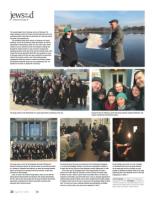
states, Hamburg is home to Europe’s second-largest port. Here, trip
participant Sarah Crane helps our guide hold up a map that orients
the group to the beautiful city.
Trip participant Daniel Stein reflects on Hamburg and Jewish
Hamburg: “As part of the Germany Close Up Program, we had the
opportunity to visit Hamburg, which was one of the major Jewish
centers in pre-war Germany. As the tour included a walking tour
through the Jewish quarters, it was not hard to recognize the
significant presence Jews had on the city. Even though much of the
Jewish life was lost during the World War, the resurgence of Jews
in Germany could be felt and seen upon visiting the reconstructed
Talmud-Thora-Schule, which is one of the fastest-growing
synagogues/Jewish day schools in modern-day Germany. Seeing
that growing community center was very empowering, and I am
hopeful for the future of Jewish life in Germany.”
The group pauses by the Binnenalster for a quick photo before continuing on the tour.
The group poses in front of the Bundestag, the lower Parliament in
Germany’s bicameral system. We had the chance to meet with the staffer
of a member of Parliament who talked to us about the currently debated
topics and answered our questions about the presence of right wing
extremism in those debates.
Later, we went to the Federal Foreign Office, where we met with the
Deputy Special Representative for Relations with Jewish Organizations.
We were able to gain some insight into the ways the federal government
approaches and supports the Jewish community in Germany and
represents their interests abroad.
22
April 19 • 2018
jn
During free time in Hamburg, several GCU group members explored Hamburg’s rich
culture and delicious international cuisine.
The Germany Close Up group was welcomed to the Fraenkelufer Synagogue,
a 101-year-old synagogue in Berlin. It was the first congregation in Berlin to
re-open after the war, with Erev Rosh Hashanah services taking place in 1946.
A few years ago, the synagogue didn’t have enough people to create a
minyan; but on this night, the sanctuary was full of locals and visitors alike.
At dinner, we had a chance to get to know one another, share a bit about our
respective communities, sing and break bread. It was an amazing opportunity to
celebrate being Jewish in Berlin, and we were reminded that this public display
of Judaism wasn’t safe in the not-so-recent past. Trip participant Alyah Al-Azem
said, “It moved me to tears watching, listening and participating in Shabbat
services in a place where Jews were never supposed to return.”
All good things must come to an end, including
our wonderful GCU trip. As the group reflected
on the week past and all we learned, we said
goodbye to Shabbat and looked ahead to the week
beginning with a brief Havdalah service in the GCU
headquarters in Berlin. •
Avery Drongowski is a program and engagement
associate at The Well. Julie Bagley is a member of
The Well’s Bucket List, volunteer leaders who are
stoked about building vibrant, inclusive and mean-
ingful Jewish community in Metro Detroit.