

jews d
in
the
Germany
Close Up
The Well takes a group
of young professionals
to Germany to discover
its Jewish history.
STORY AND PHOTOS BY JULIE BAGLEY AND AVERY DRONGOWSKI
SPECIAL TO THE JEWISH NEWS
I
n late February, The Well, a Jewish community
building, education and spirituality outreach
initiative geared toward millennials, took 29
people to Germany to seek out its Jewish roots on
a trip called “Germany Close Up” (GCU). Here are
the photo highlights.
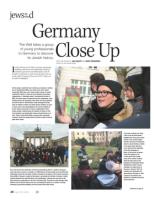
On the group’s second full day in Germany, we enjoyed a walking
tour of Jewish Berlin-Mitte, once home to the city’s Jewish
community. While there aren’t many visible remains of Jewish
community in Berlin, in cities all across Germany and Europe,
stolpersteine or “stumbling stones” commemorate victims of
WWII. The brass stones, incorporated into the cobblestone of the
wi nding streets and courtyards, name those who were deported
and sent to labor or extermination camps throughout Europe.
They sit outside of victims’ last freely chosen residence or place
of work, and it is the responsibility of the current residents to
do the research necessary to receive a stolpersteine. These
stones provide a physical place for families of victims to visit
and remember even though their homes and storefronts are no
more. Today, Jewish Berlin-Mitte is packed with monuments,
museums, shops and Jewish history. Pictured at right is German
guide Anne Lepper.
One of the best-known landmarks of Germany, Brandenburg Gate is a symbol of European
unity and peace as well as a reminder of a difficult past. The gate stands on the location that,
historically, marked the city limits of Berlin and leads to the palace of the Prussian monarchs.
During WWII, it became a symbol of Nazi power; and during the Cold War, it became a border
crossing between East and West Berlin. Post reunification, it became the main site for the
20th anniversary celebrations of the fall of the Berlin Wall. The gate has stood through vastly
different eras of German history and, now, surrounding the plaza are a number of foreign
embassies, government buildings and many tourists with selfie sticks!
The group’s walking tour, titled
“Don’t Trust the Green Grass,”
highlights the many open, grassy
spaces in the city that appear
unused and used to be important
sites for Jewish Berliners. Visible
in the green space right next
to our hotel was the foundation
of the first synagogue in
Berlin. In this photo, the group
visits what appears to be
a lovely green park tucked
away, but as visitors continue
down the path, they see the
headstone of philosopher Moses
Mendelssohn, which remains
standing in a lonely corner of
the space. Closed in 1827, the
cemetery was destroyed and
desecrated by the Nazis in 1943.
A group of us paused to say
Kaddish to remember those who
were buried here.
continued on page 22
20
April 19 • 2018
jn