
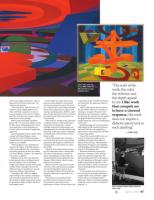

and we have eight watercolors, some as
big as 50 by 60 inches,” Klein says. “He
created environments.
“The scale of the work, the color, the
richness and the depth appeal to me.
I like work that compels me to have a
visceral response and is not too intellec-
tual. His work does not require a didactic
panel next to each painting.”
Held’s work had a black and white
phase, 1967-78, with color added to work
of other times. Defined geometric forms
were important to give dimension to
the flat surfaces on which he applied his
approach.
In developing the Detroit exhibit, Klein
worked with Daniel Belasco, execu-
tive director of the Al Held Foundation
located where the artist had a home and
studio in the Catskills.
“The foundation was established to
preserve the legacy of Al Held, educate
artists and students in the community
and invite groups to see how he worked
and lived,” Belasco explains. “His studio is
now used as a gallery.”
Held grew up in New York, raised by
Jewish parents who were liberal social-
ists. He studied at the Art Students
League and aspired to paint social realist
murals. While working in Paris in the
1950s, he began to identify as a second-
generation abstract expressionist.
Throughout the 1950s, he applied
paint thickly on his canvases, aiming to
add structure to gesture. By the end of
the decade, he began using acrylic paints
for geometric shapes and gave his forms
hard-edged clarity.
In the 1960s, the artist showed sug-
gestions of the alphabet, each project
moving into geometric forms. He went
on to explore space and volume through
interconnected geometric shapes with
varying vanishing points. With the addi-
tion of color during the 1970s, he further
extended architectural dimensions of
the paintings.
Held spent six months at the American
Academy in Rome in 1981 and became
inspired by the perspective, volume
and light important to Renaissance art.
Throughout his last decades, Held’s work
picked up on Baroque spatial complexity
and luminosity, and he found a second
home in Italy.
“He had a beautiful villa,” says Klein,
who notes that the artist was part of the
generation that fought in World War II,
enabling Held to learn about art under
the GI Bill.
“Because he loved Renaissance paint-
ing, his watercolors show a strong affin-
ity to the way Renaissance artists cre-
ated a strong illusion of space, like the
checkered-pattern floors going into the
distance. That’s why he chose to make
Italy his second home.”
Held had served in the Navy, was mar-
ried three times and had the one daugh-
ter, who developed her interest in art
by watching her father in his studio and
using his materials to express her own
creativity.
When Klein escorted Mara Held
around the Detroit Institute of Arts,
she wanted to spend time in the
Renaissance section. Like her father and
as president of the Al Held Foundation,
she found that the approach spoke to
her as well.
“Held’s truly mature style started in
the late 1960s,” Klein says. “People are
starting to recognize the later work,
which had color and greater depth in
the illusions. Because he moved outside
the gestural abstract painting world,
people found his work to be challenging,
and it sold.”
Besides focusing on his own projects,
Held taught at Yale University between
1962 and 1980. He was regarded as a
great teacher, interacting with and influ-
encing young artists.
Around the country, Held’s work can
be seen in numerous public spaces,
including the Empire State Plaza in
Albany, Social Security Administration
Mid-Atlantic Program Center Building
in Philadelphia and the Ronald Reagan
Airport in Washington, D.C.
Numerous museums, such as the
Kalamazoo Institute of Arts, hold his
work. The museums range from the
Cleveland Museum of Art to the Museu
des Arte Morderna in Portugal. Among
Held’s professional recognition is the
Jack I. and Lillian L. Poses Creative Arts
Award, Painting Medal, from Brandeis
University.
“In the last five years, there’s been a
lot more interest in people wanting to
acquire Held’s work, and that’s another
reason why we are doing the show,”
Klein says. “Since we opened the gallery
in Detroit, we have space to really do it
properly.” •
“The scale of the
work, the color,
the richness and
the depth appeal
to me. I like work
that compels me
to have a visceral
response. His work
does not require a
didactic panel next to
each painting.”
— DAVID KLEIN
AL HELD FOUNDATION
Orion V, 1991, acrylic on
canvas. INSET: Umbria 24,
1992, watercolor on paper
mounted to board.
Held in his West Broadway studio, working on
Orion V, 1991
jn
April 12 • 2018
47