

Jewish Contributions to Humanity
#14
#16 in
in a a series
series
Meet The Team
Nora Youkhana
Nadine Yousif
Kalasho
Michael Steinberg
Wendy Richards
Kim Scott
Bonsitu Kitaba
Margo Schlanger
Nora Youkhana was born in Iraq and came to the
U.S. at age 4. “I remember my parents struggling
with the language and culture of a new country,”
she says. Employed at Geoffrey Fieger Law, she
started CODE Legal as a service to the community.
Nadine Yousif Kalasho explains the history of
CODE: “Nora and I graduated from Wayne State
University Law School in 2012, and we both had
a vision to help our community, particularly the
refugee and immigrant community, with free legal
help and advocacy,” she says.
Michael Steinberg grew up in a religious
Jewish family in the Boston area. “Now I see
myself more as a secular Jew,” he says. He is
active in the Jewish Cultural Society in Ann Arbor,
especially on the social justice committee. He has
been legal director of the ACLU in Michigan for
almost 20 years. “Given the Jewish experience
in Europe and in the USA in the years leading up
to WWII, it makes sense for us to be working for
social justice,” he says.
Wendolyn Richards is a member of the
firm Miller Canfield, a firm that encourages pro
bono work on issues to fill gaps in the local
legal climate. The “sweet spot” for Richards?
“Immigrants’ rights because the due process
rights of immigrants are under threat.” Richards
considers herself a product of immigrants from
Central Europe. “It is a core American value that
we should not turn a person away, someone who
faces persecution, torture or death,” she says.
Fellow Miller Canfield employee, Kimberly
Scott, can trace her family tree back a long way
to Tennessee and elsewhere in the South. “Of
course, there must have been immigrants … but
we cannot trace our family back that far.”
Bonsitu Kitaba’s father came to Canada as
a refugee from Ethiopia. In Ethiopia, he was an
activist who voiced opposition to the government,
which put his life in danger. Her mother came to
Canada from Guyana in South America, seeking
a better life. “I always wanted to grow up to be a
lawyer, protecting the rights of people who do not
have resources, working on issues that have day-
to-day importance in people’s lives,” Kitaba says.
Margo Schlanger is the Wade H. and Dores
M. McCree Collegiate Professor of Law at the
University of Michigan, but her work on this case
is entirely separate from the university.
For two years, she worked in the Department
of Homeland Security as the head of the Office
for Civil Rights and Civil Liberties, appointed
by President Obama. “I was chosen for the job
because it was important to reform immigrant
detention. I was brought in as an expert in prison
reform. While I was there I gained substantial
experience in immigration policy,” she says.
She is also a former board chair for the Ann
Arbor Reconstructionist Congregation, and
active in the Ann Arbor Jewish Sanctuary and
Immigration Advocacy Group. That group’s website
is WeWereStrangersMI.wordpress.com.
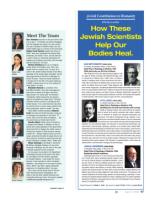
How These
Jewish Scientists
Help Our
Bodies Heal.
ELIE METCHNIKOFF (1845-1916).
b. Kharkov Governorate, Russia. d. Paris, France.
Nobel Prize in Physiology or Medicine 1908.
White blood cells—our first line of defense.
After obtaining his four-year natural sciences degree in only
two years at Kharkiv University, Elie Metchnikoff began work
in a private lab in Messina, Italy in 1882. There, he noticed a
reaction in starfishes when he stuck small thorns into them—
white cells would inflame the affected area and then surround,
attack, and literally devour the invader. These defensive cells
were named “phagocytes,” and although Metchnikoff’s findings were initially met with skep-
ticism, he was awarded a Nobel Prize in 1908 for his discovery of this key element of organ-
isms’ innate immune system—the body’s first line of defense. Metchnikoff’s research into
lactic acid also began the widely popular probiotics movement. He theorized that ingestion
of certain bacteria—often found in types of yogurt and milk—could prolong life.
OTTO LOEWI (1873-1961).
b. Frankfurt, Germany. d. New York City.
Nobel Prize in Physiology or Medicine 1936.
Identifying how our brain communicates with our body.
Initially an aspiring clinician, Otto Loewi switched to research
after he arrived at the painful conclusion that modern medicine
had no treatment for people with advanced tuberculosis and
pneumonia. That detour revolutionized human medicine. Loewi,
bucking the conventional scientific wisdom of his time, discovered
that neurons can communicate with each other through chemical
reactions—not only electrical signals. This discovery of neurochemical transmission was
instrumental in pharmacology, pathology, psychiatry, and countless other medical fields.
Suspecting that chemicals played an intimate role in neuro-communication, Loewi took two
beating frog hearts and covered them both in saline solution. He stimulated the vagus nerve
of one of the hearts, thus slowing down its heart rate. He then transferred some of the saline
from that heart on to the other heart, which in turn slowed down that heart’s rate, proving
that there was a chemical—not only an electric impulse—released by the vagus nerve that
impacted cell and neuron behavior. That chemical, or neurotransmitter, is now known as
acetylcholine, a vital chemical in biology and pharmacology.
JOSHUA LEDERBERG (1925-2008).
b. Montclair, New Jersey. d. New York City.
Nobel Prize in Physiology or Medicine 1958.
Explaining bacterial resistance.
Graduating high school at 15 and receiving his Nobel Prize
only 18 years later, Joshua Lederberg’s genetic research made
him one of molecular biology’s foundational scientists. A zoolo-
gist and doctor by training, Lederberg bucked the majority of
scientists of his time who believed that bacteria pass down ex-
act genetic copies to their offspring. In the late 1940s Lederberg
showed that bacteria transfer and share DNA among themselves, creating offspring with
different genes that are better adapted for that specific environment. The discovery had
massive implications for biotechnology, genetics, and pharmacology, particularly in under-
standing how bacteria develop resistance to drugs. Lederberg went on to chair the genetics
department at Stanford, write regular science columns for the Washington Post, and advise
several U.S. presidents and NASA.
Original Research by Walter L. Field Sponsored by Irwin S. Field Written by Jared Sichel
continued on page 18
jn
April 12 • 2018
17