

jews d
in
the
continued from page 10
of Hillel Day School of Metropolitan
Detroit, attending the school from
grades 1-9 and graduating in 1967. He
then went to Israel, where he began his
sophomore year a few days after the Six
Day War.
“It was a marvelous experience and
a great privilege to spend a whole year
there. It was one of the greatest bless-
ings of my life. I learned so much about
the land and learned to speak fluent
Hebrew. The experience really deep-
ened my attachment to Israel,” says
Goldsmith, who has since visited the
Jewish state 16 or 17 times. “I kind of
lost count.”
His sister made aliyah in 1970, and
each year she visits the U.S. or he visits
Israel. “There’s always something new to
explore, some new perspective I get each
time I go.”
He came back to Detroit for his junior
year, attending Cass Tech High School
and graduating in 1971. From there, it
was on to the University of Michigan. He
knew he wanted to go to law school and
have a legal career of some kind.
“I wasn’t quite sure if it would be
teaching, in government, in private
practice or politics, but I knew whatever
I wanted to do, it would start with law
school.”
The communal aspect of law appealed
to Goldsmith. “I liked the idea of trying
to solve problems. I’ve always thought
of lawyers as peacemakers. Even though
it may not appear that way to everyone,
lawyers are ultimately engaged in a
peacemaking activity.”
After U-M, he headed east to Harvard
Law School, where he graduated in
1977 and began a career in private prac-
tice, first in New York and then back
to Michigan where he spent some six
years as a solo practitioner and over
16 years as an associate and partner at
Honigman Miller Schwartz and Cohn.
He applied to fill a vacancy in the
Oakland County Circuit Court and was
appointed to that bench in 2004 by Gov.
Jennifer Granholm and was elected later
that same year and re-elected in 2006.
In 2009, he applied for a federal judge-
ship to fill a vacancy on the bench. Sen.
Carl Levin and Sen. Debbie Stabenow,
both Democrats, recommended him to
Obama.
Going from state judge to federal
judge was an adjustment as the two
jobs are completely different, he says.
“Dockets of state courts are much
12
April 12 • 2018
jn
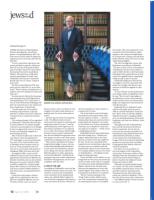
Goldsmith in his conference room/law library
busier. In state court, I would be in trial
roughly every other week; and here in
federal court, I’m not in trial nearly as
much.”
But that doesn’t mean he’s doing less
work. “It’s different kinds of work —
much more time spent in reviewing and
analyzing motions,” he says. “I end up
addressing many of the legal issues in
the motions I preside over as opposed
to in a trial. I love being a district judge
because I enjoy trying to understand
how the law addresses important issues
that impact our lives, and I derive great
satisfaction in playing some role in that.”
He’s earned a reputation for being a
tough but fair judge. Lawyers who rep-
resent both plaintiffs and defendants
in civil cases say Goldsmith is neutral
in his rulings. One lawyer offered the
following advice to others appearing
in front of Goldsmith: “You’d better be
prepared, and your written submissions
should be well organized, succinct and
compliant with the rules.”
A LOVE OF THE LAW
According to Goldsmith’s views, the law
embodies the basic values of society. “In
America, we look at the Constitution
as the repository of our fundamental
values. As a federal district judge, I’m
one of the first responders when there is
some invocation of the law, whether it’s
of the Constitution or some statute or
common law,” he says.
“We at the district court level begin
that judicial conversation about what
the law requires or allows — what the
fundamental values are and how they’re
impacted by the claimants. I’m trying
to sort all that out. Trying to determine
what facts are in dispute or what facts
are really not in dispute — which can be
a challenging exercise.”
Goldsmith’s Jewish values help shape
the kind of judge he is. “I think every
judge is impacted by his or her back-
ground, no matter what that might be,”
he says. “In my case, my Judaism has
imparted to me certain basic values that
in many ways are consistent with the
fundamental values of our Constitution.
For example, Judaism focuses very much
on individualism — the dignity of each
human being important.
“From the Ethics of Our Fathers, we are
taught that he who saves one person has
saved an entire world. That is a magnifi-
cent statement about individual human
dignity. American law has that same
focus on the importance of every indi-
vidual’s dignity. That really is what our
Constitution is all about,” he continues.
“There’s a famous passage in the
Torah: ‘Justice, justice shall you pur-
sue.’ The commentators interpret this
as requiring just means to accomplish
just results. This same approach is very
consistent with American law, which
requires a fair outcome brought about
by a fair process. I bring to my job those
kinds of Jewish values, the focus on indi-
vidual human dignity.”
The role of a judge also comes with
limitations, according to Goldsmith.
“You have to have a sense of acceptance
of limitations because you’ve taken an
oath to follow the law. And if I personal-
ly disagree with a particular law or how
it has to be applied, that is something I
simply accept as part of my job.”
Goldsmith emphasizes that the job
of a judge is not to be concerned with
policy but to judge what the law says
and how it should be applied in a fair
manner.
“It may well turn out the judicial deci-
sions impact policy in significant ways,”
he says. “But we don’t want judges to
be politicians; we have other branches
of government who worry about policy.
Judges are supposed to stay focused on
what the law says.”
Goldsmith lives in Oakland County
with his wife, Judy, whom he met in
1986 at a Jewish Federation “break-the-
fast” dance. They are shomer Shabbos.
Together, they have a daughter, Molly,
24, a son, Jared Rosenbaum, 39, his wife,
Stephanie, and their two children, Alexis
and Emily.
Throughout his life, Goldsmith has
been actively involved in the Detroit
Jewish community. At one time, he
served on the executive committee of
Federation’s Young Adult Division (now
called NEXTGen Detroit) as well as
on the board of the Anti-Defamation
League. He’s been involved in leadership
positions at previous shuls, including
Congregation Beth Shalom where he
served as president.
He’s also served as president of
the local chapter of the Federal Bar
Association. He became a fellow of the
Michigan State Bar Foundation in 2005
and was honored with the Wings of
Justice Award by the Oakland County
Democratic Party in 2009.
Although not professionally trained
as a cantor, over the years, Goldsmith
has studied cantorial music on his own
and often leads the chanting at the
Woodward Avenue Shul, where Judy
makes the cholent for Kiddush. “We’re
the only shul in town with a cholent bar
— four different kinds! I invite everyone
to come try it out!” •