
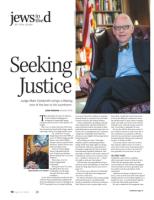

on the cover
PHOTOS BY JERRY ZOLYNSKY
jews d
in
the
Seeking
Justice
Judge Mark Goldsmith brings a lifelong
love of the law to his courtroom.
JACKIE HEADAPOHL MANAGING EDITOR
T
he blind draw for the U.S. District
Court of Eastern Michigan is
designed to impartially assign
criminal and civil cases to the district’s 22
judges.
But every so often, the luck of the draw
has an uncanny knack of favoring a partic-
ular judge with a lot of high-profile cases.
For a dozen or so years
beginning in the mid-1990s, it
was U.S. District Judge Gerald
Rosen, now retired (2003
sleeper cell case, partial birth
abortion, Tamara Green case,
Jack Kevorkian case).
And U.S. District Judge
Nancy Edmunds had her
turn (Underwear Bomber,
Kwame Kilpatrick et al, Chris
Webber).
These days, it is U.S.
District Judge Mark
Goldsmith.
During the past two years,
the blind draw has sent
Judge Goldsmith in his chambers Goldsmith several major
lawsuits that have made
headlines.
In late 2016, Goldsmith decided the fate
of Green Party presidential candidate Jill
Stein’s presidential recount in Michigan. In
2017, he presided over two legal challeng-
10
April 12 • 2018
jn
es to more than $34.5 million in taxpayer
backed bonds to construct the new Little
Caesars Arena for the Detroit Pistons.
Today, Goldsmith is handling a lawsuit
that could decide whether hundreds of
Iraqi Christians will be sent back to their
homeland and an uncertain future for vio-
lations of U.S. immigration law. A January
ruling from Goldsmith stated that the
detainees were eligible for hearings before
being deported.
In his ruling, he wrote, “Our legal
tradition rejects warehousing human
beings while their legal rights are being
determined, without an opportunity to
persuade a judge that the norm of moni-
tored freedom should be followed. This
principle is familiar to all in the context of
criminal law, where even a heinous crimi-
nal — whether a citizen or not — enjoys
the right to seek pre-trial release.”
(His decision was appealed by the gov-
ernment and is still pending. To read more
about the Iraqi deportation case, turn to
page 14.)
In an interview with the JN, Goldsmith
sat down to talk about his background
and views on the law.
He always dreamed of becoming a judge
when growing up in a predominantly
Jewish community on Detroit’s northwest
side. When he was in junior high, on his
days off he would take a bus Downtown
to sit in the different courthouses, from
the old Recorder’s Court, where criminal
trials were held, to Circuit Court and the
Federal Court, which he always saved for
last. “It was like a cathedral,” he says.
He says he still has that same sense of
awe when he comes to work every day at
the courthouse on Lafayette in Detroit,
where he has served since nominated by
President Barack Obama and confirmed
by the U.S. Senate in 2010.
“Every day when I come into work in
this majestic edifice where we work to
solve some of the more momentous prob-
lems that we have to face, I’m struck by
how grateful I am to be here,” he says.
HIS EARLY YEARS
Goldsmith comes from a tradition-
ally Conservative home in Detroit in the
1950s-’60s. His parents, Max and Alice,
were founders of Adat Shalom Synagogue,
where his father served as president and
his mother served as president of the
sisterhood.
“Judaism was always a big part of our
lives. I went to shul each week and enjoyed
Shabbat dinners every Friday together as a
family,” he says. “I continue that tradition
to this day with family and friends.”
He was a student in the inaugural class
continued on page 12