

jews d
in
the
“When you come here it’s like walking into a
synagogue. Every grave here is treated with respect.
Dignity is of utmost importance.”
RALPH ZUCKMAN, CEMETERY DIRECTOR
continued from page 12
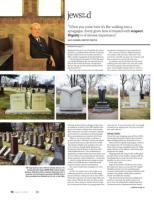
TOP: Ralph Zuckman, Clover Hill Park Cemetery director, in the
Davidson/Hermelin Chapel. CENTER ROW: Davidson-Saulson
headstone, Rabbi Morris Adler’s headstone, Rabbi Irwin Groner’s
headstone and David Hermelin’s gravestone. BOTTOM: Some of
these gravestones have birthdates from the mid- to late-1800s.
Benjamin B. Jacob. It was a board like few others
because, in a tradition that continues to this day,
Shaarey Zedek owns the cemetery, but Clover
Hill is entirely managed by its board of directors.
The first burial was on July 10, 1918. His name
was Adolph Blumberg. He was married, lived in
Detroit and he died of chronic vascular heart
disease. His age was 60, and his brother Morris
purchased his lot.
Since then, the cemetery has seen thousands
overdosed on drugs have been buried here.
The cemetery’s director Ralph Zuckman,
who speaks with reverence about his work,
can locate virtually any grave in an instant and
knows many true stories, like this one:
An elderly woman had died; she had loved
walking and took walks every time she could.
The hearse going to her funeral refused to
start, so the family walked with her casket to
the cemetery. Afterward, the hearse immedi-
of burials and faced the challenges of the times.
According to its rules, Clover Hill “shall be oper-
ated in accordance with the laws of the Jewish
faith,” which does not allow cremation, embalm-
ment, burial in a mausoleum or intermarriage.
Yet accommodations are made for all of these.
While no one may purchase, in advance, a
spot for his ashes, “cremains” (as they are known
by funeral directors) are allowed at Clover Hill.
Mausoleums initially were included, and a few
exist to this day, though Rabbi Abraham M.
Hershman (head of Shaarey Zedek from 1907-
1946) disallowed them. A few embalmed (as
required by civil law) bodies have been laid to rest
at Clover Hill, as have dead buried in their finery
and in expensive caskets (Halachah — Jewish law
— calls for a plain shroud and a simple wooden
coffin). Clover Hill also has a “blended family”
section for those who have intermarried.
The ways of death have changed over time
as well.
In 1918, the nation was in the midst of an
influenza pandemic, the most-deadly single
event in history, ending more lives than WWI.
While life expectancy is much longer 100 years
later, Clover Hill has become the final resting
place for those dying in another kind of trage-
dy: In the past few years, six young people who
ately started. It was, the family said, “as though
Grandma was making sure everyone took that
last walk with her.”
VINTAGE CHAPEL
One of the most intriguing areas of Clover Hill is
its Davidson/Hermelin Chapel, Metro Detroit’s
oldest building still in use for Jewish services.
Fitted with the original stained-glass windows,
the chapel seats 150 and features a podium at
front with two large candelabras from the 1930s,
along with heavy, but delicate, white lamps that
hang from the ceiling.
Stepping inside the chapel is like walking into
the past. There is that familiar vintage smell; the
knowledge that so many have been here to say
goodbye; secrets in every corner.
Come, take a look.
Begin at the bottom. Would you even notice
the carpet you step on as you enter the chapel?
Probably not, but it covers something quite
unusual. Underneath is an intricate tile floor with
a pattern of a popular 1920s Indian symbol; it
closely resembles the swastika.
Way above the front door look carefully and
you’ll see a tiny hole, the perfect size for one
eye to view everything below. Behind that hole
is what was once an apartment for the shomer,
continued on page 16
14
April 5 • 2018
jn