

arts&life
PHOTOS COURTESY OF GREENWICH ENTERTAINMENT
film
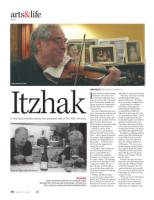
Itzhak Perlman at home
Itzhak
A new documentary shows the personal side of the violin virtuoso.
Having dinner (and a laugh) with Alan Alda
details
Itzhak is scheduled to open April 4 at the Maple Theater,
Bloomfield Hills. Check your local movie listings. It will also air on
PBS in October to coincide with National Disabilities Month.
70
March 29 • 2018
jn
GERRI MILLER JEWISH JOURNAL OF GREATER L.A.
I
sraeli classical violinist Itzhak
Perlman is one of the most
revered and celebrated musi-
cians of our time. He is the recip-
ient of 16 Grammy Awards, four
Emmy Awards, the Presidential
Medal of Freedom and Israel’s
Genesis Prize.
He’s also a philanthropist, edu-
cator, observant Jew and devoted
husband to Toby, his wife of 51
years, with whom he shares pas-
sions for music and the New York
Mets. The new documentary
Itzhak celebrates his genius while
revealing the man behind it.
Filmed in cinema verité
style over two years, it follows
Perlman from his home in New
York — where family photos line
the elevator and autographed
baseballs are displayed next to
his awards — to Israel (twice)
and to various engagements
around the world.
Filmmaker Alison Chernick,
who previously focused her
lens on artists Jeff Koons,
Roy Lichtenstein and Julian
Schnabel, knew Perlman would
be a great subject. “He is gregari-
ous and warm and effusive with
a large personality,” she says. “I
knew that he would be able to
carry the film from start to fin-
ish without having to do talking
head interviews.”
Perlman initially hesitated
to commit to the project but is
glad he did. “[Chernick] captured
pieces of our lives with a lot of
honesty and accuracy,” he said in
a telephone interview with his
wife before a rehearsal in Florida.
“She knew what she was doing
and blended into the back-
ground,” Toby said. “We didn’t
have one minute of aggravation.”
Archival and new footage
of Perlman rehearsing and
performing provided a built-
in soundtrack and allowed
Chernick to showcase the violin-
ist’s extraordinary talent. “I want
people to understand that the
sound that he gets is not just the
technical virtuosity,” she said.
“He creates that music from all
of the experiences and love and
emotion that he has in his heart,
and it flows through his hands.”
In addition to playing classical
works in the film, Perlman sits
in with Billy Joel at New York’s
Madison Square Garden and
plays the national anthem at
a Mets game. “We were just at
spring training, and they asked
me to play it again. But maybe
I shouldn’t do it because every
time I did, they lost the game,”
Perlman said. “Maybe I’m bad
luck for them.”
Perlman also plays his most
requested and asked-about piece
of music, John Williams’ theme
to the film Schindler’s List. “No
matter what place in the world
I’m in, not necessarily in a Jewish
community, it’s what they want
to hear,” he said.
“When we listen to this theme,
we think of the movie, we see
the pictures in our mind and
respond to that,” Toby added.
“The music is a trigger for that,