

passover
continued from page 38
“The toughest guests to please at your
seder can be the teenagers, but having
good questions on hand are worth their
weight in matzah balls!”
— RABBI DA-VID ROSENTHAL,
AISH DETROIT
INCLUDE MAIN THEMES
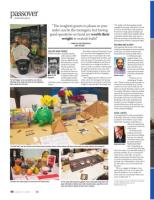
The Ten Plagues can be recreated for your table by
collecting crafts, candy and small toys and displaying
them in glass jars and vases.
With his family in Australia and his
wife’s in Israel, AISH
Detroit Managing
Director Rabbi Da-vid
Rosenthal also created
family from nearby
friends and hosts a
seder each year. He
has held pre-Passover
programming for men
Rabbi Da-vid
to improve their seder
Rosenthal
leading skills and has
also published articles
with tips on how to prepare for the ritual
meals.
Rosenthal cautioned that leaders need
not cover the entire Haggadah text but
should be sure to touch upon the main
themes: the Paschal lamb sacrifice, mat-
zah and maror. If your guests are recep-
tive to mindful meditation, ask them to
close their eyes to imagine the life of a
slave or what it was like to walk through
the split Sea of Reeds. Above all, seder
leaders should prepare in advance and
come equipped with lots of engaging
questions.
“The toughest guests to please at your
seder can be the teenagers, but having
good questions on hand are worth their
weight in matzah balls!” Rosenthal said.
“The night is all about getting people
engaged in the topic, and there is no bet-
ter way to do that than with questions.
If you have a large group of people, get
everyone to talk to their neighbor about
a question and give their own answer —
that way everyone can feel like they are
participating without it taking all night!”
RECLINING AND SLAVERY
One question that is part of the tradi-
tional Four Questions is about reclining
at the feast. At a 2018 Limmud class,
Frankel Jewish Academy bible educa-
tor Michael Langer
suggested this is an
often overlooked and
underdiscussed seder
element that deserves
more attention and
can be seen as the ulti-
mate physical symbol
of freedom during the
Michael Langer
seder.
“As slaves, we ate
standing up,” Langer
said. “Today, as busy, modern people, we
sometimes eat standing up at a lunch
counter or in our cars or with our cell
phones in hand. Therefore, what is a bet-
ter symbol of freedom today but putting
aside all that business and distractions
and recline and dine and simply be with
the people seated at your seder table.
Reclining at the seder symbolizes the
freedom to not be beholden to all the
outside distractions of life and that we
do not have to jump up and do the tasks
of the outsider’s bidding.”
SOCIAL JUSTICE
“The Kids Table” from the Pinterest event features paper pyramids, snacks, coloring options and flower vases made from empty Passover food containers.
A charoset bar allows people to create their own favorite blend.
40
March 22 • 2018
jn
For the seder table, Pinterest suggests a linear seder plate using black craft
paper with labels in Hebrew and a table set with snacks, egg shells as mini
vases and sheets of matzah to frame vases of flowers.
At Temple Beth El’s 76th annual Rabbi
B. Benedict and Ada S. Glazer Institute
on Judaism to be held at 7 p.m. today
(March 22), members of all faiths are
offered an opportunity
to experience elements
of the seder.
“Of all the Jewish
holidays, this is the
most observed holiday
because it is situated
around the home, fam-
ily, ritual and food,”
Rabbi Mark Miller Rabbi Mark Miller
said. “Something we
can take from learning
about the seder in an interfaith setting of
learning and then at our own Passover
observances is that after we spend a
night learning about freedom from slav-
ery, from moving from a narrow place
through one of redemption, what will we
do, how will we act, to carry this ideal
forward?
“After we engage in dialogue at our
seder tables, how can we act upon this
after the holiday is over to make our
towns and our communities better and
more socially just?” •
To see a video from the “Pinterest for Passover”
event at Hillel Day School, go to
thejewishnews.com.