

Jewish Contributions to Humanity
#11
#13 in
in a a series
series
How one Jewish
genius changed...
everything.
W HEREVER Y OUR
T RAVELS T AKE Y OU .
Private aviation allows you to experience travel the
ZD\LWVKRXOGEH/HWXVVKRZ\RXWKHEHQHÀWV
SAFETY | SECURITY | EFFICIENCY | CONVENIENCE | COMFORT | FLEXIBILITY | SERVICE
888-426-8999 | PentastarAviation.com |
Private Jet Charter | Aircraft Management | Advisory Services
Aircraft Maintenance | Avionics Services | Interior Services | Executive Terminal
©2018 Pentastar Aviation.
Join our commitment to people helping people
Please support our mission to
keep our best and brightest
kids in Michigan. By making
a tax-deductible donation,
your gift will support the
next generation of Michigan
innovators and leaders.
The Community Choice
Foundation, through its
Scholarship program, supports
local students who want to
build their lives and careers in Michigan. Scholarship winners pledge to use
their education to Give Big™ in Michigan.
You can mail your gift to:
Community Choice Scholarship Fund
31155 Northwestern Hwy. ∞ Farmington Hills, MI 48334
YOU CAN ALSO MAKE A SECURE, ONLINE DONATION AT:
CommunityChoiceFoundation.networkforgood.com
To learn more, visit CommunityChoiceFoundation.com
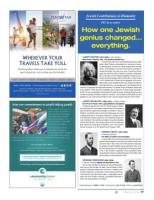
ALBERT EINSTEIN (1879-1955). b. Ulm, Germany.
Nobel Prize in Physics 1921. The greatest scientist ever.
Likely the most well-known and influential physicist in modern
history, Albert Einstein is responsible for a vast array of human-
ity’s technological, civil and even military development in the 20th
century. From television to remote control devices, and lasers to
nuclear technology, the world as we know it would be unimag-
inably less advanced without Einstein’s scientific contributions.
Born in Germany, Einstein already established himself as a pre-
eminent physicist decades before he fled Hitler in 1933, winning
in 1921 a Nobel Prize in Physics for his explanation of the photo-
electric effect, which established that many metals emit electrons
when light hits them, a crucial discovery in the development, for
example, of spacecraft and night-vision devices. His General Theory of Relativity helped lead
to the creation of GPS devices and satellites, and his discovery of mass-energy equivalence
(E=MC^2) was a crucial step in the development of atomic energy. Amazingly, these are only a
handful of examples of Einstein’s impact on humanity. Try to be aware of all the electronics and
gadgets you use. Odds are that Einstein’s work in physics played a big role in their creation.
ALBERT MICHELSON (1852-1931). b. Strzelno, Poland.
Nobel Prize in Physics 1907. Laying Einstein’s foundations.
On special appointment at the U.S. Naval Academy, Michel-
son performed one of the earliest measurements of the speed of
light and laid the experimental foundation for Einstein’s Theory of
Relativity. His interferometer (a device that helps gauge very small
measurements) was an invaluable contribution to physics and led
to the Michelson-Morley experiment, which helped lay the ground-
work for Einstein. If the world as we imagine it would be impossible
without Albert Einstein, then his discoveries would have been less
likely without the contributions of Michelson, who in fact was the
first ever American to win the Nobel Prize for Physics in 1907.
HEINRICH HERTZ (1857-1894).
b. Hamburg, Germany.
The father of modern communication.
In his short life, Hertz’s discovery that electricity can be trans-
mitted in electromagnetic waves led to the creation of radio, tele-
vision and radar. In fact, Hertz was the first person to ever prove
the existence of electromagnetic waves, earning the honor of his
last name being used as the international unit of frequency (Hertz
or Hz). In fact, Einstein’s explanation of the photoelectric effect
was preceded by Hertz’s accidental discovery of that effect while
experimenting on electromagnetic waves.
HERMANN MINKOWSKI (1864-1909).
b. Kaunas, Lithuania. Adding one dimension to 3-D.
Like so many scientists, the impact of Hermann Minkowski’s
work was not felt until after his death. One of Einstein’s former
teachers, Minkowski believed that the theory of relativity could
be best understood in a dimension in which space and time are
combined into a four-dimensional realm—a geometrical view of
space and time. Einstein eventually incorporated Minkowsky’s
theory into his general theory of relativity.
Original Research by Walter L. Field Sponsored by Irwin S. Field Written by Jared Sichel
jn
March 22 • 2018
17