

looking back
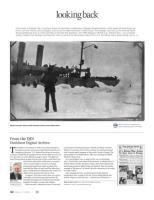
Is this winter in Michigan? No, it’s spring in Russia! As World War I winded down, President Woodrow Wilson, at the request of Great Britain and
France, sent two infantry units and support units to join the Allied Intervention in North Russia. The campaign was known as the American North
Russia Expeditionary Force or, more commonly, as the Polar Bear Expedition. The 339th Regiment, referred to as “Detroit’s Own,” was comprised
mainly of soldiers from Michigan and Wisconsin. When it was time to leave Russia in May 1919, U.S.S. Des Moines had to break through the ice. •
Historic photos are curated by the
Jewish Historical Society of Michigan.
Courtesy Leonard N. Simons Jewish Community Archives, Gerson Weiner papers.
From the DJN
Davidson Digital Archive
T
he headline in the March 12, 1943, issue of the JN speaks to
the primary concern of America’s (and Detroit’s) Jewish com-
munities at this time: “U.S., Britain Plan Action to Save Jews
in Europe.” World War II is going well now for the Allies (if a war can
ever “go well”) or, as the editorial on page 4 states: “The lights are
slowly being turned on again in those parts of the world where men
and women still acclaim civilization as a human
asset.” An action plan to save Jews in Europe
sounds pretty good, but a plan is a plan. How
much did the Allies do, and could the Allies have
done, to help the Jews? Historians will continue to
debate these questions for years to come.
In support of the above story, there was a picto-
rial display on the front page sponsored by the
United Jewish Appeal. It consisted of several pho-
Mike Smith
tographs of refugees, women and children.
Detroit Jewish News
Foundation Archivist
There was also a related local story. The Jewish
62
March 15 • 2018
jn
Community Council had declared a “Month of Tribute to Jewish
Martyrs” in memory of the victims of Nazis. It would be launched
with a Sunday public program at the Jewish Center in Detroit. The
main speakers were Rabbi Morris Adler and, speaking in Yiddish,
Abraham Meyerowitz.
On a much lighter note, on page 6 there was an interesting
story: “The Jewish Center Musical Department. A Cultural Force in
Detroit.” Photos of Mrs. Abraham Cooper, chair of the department,
and pianist/composer Julius Chajes are featured. This was another
example of “life goes on” in Detroit’s Jewish community in the midst
of world conflict.
And, speaking of music, an advertisement from Hudson’s
Department Store on page 3 lists the 23 best-selling albums that
month. I’ll give you the top entry — Jerome Kern’s Showboat. •
Want to learn more? Go to the DJN Foundation archives,
available for free at www.djnfoundation.org.