

jews d
in
the
“Charley works for the survivors and for their
families. He has known all of them for his whole
adult life. Not many of us can say that.”
— RENE LICHTMAN
continued from page 10
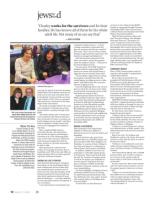
TOP: Local survivors Rae Nachbar and
Sabina Heller. ABOVE: Renee Fein and
Charley Silow both staff the Program for
Holocaust Survivors and Families.
How To Go
“Concert of Hope & Unity,”
7 p.m. Monday, March 19, is the
annual fundraiser benefiting the
Program for Holocaust Survivors
and Families, a service of Jewish
Senior Life. PHSF founding
director Dr. Charles Silow will be
honored for his work with the
Holocaust survivor community at
this 25th anniversary program.
Performers will include Hazzan
David Propis, Cliff Monear Trio,
Larry Callahan & Selected of God
Gospel Choir as well as additional
musical guests. At Detroit Film
Theater at Detroit Institute of Arts.
Free. Info: rfein@jslmi.org or
(248) 592-5028.
12
March 15 • 2018
marriage she joined in Brussels. His father,
Nathan Silow, fled to Russia when the war
broke out; he met Sara in Brussels where
he had family. Turned out both were from
Lodz, Poland. In 2014, their son attended
70th anniversary ceremonies for the liqui-
dation of the Lodz Ghetto.
The family eventually settled in St. Louis.
Silow attended an Orthodox day school,
Epstein Hebrew Academy, through ninth
grade.
“My mother always said, ‘So many Jews
were murdered in the Holocaust because
they were Jewish. We have to continue our
Jewish religion and our people,’” said Silow,
today the gabbai in charge of ritual and
services at Congregation Or Chadash in
Oak Park.
Silow completed high school in
University City, Mo., and earned bach-
elor and M.S.W. degrees at Washington
University in St. Louis. Following gradu-
ation in 1973, Silow moved to Detroit for
work. His parents joined him after his
father retired as a Chevrolet autoworker;
he died in 1998.
Silow practiced as a clinical social
worker at Counseling Associates, then in
Southfield, until 1995. In the mid-1980s, he
began pursuing a Ph.D. in clinical psychol-
ogy at the University of Detroit.
FINDING HIS LIFE’S PURPOSE
Silow found his life’s purpose writing his
dissertation on the psychological adjust-
ment of Holocaust survivors. More than
just troubled by their memories, the 39
survivors in his study showed signs of still
feeling traumatized by the personal trag-
edies they’d experienced almost 50 years
after the Holocaust — even those individu-
als who outwardly seemed well-adjusted. It
was a revelation.
“I was determined to immediately start
jn
a program to help survivors — to form
a caring community, to help them feel
they are not alone and they are cared for,”
Silow said. “Since I was an intern at Sinai
Hospital, I approached my supervisors who
heartily encouraged and helped me.”
With his doctorate achieved in 1993,
Silow was ready to roll out his program
under the auspices of Sinai — then part of
the Detroit Medical Center.
Ten years later, when DMC Sinai-Grace
Hospital ended its sponsorship, PHSF
found a new home with Jewish Home &
Aging Services (now Jewish Senior Life).
“It seemed like a logical choice to bring
the program to Jewish Senior Life, the
central agency providing services to older
adults,” said Barbra Giles, JSL’s executive
director of aging services.
From the beginning, Silow took “the pro-
gram to where the survivors went,” which
was the Jewish Community Center in Oak
Park before its closing in 2015.
Support groups remain the heart of
PHSF, and Silow leads more than 160 ses-
sions yearly. They include weekly groups
at Prentis in Oak Park and Fleischman
Residence in West Bloomfield; monthly
groups at Meer Apartments in West
Bloomfield; groups for Russian-speaking
Holocaust survivors (aided by bilingual
social workers) at Prentis and neighboring
Teitel JSL Apartments; and a new group
he started for survivors speaking at the
Holocaust Memorial Center (HMC) in
Farmington Hills.
MAKING A DIFFERENCE
Silow founded his first organization,
CHAIM, in 1979 to give children of
Holocaust survivors a sense of comfort and
belonging.
He met his future wife, artist Sarah
Hartman-Silow, at a CHAIM program and
they married in 1992. Their daughters are
Shoshana, 21, a junior at Touro College in
New York, and Naomi, 15, a freshman at
Farber Hebrew Day School in Southfield.
In addition, children of survivors can
participate in a biweekly support group
at Fleischman. Their issues include deal-
ing with the “emotions of losing a parent
as well as the unique care challenges of
survivor parents,” said Renee Fein, pro-
gram coordinator of PHSF and the JSL
Foundation. Outreach continues to the sur-
vivors’ grandchildren.
An annual highlight is bringing survivors
and family members by bus to Lansing
for April’s Holocaust Remembrance Day/
Yom HaShoah at the state capital. A lunch
with students follows at Michigan State
University Hillel.
“In November, we take Holocaust
survivors to Ann Arbor for the SHARE
Luncheon, sponsored through University
of Michigan Hillel,” Silow said. Survivors
celebrate Purim and Chanukah with Farber
Hebrew Day School students.
With the help of sponsors, Silow initi-
ated “Portraits of Honor: Our Michigan
Holocaust Survivors.” The project is a
source of pride for local survivor fami-
lies. It started with the black-and-white
photographs Silow took of survivors. The
pictures later were paired with details of
each person’s history, from Silow’s inter-
views, for a digital database at the HMC.
Indivi dual entries may be accessed there
or online at portraitsofhonor.org. The next
stage, already under way, is preparing all
550 and counting portraits for display on
HMC classroom walls.
COMMUNITY IMPACT
Silow, a HMC board member, lends his
expertise and empathy to organizations
outside Metro Detroit.
He recently was elected first vice
president of World Federation of Jewish
Child Survivors of the Holocaust and
Descendants (WFJCSHD). Silow is respon-
sible for second- and third-generation
programming at the group’s annual confer-
ences. He also serves on the Coordinating
Committee of Generations of Shoah
International, a federation of second-gener-
ation organizations.
WFJCSHD President Stephanie Seltzer
said Silow’s “organizational and leadership
skills have helped us through the years; we
can depend on Charley to follow through
with any tasks he has taken on.”
It’s back home where Silow continues
having his greatest impact.
“Charley works for the survivors and for
their families. He has known all of them
for his whole adult life. Not many of us can
say that,” said Rene Lichtman, founder of
Hidden Children of Michigan.
“Charley is a wonderful person,” said sur-
vivor Michael Weiss, an HMC speaker. “He’s
dedicated his life to the survivors and does
it very well.”
Renee Fein said, “For holidays and
Shabbat, he and his wife, Sarah, often invite
survivors to join them for lunch, as well as
for Passover seders.”
“Charley is a very dedicated, warm indi-
vidual who has worked tirelessly over the
years,” said Rosa Chessler, a CHAIM board
member.
Close friend David Oliwek, also a CHAIM
board member, said, “Charley is a liaison
for survivors to the outside world. He
knows where to refer them to help them
get benefits.”
Survivor Anna Fein, Renee Fein’s mother,
said, “He calls if someone doesn’t come to
the support group to make sure everyone
is OK.”
“I figure we’ve touched the lives of more
than 2,000 survivors and family members
with our support groups, Café Europa
and enrichment programs,” Silow said.
“Everything offered to survivors is so they
will not feel alone.” •