

jews d
in
the
continued from page 12
“We feel we are keeping aviation
history alive ... The day will come
when we will pass the torch.”
— PHILIP HANDLEMAN, SPEAKING OF HIS WWII BIPLANE
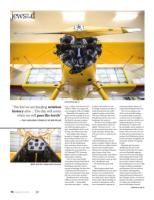
ABOVE: World War II antique biplane and cockpit.
to go, I will go, and wherever she
will be, I will be very happy. She
is my navigator in life as in flight.”
Meanwhile, he’s eagerly await-
ing the arrival of spring so he can
get back up into the air. Because
Sky Ranch’s runways are grass,
Handleman has to wait until
mud season is over before taking
one of his two planes up for a
spin, something he strives to do
at least a few times each week.
Each bright-yellow plane is
housed in a hangar so pristine
that the floors shine. One is a
sleek, tandem-seat Cub Crafters
Sport Cub the Handlemans
have owned for about 10 years.
Gorgeous as this one is, the other
craft gets the most attention — a
1943 Boeing B75N1 Stearman
biplane trainer in impressively
immaculate condition.
The U.S. Navy used 10,000
such planes during World War II,
primarily for training purposes,
Handleman said. (In a nod to
current technology, the plane has
a sophisticated GPS system as
well as two parachutes that, hap-
pily, have never been needed.)
Handleman loves welcoming
military veterans who flew that
exact model — and possibly
even that exact plane — during
wartime. One elderly vet was
too fragile to fly but was able to
reach up and touch the craft’s
original wooden control stick.
“His eyes welled up with tears,”
Handleman said, his own voice
breaking at the memory.
“We feel we are keeping a little
bit of aviation history alive,” he
added. “We don’t own it — we
are borrowing it from those who
made it famous. And the day
will come when we will pass the
torch.”
Among those who have
inspired Handleman is his fre-
quent co-author, Walter J. Boyne,
a retired Air Force officer, former
director of the Smithsonian’s
National Air and Space Museum
and a former chair of the
National Aeronautic Association.
“He has written over 70 books
and I am trying to catch up with
him,” Handleman said.
The admiration goes both
ways.
“After having worked with
Philip Handleman for more than
20 years, it is an absolute fact
that he continues to amaze me
on a daily basis,” Boyne told the
JN via email. “His knowledge of
aviation is widespread, and he
has a tremendous capacity for
reducing complex subjects to
easily understandable elements.
“He is, in my opinion, one
of the most powerful authors
on aviation subjects and will
continue to be so. His ability to
grasp not only the scientific and
engineering aspects of a new
development is enhanced by
his inevitably correct analysis of
the development’s effect on the
future. There are many who are,
in truth, great commentators on
aviation, but Philip leads the list
for his articulate, thoughtful and
persuasive analysis of ongoing
events.”
Philanthropic by nature,
Handleman has sat on the
boards of more than two dozen
civic and charitable organiza-
tions over the years, including a
stint heading the Friends of the
Detroit Public Library. (In addi-
tion to their aviation collection,
the Handlemans own some 7,000
volumes of history, biography
and literature.) He has received
the Lifetime Distinguished
Achievement Award from the
National Historical Museum of
the Tuskegee Airmen, the Harriet
Quimby Award for contributions
to aviation art and literature
from the Michigan Aviation
continued on page 16
14
March 8 • 2018
jn